ONE Championship Rules Explained: How They Differ From the UFC
How ONE Championship's rules differ from the UFC's: knees to grounded opponents, whole-fight judging, hydration weigh-ins, and Muay Thai and kickboxing.
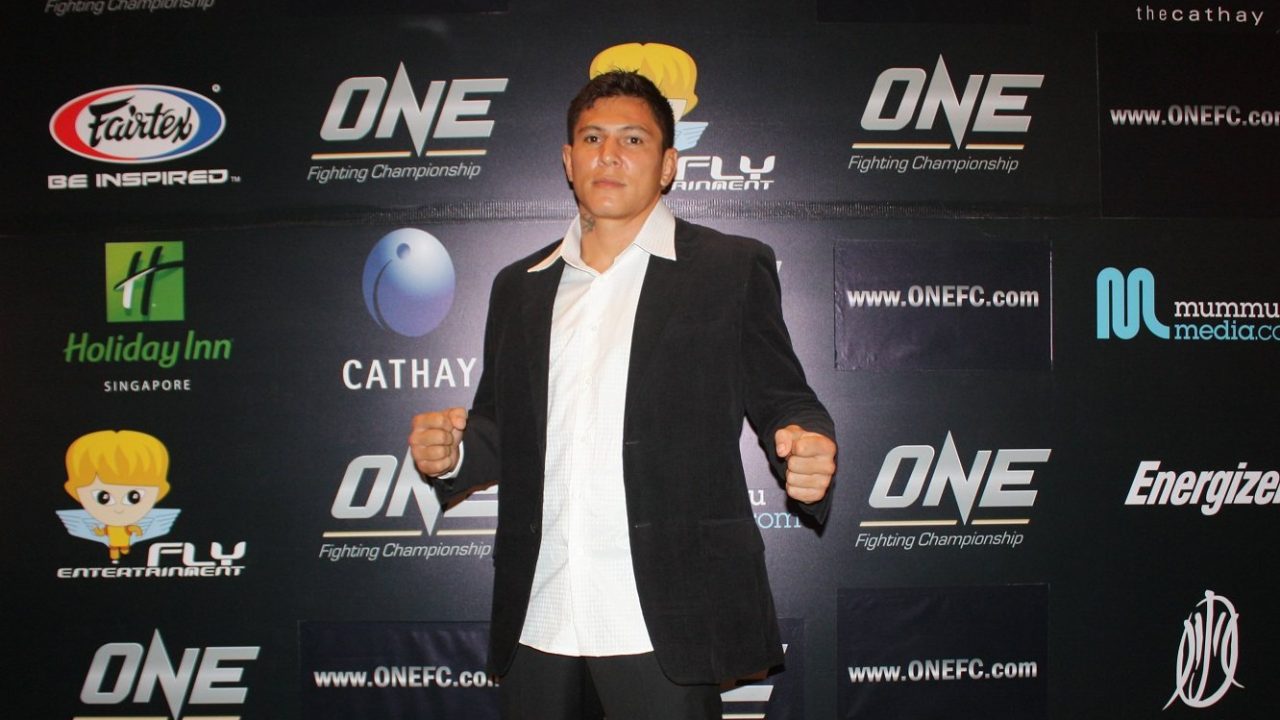
ONE Championship is a Singapore-based promotion that has grown into one of the largest combat sports organizations in the world. It was founded on July 14, 2011, by Chatri Sityodtong and Victor Cui. Fans who come to it from the UFC quickly notice that things are different: knees to a downed opponent’s head are legal, judges score the fight as a whole rather than round by round, weigh-ins include a hydration test, and the same cards often mix MMA with Muay Thai, kickboxing and submission grappling.
This guide explains ONE’s main rules and how they compare with the Unified Rules of MMA used for UFC events in the US. ONE updates its rules from time to time, and rules for events held in a particular jurisdiction can be adapted to local regulations, so check the official documentation for a specific event.
Where ONE’s Rules Come From
The UFC operates in the US under the Unified Rules of Mixed Martial Arts, adopted by state athletic commissions. Our guide to the Unified Rules of MMA covers that framework. ONE, which built its business in Asia, writes its own “global” rule set. Its early rules were influenced by Japanese MMA, particularly PRIDE, which allowed strikes that US commissions banned.
ONE has changed those rules over time. Soccer kicks to grounded opponents, initially permitted under its PRIDE-inspired rules, were banned in 2016. Knees to the head of a grounded opponent remained legal and are now the most famous distinction between ONE and the UFC.
When ONE has held events in the US, its global ruleset has been submitted to state regulators. The Colorado-approved version published in 2021 offers a detailed public text of the rules, and much of what follows draws on it alongside ONE’s own rules page.
Strikes on a Grounded Opponent
This is where ONE’s MMA rules differ most from the UFC’s.
What counts as “grounded”
In ONE’s ruleset, a fighter is grounded when any weight-bearing body part other than the soles of the feet is touching the ground. That means a hand or knee down makes a fighter grounded.
What’s legal and what isn’t
| Technique on a grounded opponent | ONE global rules | Unified Rules (UFC in the US) |
|---|---|---|
| Knees to the head | Legal | Illegal |
| Knees to the body and legs | Legal | Legal |
| Kicks to the head (including soccer kicks) | Illegal | Illegal |
| Kicks and stomps to the body and legs | Legal | Kicks to the body allowed; stomps illegal |
| Stomps to the head | Illegal | Illegal |
| Up-kicks from the bottom to the body and legs | Legal | Legal |
The practical effect is significant. In the UFC, a fighter defending a takedown can sometimes protect against knees by keeping a knee or hip on the canvas. In ONE, a fighter who shoots for a takedown or turtles up can be kneed in the head. Wrestlers have to be more careful about lingering in front-headlock and sprawl positions, and the threat of knees changes how fighters scramble back to their feet.
Whole-Fight Judging and the Global Criteria
The UFC’s judges use the 10-point must system, scoring each round separately. ONE’s MMA judges don’t. Under ONE’s rules, bouts are evaluated in their entirety, not round by round, and judges pick a winner based on the fight as a whole.
ONE’s MMA judging criteria are listed in descending order of importance:
- Near knockout or near submission
- Damage
- Striking superiority and ground control (described on ONE’s site as striking and cage or ring generalship)
- Takedowns and takedown defense
- Aggression
The order matters. Moments where a fighter is nearly finished sit at the top, and damage comes next. A fighter who holds positions without threatening or hurting the opponent will struggle to win a decision, which is part of ONE’s stated aim of rewarding fighters who try to finish.
How whole-fight judging changes decisions
- No round-counting: a fighter can win two rounds narrowly and still lose the decision if the opponent nearly finished them in the other round.
- Big moments carry over: a near-knockout in round one can still decide a fight that ends level on activity later.
- No scorecards to add up: fans used to round-by-round 10-9 cards have to judge the overall picture instead.
Rounds, Gloves, Attire and the Competition Area
- Rounds: standard MMA bouts are three five-minute rounds; world championship bouts are five five-minute rounds, with a minute’s rest between rounds. ONE’s 2021 rules also described a one-night, four-man tournament format with two five-minute rounds per bout.
- Gloves: 4 oz ONE-supplied gloves; athletes may not use their own.
- Attire: MMA trunks, board shorts, or spandex shorts that don’t extend beyond the knee, without exposed pockets or ties. A mouthguard and groin protection are compulsory (the groin cup is optional for women). Joint strapping and neoprene supports are not allowed.
- The cage and the ring: ONE originally used a circular cage exclusively. Since 2018, some of its events have used a boxing-style roped ring, especially for Muay Thai and kickboxing.
Weigh-Ins and Hydration Testing
ONE’s weight system is one of its biggest differences from the UFC. After 21-year-old Chinese fighter Yang Jian Bing died on December 11, 2015, from complications linked to dehydration from weight cutting, ONE banned weight cutting through dehydration.
Instead of a single scale check, ONE combines weigh-ins with urine specific gravity (USG) testing. An athlete is considered hydrated at a USG of 1.025 or below. ONE’s rules page describes a combined hydration test and weigh-in 24 to 48 hours before the event. Athletes who fail hydration cannot weigh in until they pass, and hydration and weight must be passed together within the testing window. ONE’s 2021 rules also banned IV use and saunas or sauna suits.
If an athlete can’t make it, a catchweight is possible only if the two fighters are within 105 percent of each other’s hydrated weight, and the athlete who failed forfeits a share of the purse to the opponent.
Because fighters must weigh in hydrated, ONE’s divisions sit higher than UFC limits. ONE lists, for instance, lightweight as 155 to 170 pounds and flyweight as 125 to 135 pounds. ONE also has an atomweight division, 105 to 115 pounds. For more on why weigh-ins matter, see our guide to weight cutting and weigh-ins.
Fouls and Penalties
ONE’s foul list overlaps heavily with the Unified Rules: no biting, eye gouging, fish-hooking, headbutts, hair pulling, groin strikes, strikes to the throat or the back of the head and spine, small-joint manipulation, or grabbing the gloves, shorts or cage. Spiking an opponent onto the head or neck and throwing an opponent out of the competition area are also banned.
What’s different is the penalty system. ONE uses cautions, official warnings and yellow cards. Under its 2021 rules, each yellow card cost the athlete 10 percent of their prize money, and a disqualification could bring a deduction of 30 to 100 percent of pay. Yellow cards are also used to punish passivity and stalling, which fits the promotion’s emphasis on action.
Muay Thai, Kickboxing and Submission Grappling
ONE is unusual in staging several sports on the same card. It announced its ONE Super Series for kickboxing and Muay Thai in February 2018, and those bouts are now a central part of its events.
| Sport | Rounds | Scoring | Gloves |
|---|---|---|---|
| MMA | 3 x 5 min (5 for world titles) | Whole fight, global criteria | 4 oz |
| Muay Thai | 3 x 3 min (5 for world titles) | Round by round, 10-point must | 4 oz |
| Kickboxing | 3 x 3 min (5 for world titles) | Round by round, 10-point must | 8 oz up to bantamweight; 10 oz featherweight and up |
| Submission grappling | 1 x 10 min | Catches and aggression; stalling penalized | None |
Two details stand out. First, ONE’s Muay Thai uses small 4 oz gloves, the same size as its MMA gloves and lighter than the 8 and 10 oz gloves it uses for kickboxing, so clean shots carry more danger. Second, ONE’s Muay Thai bouts are usually three rounds rather than the traditional five, so fighters can’t afford the slow start common in Thai stadiums, a pacing difference explained in our guide to how Muay Thai is scored. Judges score these bouts round by round, prioritizing knockdowns, damage, clean strikes, and aggression with positioning.
In submission grappling, judges count “catches,” or near-submissions, and weigh aggression. A yellow card for stalling cancels one of the recipient’s catches.
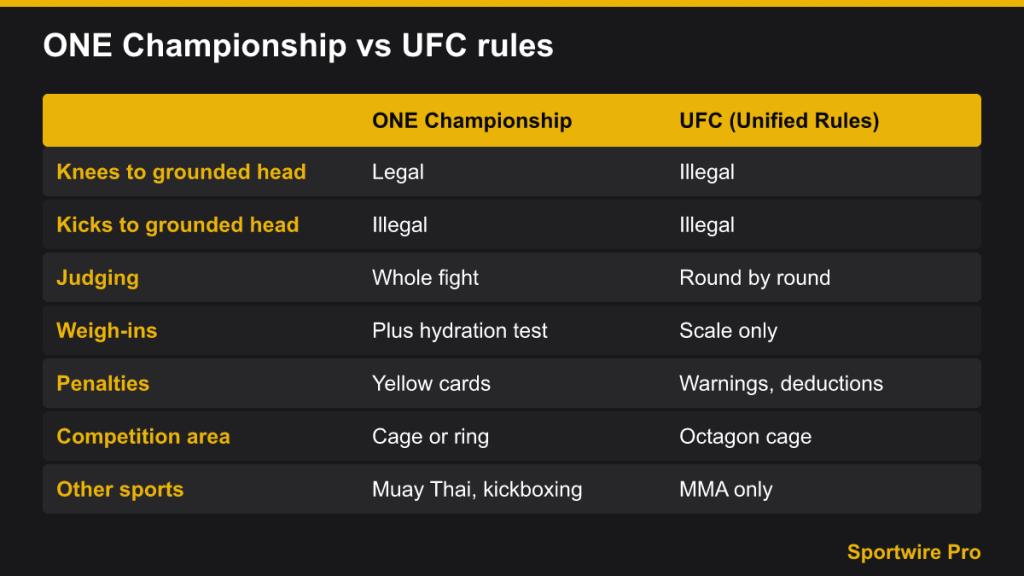
ONE vs UFC at a Glance
| Feature | ONE Championship | UFC (Unified Rules) |
|---|---|---|
| Knees to a grounded opponent’s head | Legal | Illegal |
| Kicks to a grounded opponent’s head | Illegal (soccer kicks banned in 2016) | Illegal |
| Judging | Whole fight, ranked criteria | Round by round, 10-point must |
| Weigh-ins | Combined with hydration (USG) testing | Scale only, typically the day before |
| Penalties | Yellow cards with purse deductions | Warnings and point deductions |
| Competition area | Cage or ring | Octagon cage |
| Other sports on cards | Muay Thai, kickboxing, grappling | MMA only |
Quick Answers
Are soccer kicks legal in ONE Championship?
No. ONE allowed them in its early years but banned them in 2016. Kicks and stomps to the head of a grounded opponent are illegal, although knees to the head of a grounded opponent remain legal.
Does ONE use the 10-point must system?
Not in MMA, where judges evaluate the whole fight using ranked criteria. ONE’s Muay Thai and kickboxing bouts, however, are scored round by round with the 10-point must system.
Why are ONE’s weight classes heavier than the UFC’s?
Because athletes must weigh in hydrated, ONE sets its divisions closer to the weight fighters actually compete at, rather than the weight they reach after a dehydration cut.