PRIDE Fighting Championships: The Japanese Promotion That Shaped MMA
The history of PRIDE (1997–2007): its ring and rules, Grand Prix tournaments, stars like Fedor and Wanderlei Silva, its decline and the 2007 sale to Zuffa.
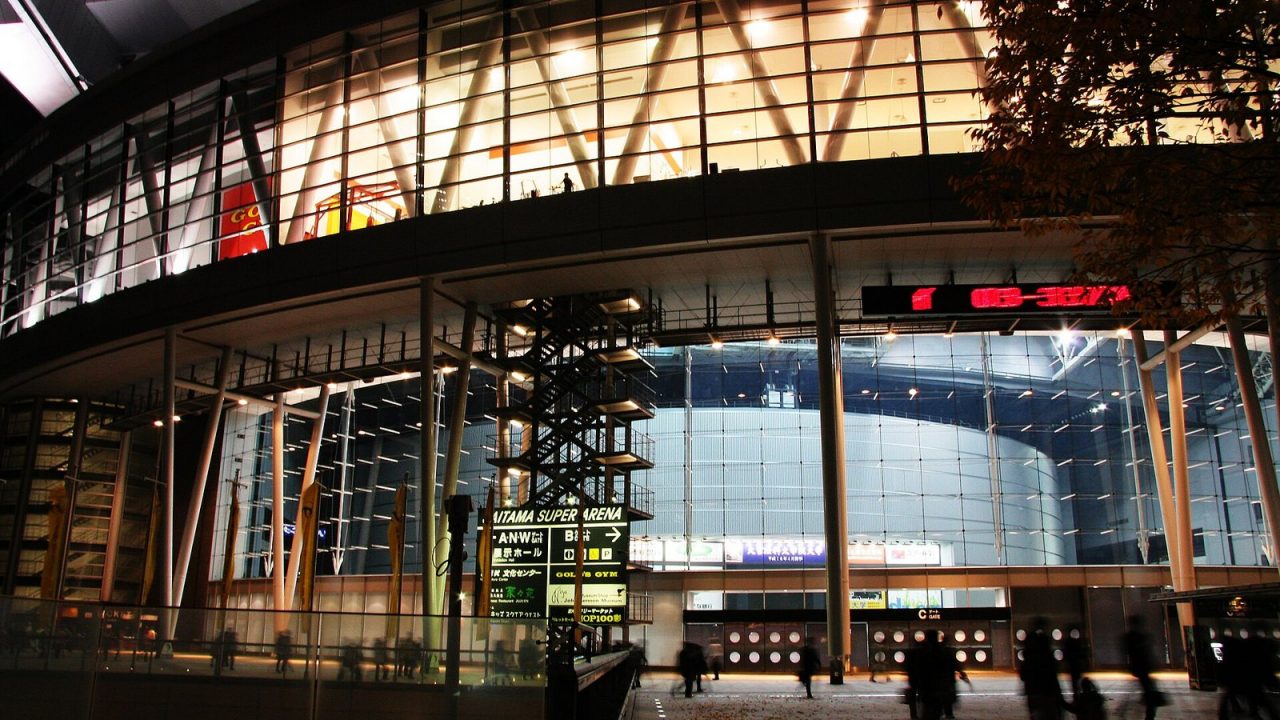
For a decade, the most talked-about MMA promotion in the world wasn’t in Las Vegas but in Japan. PRIDE Fighting Championships filled the Tokyo Dome and Saitama Super Arena, staged lavish entrances, ran open-weight Grand Prix tournaments and allowed strikes that US commissions banned. Many fans still regard its fighters from the early and mid-2000s as some of the best of their era.
PRIDE ran from 1997 to 2007. This is how it began, how its rules and tournaments worked, who its stars were and why it ended in a sale to the owners of the UFC.
The Beginning: Takada vs Gracie (1997)
PRIDE began as a single event built around one fight. On October 11, 1997, at the Tokyo Dome, Japanese professional wrestling star Nobuhiko Takada faced Rickson Gracie, the Brazilian jiu-jitsu fighter with a fearsome reputation. The event was organized by Kakutougi Revolutionary Spirits (KRS), with figures including Nobuyuki Sakakibara involved. Rickson won by armbar in the first round, at 4:47. Attendance was reported at around 47,000.
The fight, and its 1998 rematch, showed there was a large Japanese audience for real fights involving pro wrestling stars. After PRIDE’s fourth event, KRS was dissolved and a new company, Dream Stage Entertainment (DSE), took over the promotion.
From the start, PRIDE drew on Japan’s existing fight culture, including pro wrestling’s showmanship and the crossover between striking and grappling promotions, and it would later co-promote with K-1, whose own rise is covered in our history of K-1.
PRIDE’s Rules: Ring, Long First Rounds and Soccer Kicks
PRIDE’s rule set was a major part of its identity and differed sharply from the Unified Rules being adopted in the US.
- The ring: fights took place in a five-roped square ring with 7-meter sides, not a cage.
- Round structure: a 10-minute first round followed by two 5-minute rounds, with 2-minute breaks.
- Strikes on the ground: soccer kicks, stomps and knees to the head of a downed opponent were legal. So was spiking, slamming an opponent onto the head or neck.
- Elbows: elbow strikes to the head were not permitted.
- Yellow cards: fighters could be shown yellow cards for fouls or passivity, each costing 10 percent of the purse, and three warnings led to disqualification.
- Judging: judges scored the fight as a whole rather than round by round, except at PRIDE’s events in the US. Size was used as a judging factor only when there was a weight difference of 10 kg (22 lb) or more.
The long first round gave grapplers time to work and rewarded fighters with deep conditioning. The legal soccer kicks and stomps made PRIDE fights notably dangerous on the mat and changed how fighters defended from the bottom. PRIDE’s influence on later Asian rule sets is still visible: ONE Championship’s early rules were PRIDE-inspired, as our guide to ONE’s rules explains.
Bushido
PRIDE also ran a series called Bushido, focused largely on lighter fighters. Bushido events used a 10-minute first round and a 5-minute second round, and a system of red cards, each a 10 percent purse deduction.
PRIDE vs the UFC: The Rule Differences
Fans who grew up on the UFC often find old PRIDE fights jarring. The main differences, comparing PRIDE’s main-event rules with the Unified Rules the UFC followed in the US:
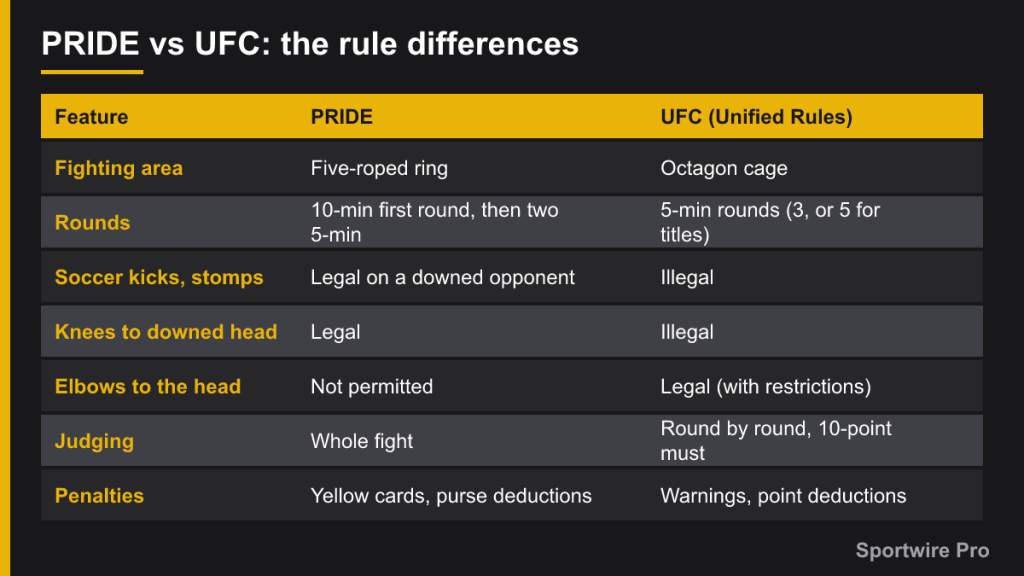
| Feature | PRIDE | UFC (Unified Rules) |
|---|---|---|
| Competition area | Five-roped ring | Octagon cage |
| Rounds | 10-minute first round, then two 5-minute rounds | 5-minute rounds (3, or 5 for title fights) |
| Soccer kicks and stomps on a downed opponent | Legal | Illegal |
| Knees to a downed opponent’s head | Legal | Illegal |
| Elbows to the head | Not permitted | Legal (with specific restrictions) |
| Judging | Whole fight | Round by round, 10-point must |
| Penalties | Yellow cards with purse deductions | Warnings and point deductions |
The result was a different kind of fight. With no elbows to the head, top fighters relied on punches, knees and stomps; with ropes instead of a fence, fighters couldn’t use a cage wall to stand up or pin an opponent in the same way. The long first round also changed pacing, since a fighter who started too fast could be exhausted halfway through a 10-minute opening frame.
The Grand Prix Tournaments
PRIDE’s Grand Prix tournaments were its signature events. They often ran over several shows, with the final rounds held on a single night, and they produced some of the most memorable runs in MMA history.
| Tournament | Winner |
|---|---|
| 2000 Openweight Grand Prix | Mark Coleman (runner-up Igor Vovchanchyn) |
| 2003 Middleweight Grand Prix | Wanderlei Silva |
| 2004 Heavyweight Grand Prix | Fedor Emelianenko |
| 2005 Middleweight Grand Prix | Mauricio “Shogun” Rua |
| 2005 Welterweight Grand Prix | Dan Henderson |
| 2005 Lightweight Grand Prix | Takanori Gomi |
| 2006 Openweight Grand Prix | Mirko Filipović (runner-up Josh Barnett) |
| 2006 Welterweight Grand Prix | Kazuo Misaki |
The tournament format suited PRIDE’s open approach to weight. Openweight tournaments let heavyweights and much smaller fighters meet, a throwback to the early UFC that most modern promotions avoid. Our history of the UFC covers how the American promotion moved the opposite way, toward strict divisions.
PRIDE’s Divisions and Champions
PRIDE’s weight classes were set in kilograms and didn’t line up neatly with US divisions. By the time of its last show, PRIDE recognized four championships:
| Division | Limit | Champion at PRIDE’s end |
|---|---|---|
| Heavyweight | No upper limit | Fedor Emelianenko (since March 16, 2003; 3 defenses) |
| Middleweight | 93 kg / 205 lb | Dan Henderson (since February 24, 2007) |
| Welterweight | 83 kg / 183 lb | Dan Henderson (since December 31, 2005) |
| Lightweight | 73 kg / 161 lb | Takanori Gomi (since December 31, 2005; 1 defense) |
Note that PRIDE’s “middleweight” was roughly equivalent to the UFC’s light heavyweight, and its “welterweight” closer to the UFC’s middleweight. That’s a frequent source of confusion when comparing fighters across the two promotions. Henderson’s position was unusual: he held two PRIDE titles at once, after taking the middleweight belt from Wanderlei Silva.
The Stars
Fedor Emelianenko
The Russian heavyweight became PRIDE’s heavyweight champion in March 2003 and held the title until the promotion ended, also winning the 2004 Heavyweight Grand Prix. His calm demeanor and ability to win standing or on the ground made him the face of PRIDE’s heavyweight division and, for many fans, the best heavyweight in the world during that period.
Wanderlei Silva
Nicknamed “The Axe Murderer,” the Brazilian became PRIDE’s first middleweight champion on November 3, 2001, at PRIDE 17, when Kazushi Sakuraba was unable to continue after the first round. Silva defended the title four times and won the 2003 Middleweight Grand Prix. From 1999 to 2004, he went 20 fights unbeaten, a run that included 18 wins, a draw and a no contest. His aggressive, knee-heavy Muay Thai style, perfectly suited to PRIDE’s rules, made him one of the promotion’s defining fighters. He lost the title to Dan Henderson by third-round knockout at PRIDE 33 on February 24, 2007.
Mirko Filipović
A former K-1 kickboxer, Filipović reached the K-1 World Grand Prix final in 1999 before becoming one of PRIDE’s most feared strikers. His crowning achievement was winning the 2006 Openweight Grand Prix.
Others
Mauricio “Shogun” Rua won the 2005 Middleweight Grand Prix, Takanori Gomi was the lightweight standard-bearer, Dan Henderson became a two-division champion, and Kazushi Sakuraba’s battles against members of the Gracie family were among PRIDE’s most celebrated attractions.
The Spectacle
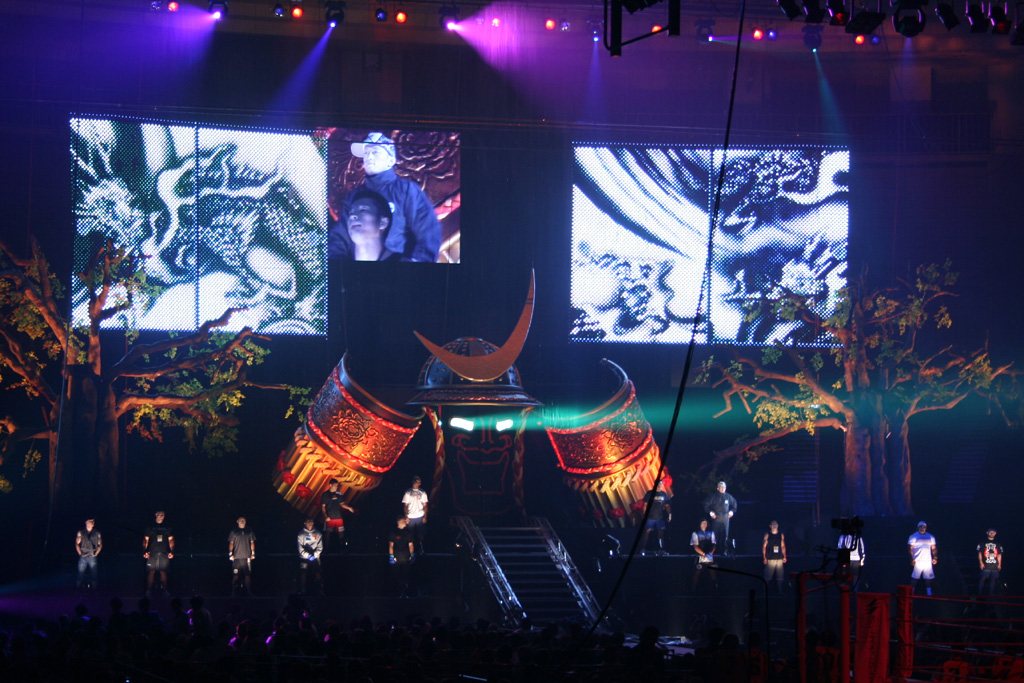
PRIDE was known for its production. Elaborate entrances and huge arenas gave events a sense of occasion that borrowed heavily from Japanese pro wrestling. Its biggest show, held in August 2002 and known in English as PRIDE Shockwave (in Japan, PRIDE/K-1 Dynamite!!), drew a reported crowd of over 71,000, with some sources claiming 91,107, which would make it one of the largest live MMA audiences on record. PRIDE Final Conflict 2003 drew more than 67,000.
Decline and the Sale to Zuffa (2006–2007)
PRIDE’s end came quickly.
- June 5, 2006: Fuji Television ended its contract with PRIDE, citing a breach of contract by DSE. Allegations of links between PRIDE and organized crime, widely reported in Japan at the time, led to the loss of broadcast deals.
- Without Japanese network television, PRIDE lost its most important source of revenue and exposure.
- March 27, 2007: it was announced that the UFC’s owners, Lorenzo and Frank Fertitta, would buy the PRIDE brand. The price was reported at around $65 million, though it was never officially disclosed.
- April 8, 2007: the last PRIDE-promoted show took place.
- May 25, 2007: the sale closed. PRIDE’s Japanese office closed on October 4, 2007.
Hopes that PRIDE would continue as a separate brand alongside the UFC did not materialize. Many of its stars eventually moved to the UFC, while others, including Fedor Emelianenko, never did.
PRIDE’s Legacy
- A stage for elite talent: in the early 2000s, PRIDE was widely seen as home to many of the world’s best heavyweights and middleweights, which shaped how fans assessed fighters for years afterward.
- Rule debates: soccer kicks, stomps and knees to grounded opponents remain part of the ongoing argument about what MMA should allow, and PRIDE’s whole-fight judging lives on in ONE Championship.
- Tournament nostalgia: its Grand Prix tournaments are still cited when fans ask for tournament formats to return to the sport.
- The talent influx: PRIDE veterans such as Rua, Henderson and Silva went on to headline UFC events, and their success after the merger fed the long debate about which promotion had the better fighters.