The Unified Rules of MMA Explained for New Fans
What the Unified Rules of MMA are, where they came from, and how rounds, attire, legal strikes, fouls and judging work under the athletic commissions.
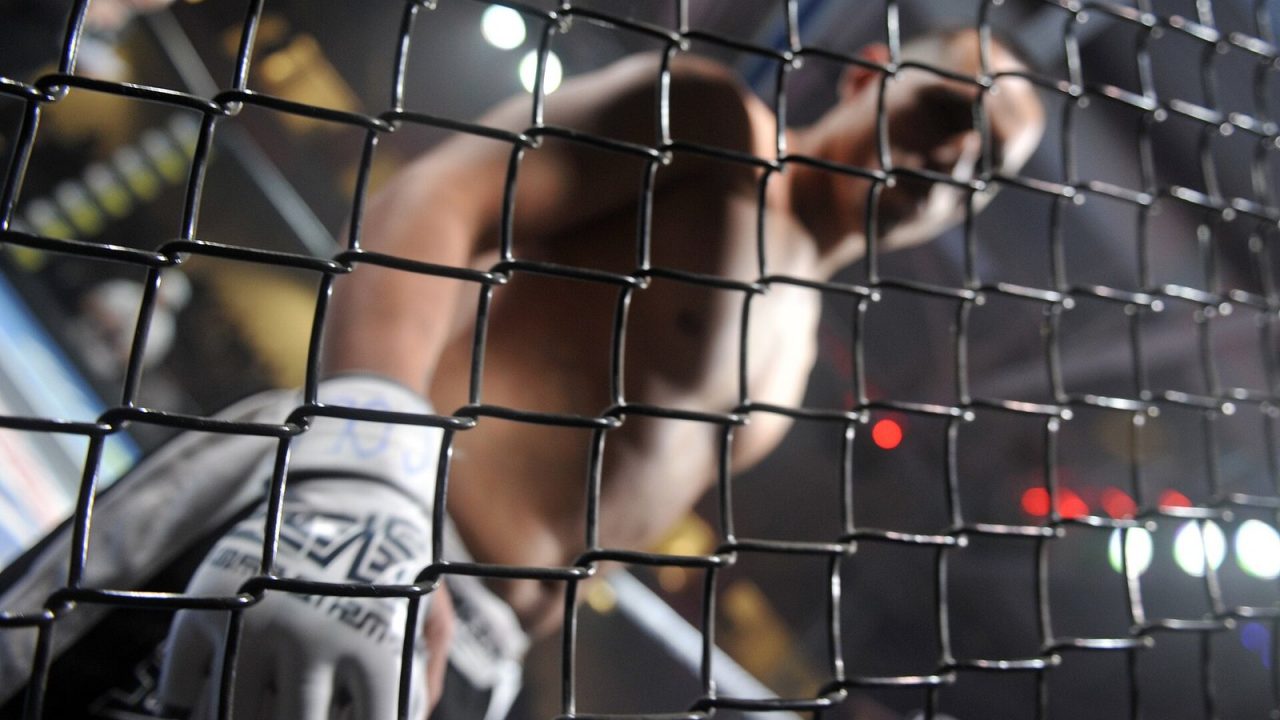
Mixed martial arts looks chaotic to people watching it for the first time. Two fighters can punch, kick, knee, elbow, wrestle and choke, often in the space of a few seconds. But almost every professional MMA bout in the United States runs under a shared, written rulebook: the Unified Rules of Mixed Martial Arts. Knowing the basics makes the sport far easier to follow, from why a referee suddenly stops the action to why a fighter loses a point for grabbing the fence.
What the Unified Rules Are and Where They Came From
MMA’s early years in North America were famously loose. Early events advertised few rules, there were no weight classes at first, and many states refused to allow the sport at all. To win regulatory approval, the sport needed a standard rulebook that commissions could license and enforce.
That rulebook took shape in New Jersey. According to Wikipedia’s history of the rules, the New Jersey State Athletic Control Board began allowing MMA events in September 2000 so it could observe them and build a regulatory framework. On April 3, 2001, the board and other parties, including promoters, agreed on a uniform rule set. It quickly became the de facto standard for professional MMA in North America.
On July 30, 2009, the Association of Boxing Commissions and Combative Sports (ABC), the umbrella organization of North American athletic commissions, formally adopted these rules as the Unified Rules of Mixed Martial Arts. The ABC continues to maintain them. Its current document lists amendments in 2010, 2016, 2017, 2018, 2019, 2023, 2024 and 2026, which shows that the rulebook is updated regularly rather than fixed in stone.
Who Actually Enforces the Rules
This is the part that confuses many new fans: the ABC writes the model rules, but it does not run fights. In the United States, combat sports are regulated by state (and some tribal) athletic commissions. Each commission decides whether to adopt the Unified Rules as written, adopt them with changes, or keep its own version. The ABC document itself notes that any modified version should not be called the “Unified Rules of MMA” and should be referred to by the name of the commission sanctioning the event.
Commissions also license fighters, referees, judges and ringside doctors, oversee weigh-ins, inspect hand wraps and gloves, require medical testing, and handle appeals. When a promotion like the UFC holds an event in Las Vegas, the Nevada commission regulates it; in New York, the New York commission does. Big promotions also have their own internal policies, but the commission’s rules govern the bout itself.
Because adoption is state by state, rule changes sometimes roll out unevenly. A widely discussed example came after the 2016–2017 updates, when some commissions adopted a new definition of a “grounded” fighter and others did not, leaving different rules in different states for a time.
Rounds, Bout Length and the Fighting Area
Under the current ABC Unified Rules:
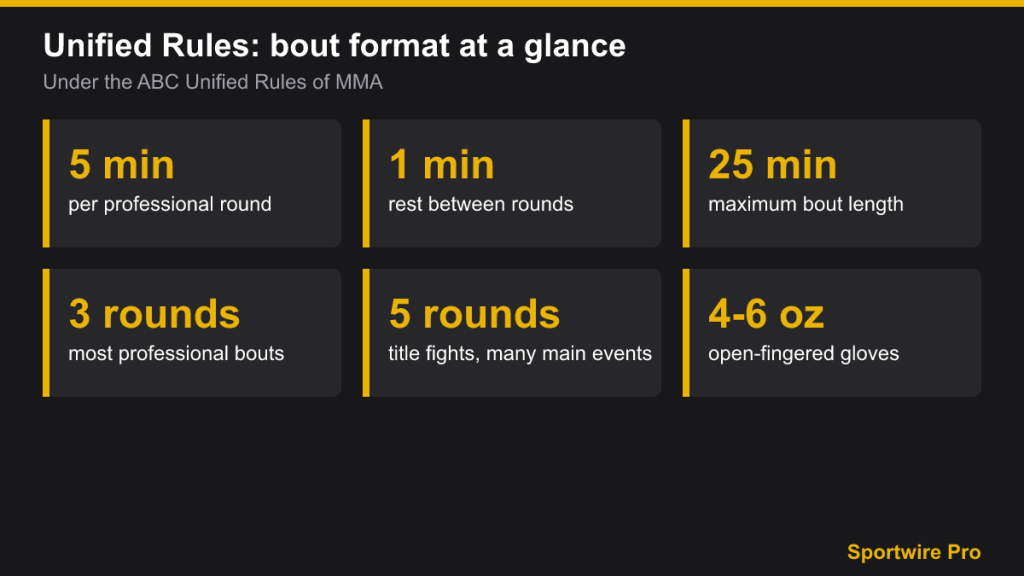
- Professional rounds last five minutes, with a one-minute rest between rounds.
- A bout may be scheduled for one to five rounds, but no contest may exceed five rounds or 25 minutes.
- In practice, most professional bouts are three rounds, while championship fights and many main events are five rounds.
The rules allow bouts in either a cage or a ring. North American promotions overwhelmingly use a cage, such as the UFC’s eight-sided Octagon, while some promotions in Asia and elsewhere use a ring. In both cases fighters may push off the fence or ropes with an open hand, but they may not grab them.
Gloves, attire and protective gear
MMA gloves are small, open-fingered gloves, typically in the 4 to 6 ounce range, which let fighters grip and grapple while still padding the knuckles. The ABC rules also cover what fighters can wear:
- A mouthpiece is required, and a round cannot begin without it.
- Men must wear groin protection and may not wear anything on the upper body.
- Women wear a short-sleeved or sleeveless form-fitting rash guard and/or sports bra; loose-fitting tops are not allowed.
- Trunks may not extend below the knee and may not have exposed Velcro, pockets or zippers.
- No shoes, jewelry or body cosmetics.
- No taping, sleeves or braces on the upper body other than the hands; soft neoprene sleeves are allowed on the knees and ankles.
Hand wraps are tightly controlled too, with limits on the amount of gauze and tape per hand and a rule that tape may not cover the knuckles.
What Is Legal: The Big Picture
The simplest way to understand MMA’s rules is that almost everything is allowed unless it is on the foul list. Fighters may use:
- Punches, kicks, knees and elbows to legal targets while standing.
- Takedowns, throws and trips (but not spiking an opponent onto the head or neck).
- Ground striking, often called ground and pound.
- Submission holds, including chokes and locks on large joints such as the elbow, shoulder, knee and ankle.
The fouls are what define the sport’s shape. The full ABC list is long, but the main ones every fan should know are:
- Headbutts, eye gouging, biting, spitting, hair pulling and fish-hooking.
- Strikes to the spine or the back of the head. The rules define the back of the head as a strip running from the crown down the back of the head, with a one-inch allowance either side, continuing down the spine.
- Throat strikes and grabbing the trachea.
- Groin attacks of any kind.
- Kicking or kneeing the head of a grounded opponent, and stomping a grounded opponent.
- Small joint manipulation: attacking individual fingers or toes. Grabbing most of the fingers at once is allowed.
- Holding the opponent’s gloves or shorts, and grabbing the fence or ropes.
- Reaching toward an opponent’s face with open, outstretched fingers.
- Throwing an opponent out of the cage or ring.
- Attacking after the bell, during a break, or when the opponent is under the referee’s care.
- Timidity, such as running from contact or faking an injury.
The “grounded fighter” rule
Whether a fighter is “grounded” decides whether kicks and knees to the head are legal, so the definition matters a great deal. Under the current ABC language, a fighter is grounded when any part of the body other than the hands or feet is touching the canvas. A fighter who is standing with a hand on the mat, therefore, can still be kneed or kicked in the head under this definition, while a fighter with a knee down cannot. This is one of the most frequently revised parts of the rules, and commissions have not always adopted the changes at the same time.
The 12-6 elbow
For decades, one of MMA’s most famous oddities was the ban on “12-6” elbows: straight-down elbow strikes, named after a clock hand moving from 12 to 6. The ban dated back to the original rules. In 2024, the ABC voted to remove it, with an effective date of November 1, 2024, subject to each commission’s approval. The UFC removed the ban for its events from early November 2024. The current ABC foul list no longer includes it.
How Fouls Are Handled
When a foul happens, the referee calls time, checks the fouled fighter, and decides how much recovery time is warranted. A fighter hit with a groin strike or an eye poke can be given up to five minutes to recover. After an eye poke, the referee and ringside doctor give the fighter time to compose themselves before asking whether they can see.
Penalties depend on intent and effect:
- If an intentional foul causes an injury severe enough to end the fight immediately, the fouling fighter loses by disqualification.
- If an intentional foul causes an injury but the fight continues, a two-point deduction is mandatory.
- If an accidental foul ends the fight early, the result is a no contest when too little of the fight has been completed (fewer than two of three rounds, or three of five), and a technical decision for whoever leads on the scorecards after that point.
Referees can also deduct points for repeated or flagrant fouls, such as fence grabbing that has a substantial effect on the fight, and can disqualify fighters for flagrant disregard of their instructions.
How Fights Are Judged
Bouts that go the distance are scored by at least three judges using the 10-point must system, also used in boxing: the round winner receives 10 points, and the loser nine or fewer. The ABC criteria are applied in a fixed order of importance:
- Effective striking and grappling (the first and most important consideration). Effective striking is judged by the damage and effect of legal strikes. Effective grappling is judged by successful takedowns, submission attempts, advantageous positions and reversals that have an impactful result.
- Effective aggressiveness, meaning aggressively trying to finish the fight. This is considered only if the first criterion is even.
- Control of the fighting area, meaning who dictates the pace, place and position of the bout. This is considered only if the first two are even.
Judges score a 10-8 round when one fighter wins by a large margin based on damage, dominance and duration, and 10-7 when one fighter is completely dominated. Importantly, the rules say that merely holding a dominant position should not be a primary factor; what a fighter does from that position is what counts. A fighter can spend much of a round on top and still lose it if the opponent did more damage.
Ways a Fight Can End
The Unified Rules list the possible outcomes:
- Submission, by physical tap, verbal tap, or technical submission (when a hold causes unconsciousness or a broken or dislocated joint).
- Knockout (KO), when the referee stops the fight because a fighter cannot intelligently defend themselves due to strikes.
- Technical knockout (TKO), by referee stoppage, a corner stoppage, failure to answer the bell, or a medical stoppage (cuts, doctor’s advice, or loss of control of bodily functions).
- Decision: unanimous, split, majority or technical.
- Draw: unanimous, majority, split or technical.
- Disqualification and no contest.
The referee is the only official authorized to stop a contest, though the rules allow commissions to use instant replay to review a fight-ending sequence after a fight is stopped.
Weight Classes Under the Unified Rules
The ABC document lists 15 weight classes, from atomweight (up to 105 lb) through strawweight, flyweight, bantamweight, featherweight, lightweight, super lightweight, welterweight, super welterweight, middleweight, super middleweight, light heavyweight, cruiserweight and heavyweight (225 to 265 lb), up to super heavyweight (over 265 lb). Promotions choose which of these divisions to use, and most use only some of them.