Wrestling in MMA: Takedowns, Sprawls and Cage Control
Why wrestling wins so many MMA fights: single and double legs, body locks, the sprawl, wrestling against the cage, and how fighters get back up.
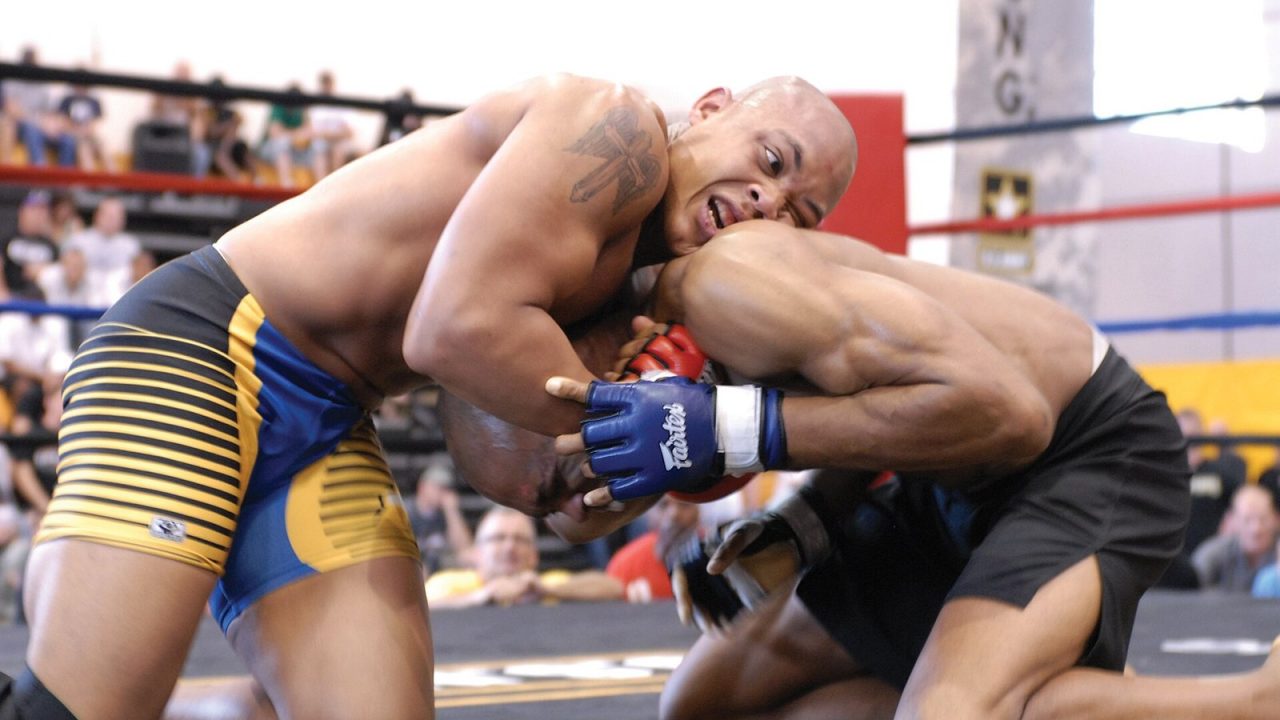
Ask coaches which base art carries over best to mixed martial arts and many will say wrestling. The reason is control. A fighter who can decide whether the fight stays standing or goes to the mat can steer every exchange toward his strengths. A striker who cannot stop takedowns spends the fight defending. A grappler who cannot take anyone down never gets to use his submissions. Wrestling sits in the middle of both problems.
This article explains the main wrestling tools seen in MMA: the leg attacks, the body lock, the sprawl, the fight along the cage, and the skill of standing back up. It is written to help fans understand what they are watching. Wrestling involves falls, lifts and pressure on the neck and spine, and anyone who wants to learn it should do so with a qualified coach.
Why wrestling matters so much in MMA
Several features of the sport reward wrestlers.
- Position decides damage. A fighter on top can strike while the fighter underneath must defend. Ground strikes are legal in MMA with some limits, so taking someone down is not just a point; it changes what both fighters can do.
- Judges credit grappling. Under the Association of Boxing Commissions’ scoring guidance, successful grappling, which includes takedowns, reversals, submission attempts and achieving advantageous positions, counts equally with successful striking when it produces results. Our explanation of how fights end covers how decisions fit with stoppages.
- Wrestling sets the location. The fighter with better wrestling often decides whether the next minute takes place at range, against the fence or on the canvas.
- It drains energy. Defending takedowns and getting up repeatedly is exhausting, which can slow a striker’s output later in the fight.
That is why so many fighters with backgrounds in American folkstyle (collegiate) wrestling, freestyle or Greco-Roman wrestling, and related grappling arts such as sambo, have done well in the sport. Folkstyle places heavy emphasis on riding and escaping on the mat, freestyle rewards explosive leg attacks and exposure, and Greco-Roman, which bans attacks below the waist, builds upper-body clinch and throwing skills. Each background brings something useful to MMA, though each also has to adapt to strikes and to the cage.
Leg attacks: the single leg and double leg
The double leg
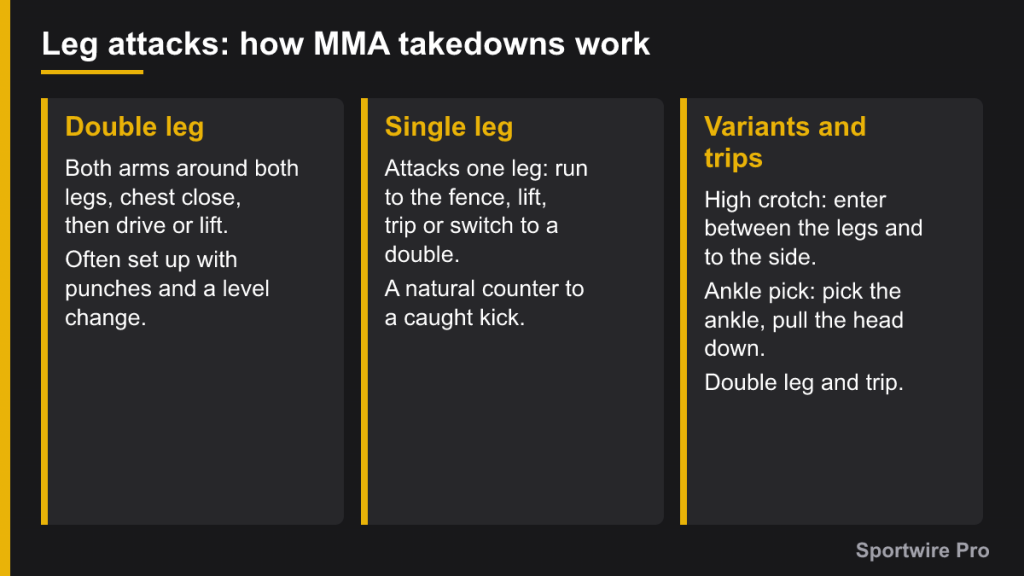
A double leg takedown means the attacker drives in and wraps both arms around the opponent’s legs, keeping his chest close, then drives or lifts to put the opponent on his back. In MMA the double leg is often set up with punches: the opponent raises his hands to block a strike, and the attacker changes levels underneath. A wrestler who telegraphs the shot by dropping his head too early risks a knee or an uppercut.
The single leg
A single leg takedown attacks one leg, usually grabbing it with both hands. Once the leg is secured, the attacker can run the opponent toward the fence, lift the leg high, trip the standing leg or switch to a double. Variants include the high crotch, which enters between the legs and to the side, and the ankle pick, which picks up the leg at the ankle while pulling the opponent’s head down.
Single legs are common in MMA because a striker often leaves his lead leg forward and exposed. They are also a natural counter to kicks: a fighter who catches a kick already has a leg in his hands.
Trips and reactions
Many takedowns combine a leg attack with a trip. A “double leg and trip,” for example, uses a double leg entry and then knocks out one of the opponent’s legs with the attacker’s own leg. Good wrestlers chain attacks: the opponent defends one direction, and the attacker uses that reaction to finish in another.
Upper-body takedowns and the body lock
Not every takedown attacks the legs. From the clinch, fighters use upper-body control to throw or trip opponents.
- Body lock: the attacker locks his hands around the opponent’s waist, often from behind or to the side, and uses a trip, lift or turn to bring him down. A body lock is especially effective against the cage, where the opponent cannot step back.
- Underhook trips: with an underhook, the attacker can step behind the opponent’s leg and knock him over it.
- Throws: wrestlers with Greco-Roman, judo or sambo backgrounds use hip throws and similar techniques. Under the Unified Rules, a throw that arcs is legal even if the opponent lands on his head. What is banned is a pile driver, where the opponent is controlled feet up and head down and driven straight into the canvas.
Upper-body takedowns carry a specific risk in MMA. When a fighter is close enough to lock his hands, he is also close enough to eat elbows, knees and short punches. The clinch is therefore a contested zone where wrestling and striking happen at once.
The sprawl and takedown defense
The sprawl is the basic defense against leg attacks. When the opponent shoots, the defender kicks his legs back so his hips drop onto the attacker’s upper back, keeping his knees off the floor and extending his hips to add downward pressure. A good sprawl flattens the shooter and leaves the defender on top, where he can stand up, circle behind or strike.
The sprawl gave its name to an MMA strategy, “sprawl and brawl,” in which a striker uses takedown defense to keep the fight standing. Takedown defense is wider than the sprawl, though. Fighters also rely on:
- Distance and footwork: staying out of range of a clean shot and circling off the fence.
- Underhooks and frames: getting an underhook or a forearm frame to stop the attacker from closing.
- Whizzers: an overhook on the attacking arm, used to break down a single leg or spin away.
- Strikes: knees, uppercuts and other punches thrown at a shooting opponent where rules allow.
- Hand fighting: controlling the wrists so the attacker cannot lock his hands.
Cage wrestling
The cage creates a type of wrestling that does not exist on an open wrestling mat. When a fighter is pressed against the fence, he cannot step back, and the attacker can use the wall to pin and tire him. Common sequences include pinning the opponent with head and shoulder pressure, fighting for underhooks, then switching to a single leg or body lock when the opponent’s weight shifts.
The fence also helps the defender. A fighter can use it to keep his balance, post his hands and push off. The Unified Rules allow fighters to put their hands on the fence and push off, and their feet and toes may touch the fence at any time. What is illegal is grabbing the fence with fingers or toes to control position. The referee can deduct a point if the foul has a substantial effect, and if it leads to a superior position the fighters may be restarted standing.
A related technique, the “wall walk,” describes a fighter who has been taken down using the fence to walk his back and hips up the wall to get to his feet. Fighters who are good at it can neutralize a strong wrestler, while wrestlers try to drag or trip them down again before they settle.
Getting back up
Since position matters so much, the ability to return to the feet is a skill in itself. In folkstyle wrestling, escaping from the bottom position is scored, and that habit transfers well to MMA. Getting up typically involves:
- Creating a frame: using arms and legs to make space between the bodies.
- Turning to a knee: getting onto the hip and then a knee, while controlling the opponent’s hands.
- Standing with the back to the fence: combining a wall walk with underhooks.
- Technical stand-up: posting a hand and the opposite foot to rise while staying ready to defend.
Rules shape the stand-up too. Under the Unified Rules, a fighter is considered grounded when any part of his body other than his hands or feet touches the canvas, and a grounded fighter cannot be kneed or kicked in the head. So a fighter on one knee is protected from head kicks and knees, but once he is fully on his feet those strikes are legal again. That moment is a common point of danger.
How wrestlers adapt to MMA
Pure wrestling does not transfer directly. Wrestlers entering MMA usually need to change several habits.
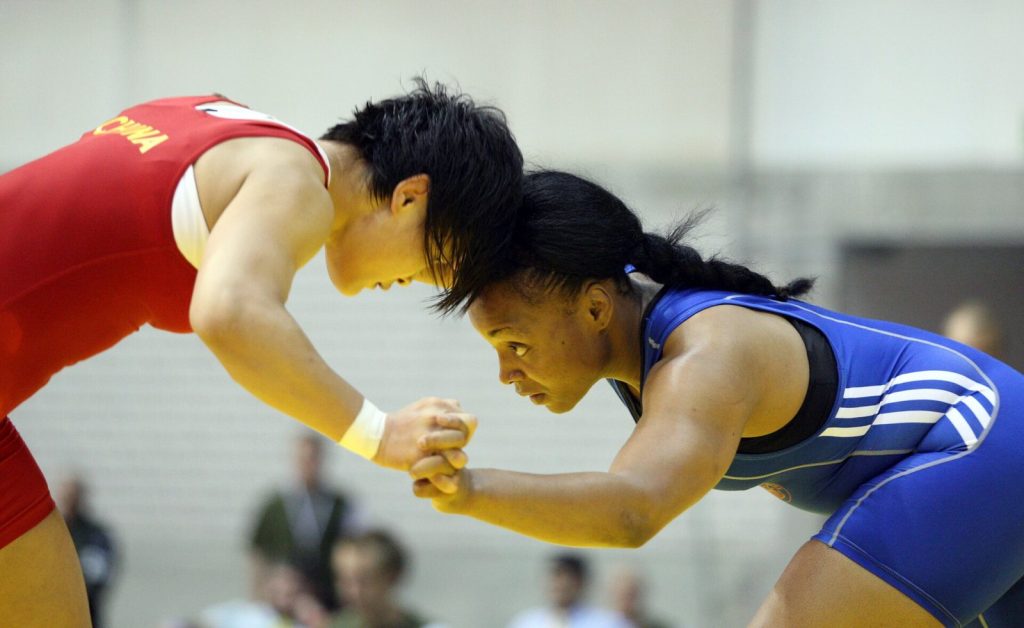
- Head position: wrestlers often lead with the head, which can expose them to knees and uppercuts.
- Stance: a very low wrestling stance makes it hard to defend kicks and strikes. MMA stances are usually more upright.
- Exposure: in folkstyle, going to the stomach can prevent being turned onto the back. In MMA, giving up the back is dangerous because of the rear-naked choke.
- Submissions: wrestlers must learn to defend guillotines, which are often attempted against a shot or a head-down clinch. Our guide to essential MMA submissions explains how chokes and joint locks work.
The reverse is also true. Strikers learn enough wrestling to defend and get up, and many add takedowns of their own. Modern MMA rarely features a “pure” specialist; fighters blend skills, and the wrestling component of a striker’s game is often what keeps him competitive.
Common things fans misread
“He took him down, so he won the round”
Not necessarily. Current ABC guidance says merely holding a dominant position does not demonstrate dominance by itself. A takedown that leads to nothing may count less than damaging strikes from the other fighter. What matters is the result of the grappling.
“The fighter on the bottom is losing”
Sometimes. A fighter on his back who is threatening submissions or sweeping can be doing well. A fighter who is stuck and absorbing strikes is not.
“Lay and pray”
This slang describes a wrestler who takes an opponent down and holds position without much offense. Referees can stand fighters up when action stalls, and judging guidance places weight on damage, so this approach carries risk.
Watching wrestling with better eyes
Once you know the basic pieces, MMA wrestling becomes easier to read. Watch for the level change behind a punch, the fight for underhooks against the fence, the sprawl and the scramble that follows, and the moment a grounded fighter rises back into range of knees. Those exchanges often decide who controls the fight long before anyone lands a big shot.