Boxing Defense Basics: Slips, Rolls, Blocks and the Shoulder Roll
How boxers avoid punches: guard positions, blocks and parries, slips, bobbing and weaving, the Philly shell shoulder roll, and footwork as defense.
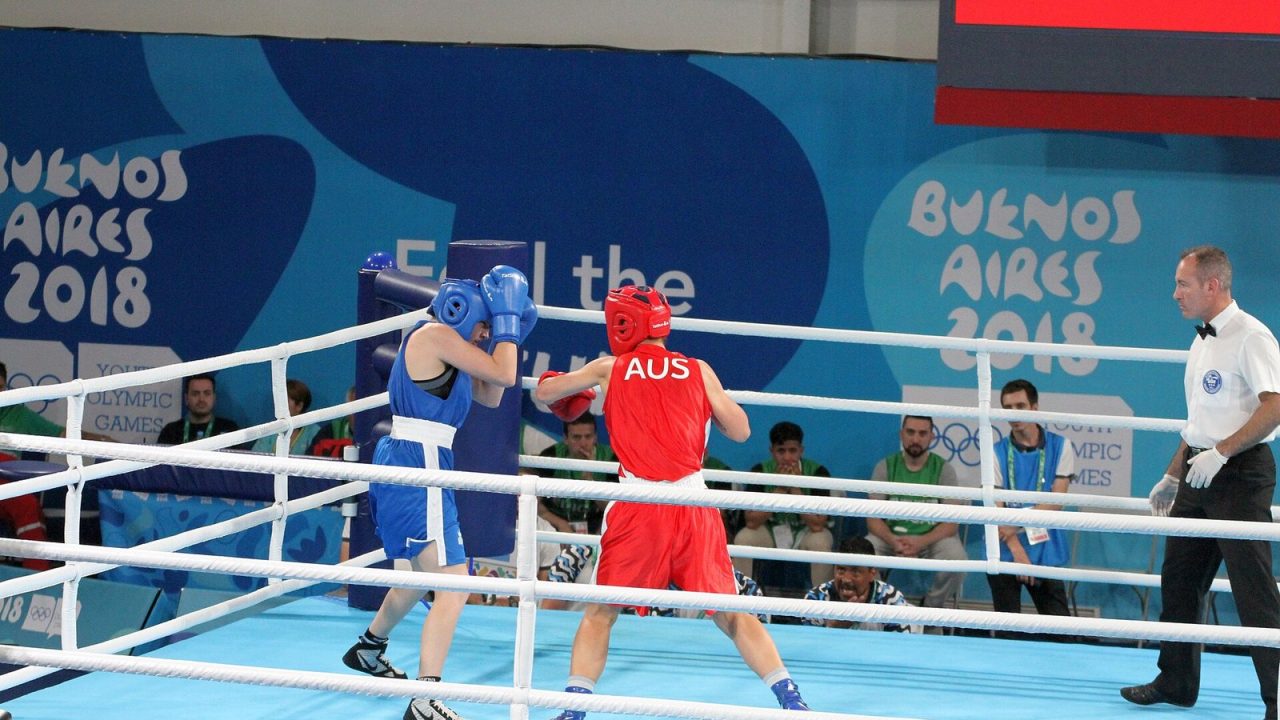
Offense wins highlight reels, but defense keeps boxers in the sport. A fighter who can make an opponent miss saves energy, avoids damage and creates openings to counter. Many of the most respected boxers in history were admired as much for what they avoided as for what they landed.
This guide explains the main defensive tools in boxing: how the guard works, what blocking and parrying mean, how slips and bob-and-weave movements take the head off the line, how the shoulder roll (often called the Philly shell) works, and why footwork is the first layer of defense. It is written for fans who want to understand what they are watching and for beginners who want the vocabulary before they walk into a gym. Defensive skills are learned through drilling and controlled sparring, so anyone who wants to practice them should do so under a qualified coach.
The layers of boxing defense
Coaches often think of defense in layers, from the outermost to the last resort:
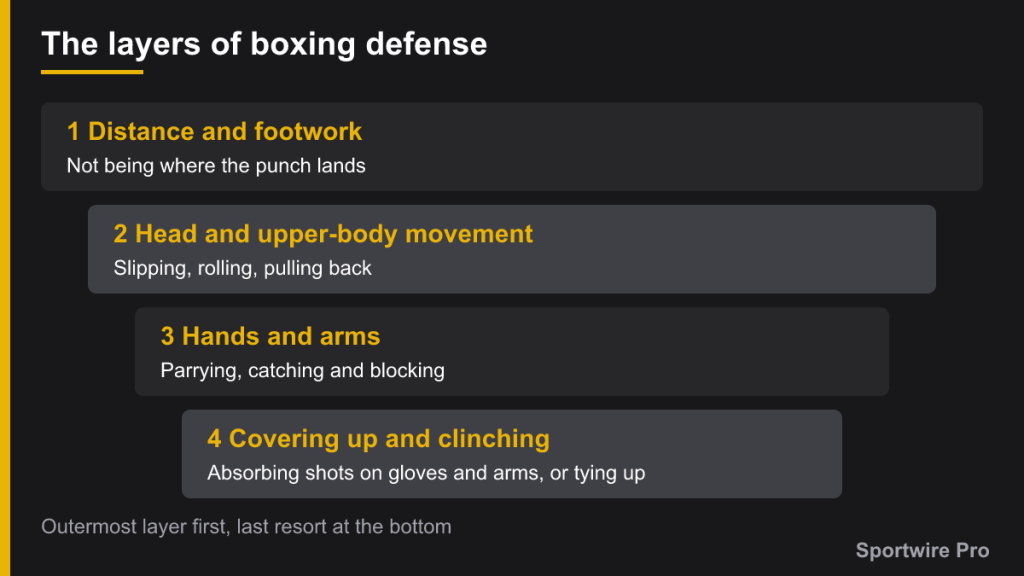
- Distance and footwork: not being where the punch lands.
- Head and upper-body movement: slipping, rolling, pulling back.
- Hands and arms: parrying, catching and blocking.
- Covering up and clinching: absorbing shots on the gloves and arms, or tying the opponent up to stop the exchange.
No boxer relies on a single layer. Good defense mixes the tools so the opponent cannot predict what will happen when he throws.
Defense also does not score on its own. Under the 10-point must system, judges reward clean punching and effective aggression, and defense matters because it prevents the opponent from landing. Our explainer on how boxing scoring works covers the judging criteria in detail. In practice, a fighter who makes his opponent miss and then lands a counter is winning both ways.
The guard: where the hands live
The guard is the default position of the hands and arms. In a standard upright stance, the lead hand is held in front of the face, roughly at eye level and some distance out, and the rear hand stays near the chin. The elbows stay close to the body to protect the ribs and liver, and the chin is tucked down so the shoulders and gloves help shield the jaw.
High guard
In a high guard both gloves sit up near the forehead and temples, with forearms protecting the face and elbows covering the body. It is popular with pressure fighters and beginners because it is simple and offers strong coverage. Its weakness is that it can leave the fighter reactive: while he is covering, he is not punching, and shots can split the guard down the middle or go around it.
Peek-a-boo
The peek-a-boo guard places the hands high in front of the face, close together, and pairs that guard with constant head movement. It is associated with trainer Cus D’Amato and his fighters. The guard on its own is not the point; the style works because the fighter keeps the head moving while staying close enough to counter.
Cross-arm and crab-style guards
Cross-armed guards stack the forearms horizontally in front of the face and body. Crab-style or low-lead guards drop the lead hand across the stomach and rely on the lead shoulder to protect the chin. The Philly shell, discussed below, belongs to this family.
Blocking, catching and parrying
Blocking covers any action that absorbs, intercepts or redirects a punch with the gloves, forearms or shoulders.
- Catching: the rear glove catches the opponent’s jab in the palm, much like catching a ball, then the boxer can fire back with his own jab or cross.
- Parrying: an open glove taps the incoming punch to the side, usually striking the wrist or forearm. A parry redirects force rather than absorbing it, which leaves the opponent slightly off line and open to a counter. In a closed stance (orthodox versus orthodox), the rear hand typically parries the jab.
- Forearm and elbow blocks: hooks to the body are often blocked by dropping the elbow and turning the torso so the blow lands on the arm rather than the ribs.
- Shoulder block: the lead shoulder rises to deflect a straight right hand, a key part of the shoulder roll.
- Covering up: both gloves on the head, forearms tucked, absorbing punches while waiting for a moment to counter or escape.
Parrying costs less energy and creates openings; blocking needs less precise timing. Most fighters use both.
Slipping, bobbing and weaving, and pulling back
Slipping
A slip moves the head just off the line of a straight punch, usually by rotating the torso and shifting the weight slightly at the knees and hips. Against an orthodox opponent, slipping to the outside of the jab moves the head away from the rear hand, while slipping inside the jab moves the head toward the center, which opens counters but carries more risk. The goal is a small movement: a slip that goes too far takes the fighter out of position to punch back.
Bobbing and weaving
Bobbing means bending the knees to drop the head under a hook. Weaving, sometimes called rolling, means moving the head in a U-shape under the punch and coming up on the other side of the opponent’s arm. Fighters who come forward use the bob and weave to close distance against taller opponents, and it sets up hooks and uppercuts from the inside. The common mistake is bending at the waist instead of the knees, which drops the head forward into uppercuts.
Pulling back
A pull-back, also called a lean-back or step-back, moves the head or whole body backward just out of range. It is effective against a jab and often precedes a counter right hand, sometimes called the pull counter. Leaning back without moving the feet is risky, because a longer second punch can catch a fighter whose weight is already on his heels.
The shoulder roll and the Philly shell
The shoulder roll is the defensive move most associated with elite counterpunchers. As an opponent throws a straight rear hand, the defender turns his upper body away and raises his lead shoulder so the punch glances off the shoulder rather than landing on the chin. As the opponent’s arm retracts, the defender rotates back and fires his own rear hand, often a straight right.
The Philly shell is a full guard built around that movement. The lead hand is held low across the stomach, the lead shoulder is high and the chin is tucked behind it, and the rear glove sits near the face on the rear side, ready to catch or parry. Wikipedia’s overview of boxing styles describes it as a variation of the cross-armed guard used by fighters who like to counterpunch, and lists George Benton, Floyd Mayweather Jr. and James Toney among its notable users. It is also sometimes called the “Michigan defense.”
Where the name comes from
The “Philly” refers to Philadelphia’s boxing tradition. George Benton, born in Philadelphia in 1933 and a highly ranked middleweight in the early 1960s, is credited with popularizing the style; he used it throughout his career and later taught it as a trainer, including to Pernell Whitaker. Benton was inducted into the International Boxing Hall of Fame in 2001. The guard did not begin with one person, though. Shoulder-roll defense appears in older boxing as well, and the name is best understood as a label for a style closely linked to Philadelphia gyms rather than a single invention.
Strengths and weaknesses
- Strengths: it protects the chin against straight rear hands, keeps the lead hand free to block body shots and throw a check hook or jab from low, and sets up the counter right hand.
- Weaknesses: it requires excellent timing and reflexes, it can leave the lead side of the head open to hooks if the shoulder is not raised in time, and it is often less effective against southpaws, whose straight left comes from a different angle. It also tends to work best for fighters with good reach and footwork who can control distance.
Stance matters a great deal here. Our guide to orthodox vs southpaw matchups explains why the open-stance lead-foot battle changes which punches arrive at which angle, and therefore which defensive tools are safest.
Footwork as defense
The cleanest way to avoid a punch is to be out of range or at an angle where it cannot reach. Footwork in defense includes:
- Stepping back and to the side: retreating in a straight line invites the opponent to follow; stepping back at an angle makes him reset.
- Pivoting: turning on the lead foot to rotate out of the line of attack, often after a combination or when pressed near the ropes.
- Circling away from power: against an orthodox puncher, moving to the left (away from his right hand) is a common default, though it can walk a fighter into the left hook.
- Getting off the ropes: the ropes and corners remove escape routes. Good defensive fighters use feints, slips and pivots to slide out before they get trapped.
Footwork and head movement work together. A slip that is followed by a step to the outside leaves the opponent punching at air and facing the wrong way.
The clinch as a defensive tool
When a fighter is hurt or is being out-fought on the inside, he may clinch: tie up the opponent’s arms so neither man can punch effectively. Holding is a foul if it is excessive, and referees break clinches, but a well-timed clinch can buy seconds to recover. Veterans also use the clinch to frustrate pressure fighters and slow the pace. Our guide to fouls in boxing and MMA explains where the line falls between legal tying up and illegal holding.
Common defensive mistakes
- Dropping the hands after punching: the punching hand must return to the guard; a lazy return is when counters land.
- Closing the eyes or turning the head away: a fighter who cannot see the punch cannot react to the next one.
- Over-committing to movement: slipping or bobbing too far leaves the fighter off balance and unable to counter.
- Predictable patterns: slipping the same way every time lets an opponent throw to where the head will be.
- Defending without countering: pure defense rarely wins rounds; defense should lead into offense.
How beginners usually learn defense
Gyms typically introduce defense step by step. Beginners first learn to keep a solid guard and to catch and parry the jab. Slips are then drilled against slow, predictable straight punches, often with a partner or a slip rope. Bobbing and weaving is practiced under a rope or against slow hooks. Counters are added once the defensive movement is automatic, and live work starts with light, controlled sparring. The shoulder roll is normally an advanced skill because it relies on precise timing.
Because defensive mistakes in sparring mean getting hit, it is important to learn in a structured environment with appropriate protective gear and a coach who controls the intensity. Anyone with a health condition or previous head injury should consult a medical professional before sparring.
Watching defense in a fight
Next time you watch a bout, follow one fighter’s defense for a full round: does he catch the jab or slip it, block body shots with his elbows, circle off the ropes, and what does he do right after his opponent misses? The best defensive fighters turn every miss into an opportunity.