How Muay Thai Is Scored: Why Kicks, Knees and Balance Matter
How judges score Muay Thai: why body kicks, knees and balance count heavily, why early rounds look slow, and how IFMA amateur scoring differs.
Watch your first stadium Muay Thai fight with boxing eyes and the scorecards can look baffling. A fighter lands more punches and still loses. The first two rounds are slow and cagey, and then the fight takes off in the third and fourth. In the fifth round, one fighter might stop fighting hard and just move around. None of this is random. Traditional Thai scoring rewards different things from boxing, and it reads the fight as a story rather than a stack of separate rounds.
This guide explains how Thai stadium-style scoring works, what judges value most, why the pacing looks the way it does, and how amateur scoring under the International Federation of Muaythai Associations (IFMA) differs. Rule sets vary between promotions and countries, so think of this as the general framework rather than one official rulebook for every event.
The Basics: Rounds, the 10-Point Must and the Whole Fight
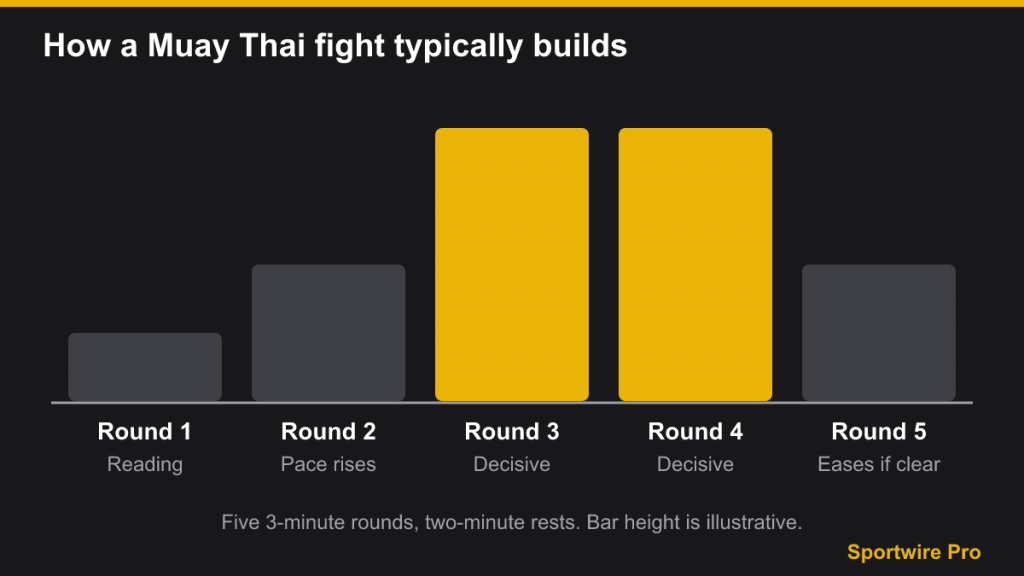
A traditional professional Muay Thai bout in Thailand is five rounds of three minutes, with two minutes of rest between rounds. Judges use the 10-point must system, so the winner of a round gets 10 points and the loser 9 or fewer, and a round judged even can be scored 10-10. If you know how boxing’s 10-point must system works, the arithmetic will look familiar.
The philosophy is what’s different. In boxing, each round is a separate contest and the totals decide the winner. Thai-style judging uses the round scores but also looks at the fight as a whole. Early rounds are often scored 10-10, with the judge privately noting who edged them, and later rounds carry more weight. A fighter who looked slightly better in rounds one to three can still lose if the opponent clearly takes over in rounds four and five. On a boxing card, losing three rounds out of five would usually be decisive. In Muay Thai, a small early lead can be overturned.
That’s why commentators describe a Thai fight as “building.” The first round is often for reading the opponent, the second raises the pace, and the third and fourth are where the fight is usually decided.
What Judges Value: Effect Over Volume
The single most important idea in traditional Muay Thai scoring is effect. Judges don’t simply count strikes; they ask what each strike did to the person who took it.
The scoring hierarchy
- Strikes with clear effect score highest: a knockdown, a standing eight count, or a kick that visibly shakes the opponent, knocks them off balance or makes them retreat.
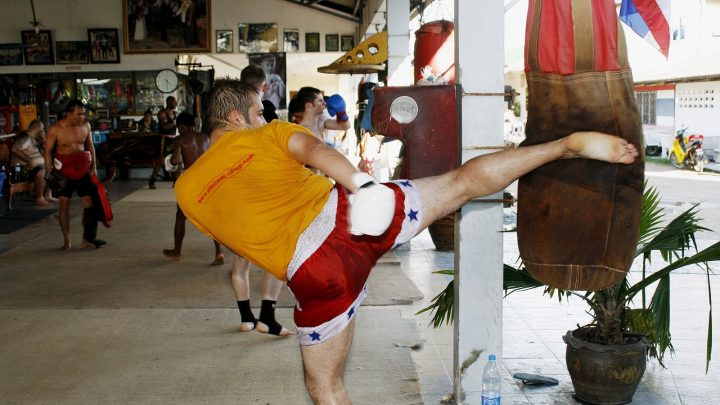
- Body kicks and knees to the midsection are the reliable scorers. A clean roundhouse to the ribs or a knee to the body generally scores even when the opponent seems unaffected, and scores more when it clearly hurts.
- Punches, elbows and low kicks score more conditionally. They count, but judges look much harder at whether they did something visible. A clean punch that jolts the head back counts; a flurry that lands on the guard doesn’t.
- Clinch dominance scores well when one fighter clearly controls the clinch, lands knees and off-balances the opponent.
Why kicks and knees outrank punches
Fans often ask why a crisp punching combination can lose to a single body kick. There are a few reasons. First, a hard roundhouse kick is a big, visible, committed strike, so its effect is easy to see. Second, Muay Thai’s identity is built around the kick, knee and clinch, and the judging culture reflects that. Third, punches are easier to block or absorb on the guard, and blocked strikes do not score. A boxing-heavy fighter can do well in Muay Thai, but the punches have to visibly hurt to win rounds on their own.
For a wider comparison of what each sport allows and rewards, see our guide to kickboxing vs Muay Thai.
Balance, Posture and the “Appearance of Dominance”
Balance is a scoring factor in its own right, and that surprises many newcomers. Judges reward the fighter who stays composed and upright and penalize the one who is constantly knocked out of position.
- Off-balancing: making an opponent stumble, lurch or lose position counts in your favor even without a knockdown.
- Sweeps and dumps: catching a kick and sweeping the standing leg, or throwing an opponent from the clinch, scores well, although less than a real knockdown.
- Composure after strikes: a fighter who takes a kick and immediately returns one, with posture unchanged, takes away much of the kick’s value. A fighter who winces, steps back or drops their hands gives the judges a reason to score the strike highly.
- Clean defense and technique: checking kicks, blocking cleanly and showing technically sound Muay Thai are considered as part of the overall picture.
This is why experienced Thai fighters often show no reaction to being hit. Hiding pain is a scoring skill. It’s also why a fighter may walk forward after eating a kick, signaling that it did nothing.
Aggression, Ring Control and Damage
Muay Thai judging does reward pressure, but less than many fans expect.
- Aggression generally matters only when the other factors are close. Walking forward without landing effective strikes doesn’t win rounds.
- Ring control and control of the exchanges rank above raw aggression. A fighter who dictates where the fight happens and wins the exchanges can outscore a busier opponent.
- Damage and fatigue work as tiebreakers. If a round is otherwise even, the fighter who looks fresher and less marked up generally gets the nod.
Put simply: effective strikes first, then control and composure, then aggression, then appearance.
Why the Pacing Looks Unusual
The scoring system explains Muay Thai’s distinctive rhythm.
Rounds one and two
Because early rounds are commonly scored even unless someone dominates, fighters have little reason to take big risks at the start. They use the time to test reactions, find timing on kicks and see how their opponent defends. To the untrained eye this can look like very little is happening. In reality both fighters are gathering information.
Rounds three and four
These are typically the decisive rounds. The pace rises sharply, fighters commit to body kicks and knees, and the clinch battles get intense. A fighter who clearly wins both rounds is usually in control of the fight.
Round five
In a fight that already has a clear leader, the fifth round can slow dramatically. The fighter ahead may move, touch gloves or make little effort to engage, and the trailing fighter may accept the result. In a close fight, or one with something big at stake, the fifth round stays hard-fought. New viewers sometimes see a quiet fifth round as poor sportsmanship. Within Thai fight culture it’s a signal that both fighters have read the scorecards the same way.
How IFMA Amateur Scoring Differs
IFMA governs amateur Muay Thai internationally, and its rules are built for tournaments with protective equipment and many bouts per day. The scoring logic shifts noticeably from effect toward counting clean, forceful strikes.
| Feature | Traditional Thai stadium style | IFMA amateur |
|---|---|---|
| Rounds | 5 x 3 minutes, 2-minute rest | 3 rounds (3 minutes for senior A-class), 1-minute rest |
| Main criterion | Effect of strikes, balance, dominance | Number of clean, forceful scoring strikes |
| Round weighting | Later rounds weigh more; early rounds often 10-10 | Each round judged on its own |
| Protective gear | Gloves, mouthguard, groin guard | Adds headgear, elbow pads and shin guards |
Scoring a point under IFMA-style rules
Under IFMA-based amateur rules, as adopted in documents such as Ontario’s amateur Muay Thai rules, a score is awarded for each legal punch, kick, knee or elbow that lands on a scoring target with force and isn’t blocked. Strikes that don’t score include those with poor technique, those blocked by gloves, forearms, shins or feet, those that land without force, and throws without a strike. A strike landed while breaking a rule doesn’t count either.
Round margins
The same amateur framework ties the round score to the margin in scoring strikes. A small margin of up to 7 scoring skills gives a 10-9 round, a clear margin of 8 to 14 gives 10-8, and total domination of 15 to 21 gives 10-7. An even round is 10-10. If the counts are equal, the round goes to the athlete who used more forceful techniques. Eight counts lower the counted athlete’s score for the round.
The practical effect is that amateur bouts tend to be busier from the opening bell. With only three rounds and no “feeling out” convention, fighters have to start scoring immediately.
Common Misunderstandings
“He landed more, so he should have won”
In stadium-style scoring, volume isn’t the deciding factor. Ten light punches to the guard can be worth less than two body kicks that bent the opponent over. In amateur rules volume matters much more, which is one reason the two styles can produce different winners from similar-looking performances.
“The first round was a draw, so it didn’t matter”
Early rounds still matter. Judges note who edged them, and that information can decide a close fight. They simply rarely produce big score swings on their own.
“Leg kicks should count more”
Low kicks are legal and can be devastating, and a kick that makes an opponent limp shows clear effect and will score. A low kick that’s checked or shrugged off scores little. Kickboxing promotions judge with their own criteria, such as those covered in our GLORY kickboxing rules guide.
“Clinching is stalling”
In kickboxing rule sets that restrict the clinch, holding is often penalized. In Muay Thai, the clinch is a scoring battleground: the fighter who controls posture, lands knees and throws the opponent off balance is winning, even if the action looks static from a distance.
How to Score a Muay Thai Fight Yourself
If you want to follow a fight the way a Thai judge might, try this checklist each round:
- Which strikes visibly moved, hurt or unbalanced the opponent?
- Who landed clean body kicks and knees, and did they get a reaction?
- Who won the clinch exchanges, and did anyone get swept or thrown?
- Who looked composed and in control, and who was retreating or showing pain?
- Only if all of that is close: who pushed the pace, and who looks more tired or marked up?
Keep a note of the early rounds without scoring them heavily, and expect the decisive moments in rounds three and four. With practice, you’ll start to see why a fighter who appeared busy on screen can lose to one who landed fewer, more meaningful strikes.
Quick Answers
How many rounds is a Muay Thai fight?
Traditional professional fights in Thailand are five rounds of three minutes with two-minute breaks. Amateur IFMA-style bouts for senior A-class athletes are three rounds of three minutes with one-minute breaks, and youth and lower classes have shorter rounds. Promotions outside Thailand sometimes use three-round formats too.
Do elbows score in Muay Thai?
Yes. Elbows are legal scoring strikes. In stadium-style scoring their value depends heavily on effect, and an elbow that cuts or stuns an opponent can swing a fight.
Is a knockdown automatically a 10-8 round?
In amateur IFMA-style rules, an eight count generally drops the counted athlete’s score for the round. In stadium-style judging, a knockdown is the clearest possible display of effect and weighs heavily, but judges still assess the whole round and the whole fight.