MMA Glossary: 60 Terms Every Fan Should Know
A reference glossary of 60 MMA terms, from calf kicks and wall walks to the D'Arce and catchweights, grouped by theme with plain-English definitions.
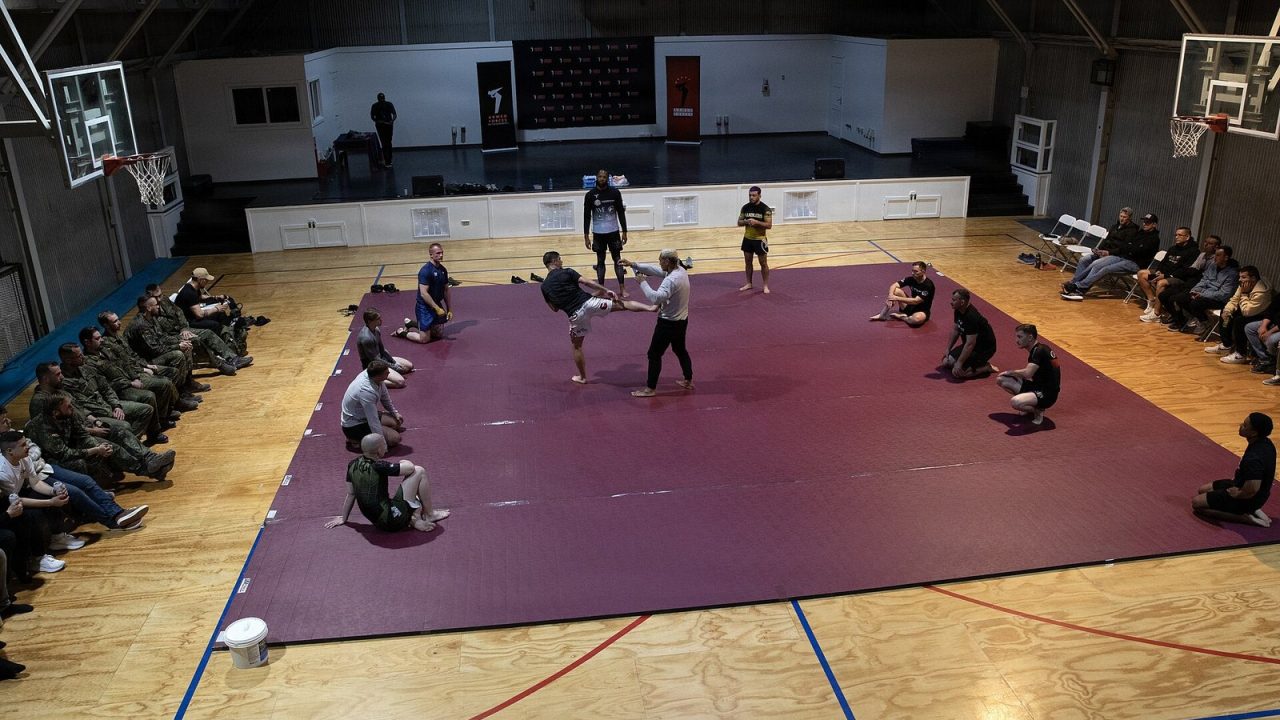
MMA commentary moves fast, and it borrows vocabulary from wrestling, Brazilian jiu-jitsu, Muay Thai, boxing and judo, plus a layer of slang that belongs to the sport itself. This glossary is built as a reference: 60 terms grouped by theme, each with a short, plain definition. Keep it open during a fight card and look things up as the commentators say them.
If you want a guided walkthrough of what happens in a fight from start to finish, start with our beginner’s guide to watching MMA. This page is the dictionary that sits next to it. Within each section, terms are listed alphabetically.
Striking Terms
MMA striking blends boxing, kickboxing and Muay Thai, but four-ounce gloves and the threat of takedowns change how strikes are used. These are the terms you’ll hear most often in the standing exchanges.
- Calf kick: a low round kick aimed at the lower leg rather than the thigh. It is hard to check and can compromise an opponent’s movement quickly.
- Check: blocking a low kick by lifting the shin so the incoming kick hits bone. A well-timed check can hurt the kicker more than the target.
- Counter-striker: a fighter who prefers to let the opponent lead, then punishes the openings created by the opponent’s attack.
- Dirty boxing: short punches and elbows thrown from a clinch or tie-up, often with one hand controlling the opponent’s head or arm.
- Flying knee: a knee strike thrown while jumping forward, usually aimed at the head of an opponent who is moving in or ducking.
- Hammerfist: a downward strike with the bottom, pinky-side edge of a closed fist. Common in ground and pound.
- Oblique kick: a straight, stomping kick to the front of an opponent’s lead knee or thigh, used to stop forward movement and keep distance.
- Spinning back fist: the fighter turns away and whips the back of the fist around into the opponent’s head, using the spin for power.
- Superman punch: the fighter fakes a kick, snaps the leg back and uses that momentum to throw a lunging punch with the same-side hand.
- Teep: the Muay Thai push kick, thrown straight ahead with the ball of the foot to the body or face to manage distance.
- 12-6 elbow: a straight downward elbow strike, named for a clock hand moving from 12 to 6. Long banned under the Unified Rules, it was removed from the foul list in a 2024 revision adopted commission by commission.
Clinch and Wrestling Terms
Wrestling decides more MMA fights than many casual fans realize. Much of it happens along the cage, where the fence becomes a tool for both the attacker and the defender.
- Body lock: both arms wrapped around the opponent’s torso, hands locked. A strong platform for trips and mat returns.
- Cage wrestling: the clinch and takedown battle that takes place against the fence, where one fighter tries to pin the other in place.
- Clinch: standing, close-range grappling where fighters tie up arms, head or body to control position, strike, or set up takedowns.
- Double-leg: a takedown in which the attacker drives through the opponent’s hips while grabbing both legs.
- Level change: dropping the hips and lowering the head before shooting, so the opponent can’t tell whether a strike or a takedown is coming.
- Scramble: a fast, chaotic exchange where both fighters fight for position, typically during a takedown attempt or an escape, before anyone settles.
- Shot: the explosive forward movement at the legs that starts a takedown. “Shooting” is the verb.
- Single-leg: a takedown that attacks one leg, usually lifting or trapping it and then finishing by tripping or running the opponent down.
- Sprawl: the main takedown defense. The defender throws the legs back and drops the hips onto the attacker’s shoulders and head.
- Sprawl and brawl: a strategy for strikers. Defend takedowns with sprawls, stay on the feet, and win the fight standing.
- Underhook: getting an arm under the opponent’s armpit and around the back. Winning underhooks is central to clinch control.
- Wall walk: a fighter on the bottom against the cage presses the back and hands into the fence to work back to the feet.
- Whizzer: also called an overhook. The defender wraps an arm over the attacker’s arm, often to fight a single-leg or body lock.
Ground Positions and Ground Fighting
Positions on the mat follow a rough hierarchy borrowed from jiu-jitsu and wrestling. Generally, back control and mount are the most dominant top positions, but the guard gives the bottom fighter real options to attack, sweep or get back up.
- Back control: a position behind the opponent, chest to back, usually with “hooks” in. It is widely regarded as the most dominant position.
- Butterfly guard: a seated or bottom guard where the fighter places the insteps inside the opponent’s thighs, used to elevate and sweep.
- Closed guard: the bottom fighter’s legs are locked around the opponent’s waist, ankles crossed, limiting the top fighter’s posture and strikes.
- Crucifix: a top fighter traps both of the opponent’s arms, often from the side of a turtled opponent, leaving the head open to strikes.
- Ground and pound: taking a fight to the mat and striking from a top position with punches, hammerfists and elbows.
- Guard: any bottom position in which the fighter on the back uses the legs to control the opponent between them.
- Guard pass: getting past the bottom fighter’s legs to reach a more dominant position such as side control or mount.
- Half guard: the bottom fighter traps one of the top fighter’s legs. Better for the top fighter than full guard, but still defensible.
- Hooks: the heels placed inside an opponent’s thighs from back control. “Getting the hooks in” secures the back.
- Knee on belly: the top fighter places a knee across the opponent’s stomach or chest, keeping the other leg posted wide for balance.
- Lay and pray: a critical, slang term for a fighter who takes an opponent down and holds position to win rounds without trying to finish.
- Mount: the top fighter sits astride the torso of an opponent who is on the back. A dominant position for strikes and submissions.
- North-south: a top position in which the fighters’ heads point in opposite directions, the top fighter’s chest over the opponent’s chest.
- Side control: chest-to-chest control from the side of an opponent who is on the back, without the bottom fighter’s legs in the way.
- Sweep: a reversal in which the bottom fighter uses the guard to flip the opponent and end up on top.
- Turtle: a defensive position on the knees and elbows, curled up. It protects the front but exposes the back.
Submission Terms
Submissions fall into two broad families: chokes, which restrict blood flow or air, and joint locks, which attack elbows, shoulders, knees or ankles. Our guide to essential submissions in MMA explains why each works; here are the names in brief.
- Anaconda choke: an arm-in front headlock choke in which the attacker threads an arm under the neck and armpit, then rolls to tighten it.
- Arm-triangle: a choke that traps the opponent’s head and one arm together, compressing the neck with the opponent’s own shoulder.
- Armbar: a joint lock that hyperextends the elbow, usually by trapping the arm between the legs and lifting the hips.
- D’Arce choke: similar to the anaconda, but the attacker’s arm threads under the opponent’s armpit and behind the neck from a different angle.
- Guillotine: a front choke with the forearm under the opponent’s chin, applied standing or from guard, often against a takedown attempt.
- Heel hook: a leg lock that twists the heel to put rotational force on the knee. Dangerous because damage can occur quickly.
- Kimura: a shoulder lock that bends the opponent’s arm behind the back using a figure-four grip.
- Rear-naked choke: a choke from back control, one arm around the neck and secured by the other.
- Tap: the signal of surrender, made by tapping the opponent or the mat. A verbal submission counts the same way.
- Triangle choke: a choke using the legs, locked in a figure-four around the opponent’s neck and one arm. Common from guard.
Event, Business and Broadcast Terms
A lot of MMA vocabulary has nothing to do with technique. These are the terms you’ll hear around fight week, on the broadcast and in post-fight analysis.
- Catchweight: a bout contracted at a weight that isn’t a standard division limit, agreed by both sides.
- Championship rounds: rounds four and five, which exist only in five-round fights such as title bouts and most UFC main events.
- Co-main event: the second-most important fight on a card, scheduled just before the main event.
- Gas tank: a fighter’s conditioning. A fighter who has “gassed” has run out of energy, often after a hard weight cut or an early flurry.
- Interim title: a provisional championship created when the champion is unavailable, typically through injury, to keep the division moving.
- Octagon: the UFC’s eight-sided cage. Many people use the word for any MMA cage, but it is specifically the UFC’s.
- Prelims: the earlier fights on a card, before the main card, often featuring newer or less established fighters.
- Short notice: a fight accepted with little preparation time, usually as a replacement for an injured or withdrawn fighter.
- Tale of the tape: the side-by-side comparison shown before a fight: age, height, reach, weight and record.
- Walkout: the fighter’s entrance to the cage, usually to music the fighter has chosen.
Terms That Get Confused
A few pairs of terms trip up new fans because they sound alike or describe related things.
Hooks vs hook
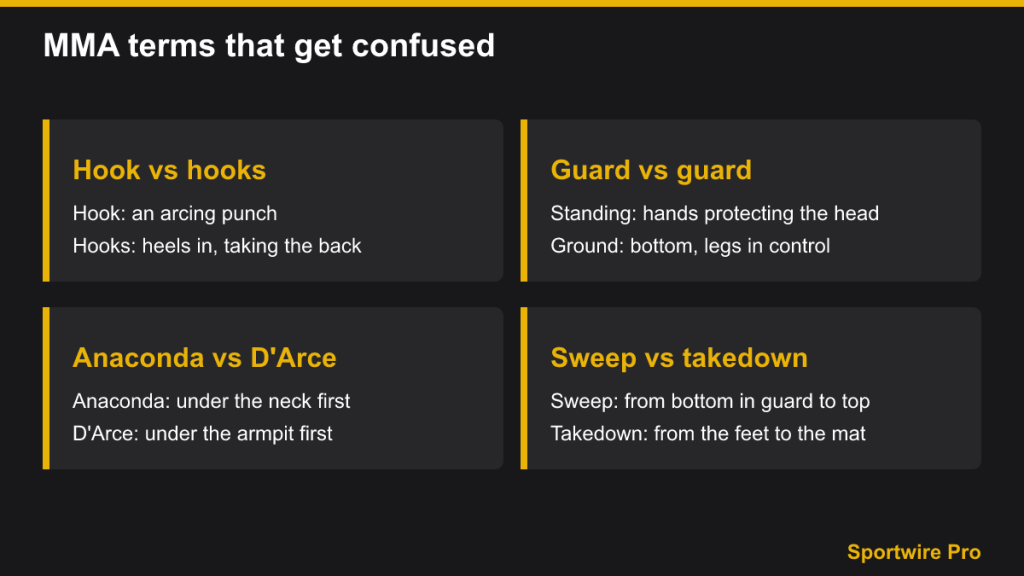
A hook is a punch thrown in an arc. Hooks, plural, in grappling, are the heels inside an opponent’s thighs when taking the back. Context almost always tells you which is meant.
Guard vs guard in striking
On the feet, a fighter’s “guard” is the position of the hands protecting the head. On the ground, “guard” is the bottom position with the legs controlling the opponent. Commentators switch between the two constantly.
Anaconda vs D’Arce
Both are arm-in chokes from the front headlock. The difference is the path of the attacking arm: the anaconda threads under the neck first, the D’Arce under the armpit first. If you can’t tell them apart live, you are in good company.
Sweep vs reversal vs takedown
A takedown starts on the feet and ends on the mat. A sweep starts with the attacker on the bottom in guard and ends with the attacker on top. “Reversal” is the broader word for any change from bottom to top.
Using the Glossary While Watching
The fastest way to learn the language is to connect each word with something you see. A few tips:
- Watch the hips during takedowns. Level changes, shots and sprawls all happen at hip height. Once you see the hips drop, listen for which term the commentator uses.
- Track positions on the ground. Try to name the position every time it changes: closed guard, half guard, side control, mount. You’ll quickly see how fighters climb the positional ladder.
- Listen for the submission setup. Commentators often name a choke or lock while it is being set up, before the finish. Knowing the term helps you see why the defender is reacting a certain way.
- Learn the results vocabulary too. KO, TKO, submission and the different decision types have precise meanings. Our guide to every way a fight can end covers them in detail.