Rounds Explained: How Long Rounds Last in Boxing, MMA and Kickboxing
How long rounds last and how many there are in pro and amateur boxing, women's boxing, MMA, kickboxing and Muay Thai, plus why title fights went from 15 to 12.
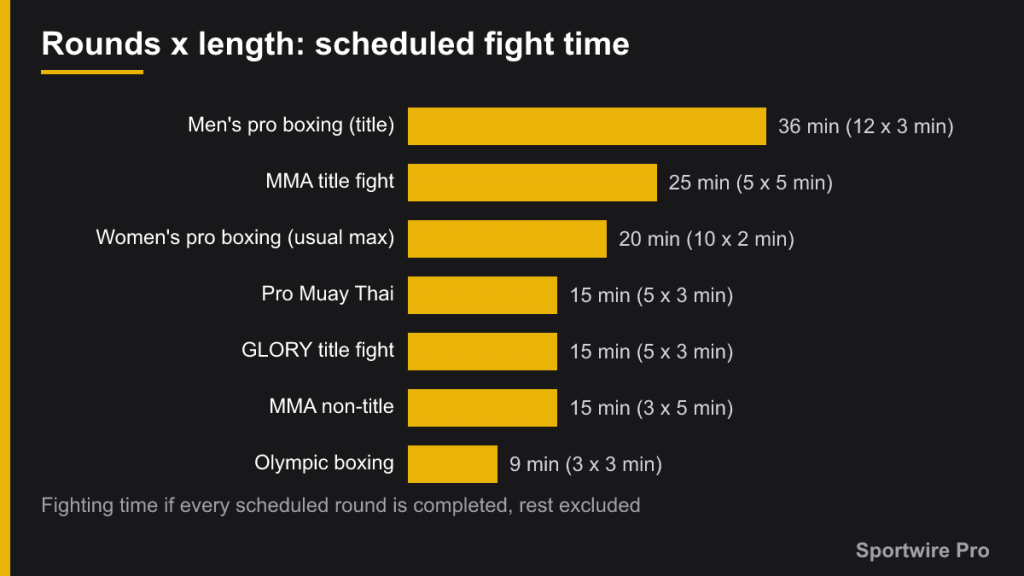
“How many rounds is the fight?” is one of the first questions new fans ask, and the answer depends entirely on the sport, the level and sometimes the gender of the fighters. A world title fight in men’s boxing can last 36 minutes of fighting time. A women’s title bout is shorter. A UFC title fight is 25 minutes, and a GLORY kickboxing title bout is 15. Those differences shape pacing, strategy and even how fighters train.
This guide compares round lengths and round counts across professional and amateur boxing, MMA, kickboxing and Muay Thai, and explains how the formats came about. Rules can vary by commission and organization, so treat these as the standard formats as of 2026 rather than rules that apply to every event everywhere.
Quick comparison
| Format | Round length | Typical rounds | Rest between rounds |
|---|---|---|---|
| Men’s professional boxing | 3 minutes | 4 to 12 (title fights 12) | 1 minute |
| Women’s professional boxing | Usually 2 minutes | Usually up to 10 | Set by commission |
| Olympic / Commonwealth Games boxing | 3 minutes | 3 | 1 minute |
| MMA (Unified Rules) | 5 minutes | 3 (non-title), 5 (title) | 1 minute |
| GLORY kickboxing | 3 minutes | 3 (single match), 5 (title) | 1 minute |
| Professional Muay Thai | 3 minutes | 5 | 2 minutes |
Professional boxing
Round length
Men’s professional boxing uses three-minute rounds with a one-minute rest. That structure goes back to the Queensberry Rules of 1867, which introduced timed three-minute rounds with one-minute breaks. Before that, under the London Prize Ring tradition, there was no fixed round length: a round ended when a fighter went down, and fights could continue until one man could not go on.
Number of rounds
Professional bouts are scheduled for a set number of rounds agreed in advance and approved by the commission. Four-round fights are common for debutants and less experienced fighters. As careers progress, fighters move to six-, eight- and ten-rounders. Most world title fights in men’s boxing are scheduled for twelve rounds. A fighter’s progression through these distances is a rough guide to his experience level, since matchmakers typically move prospects up in distance as they gain experience.
From 15 rounds to 12
For most of the 20th century, fifteen rounds was the standard championship distance. That changed after the November 13, 1982 lightweight title fight between Ray Mancini and Kim Duk-koo in Las Vegas. Mancini won by TKO early in the 14th round, and Kim died five days later from a subdural hematoma.
The World Boxing Council announced at its 1982 convention that it would reduce title fights from fifteen rounds to twelve. The World Boxing Association, which had sanctioned the Mancini-Kim fight, and the International Boxing Federation followed in 1987. The World Boxing Organization, formed in 1988, used twelve-round championship bouts from the start. Other safety measures introduced in the years that followed included more extensive pre-fight medical testing.
The change remains debated. Some historians argue that fifteen-round fights tested conditioning and allowed late comebacks; others point out that the final rounds are when exhausted fighters are most vulnerable. Twelve rounds has been the standard for major world titles for decades and is not expected to change.
Women’s professional boxing
Women’s professional bouts usually consist of two-minute rounds, with a maximum of ten rounds for most fights, compared with twelve three-minute rounds for men. The World Boxing Council has been the most vocal defender of that format. In 2017 its president stated that the WBC would not sanction women’s bouts scheduled for three-minute rounds, and the organization also said it would not sanction women’s bouts scheduled for twelve rounds.
The format is a live debate. Some female champions and promoters have argued for equal round lengths, and some events have staged women’s fights with three-minute rounds under other sanctioning bodies or commissions. Because rules depend on the sanctioning body and the commission, fans should check the scheduled format for a particular fight rather than assume one universal standard.
Amateur and Olympic boxing
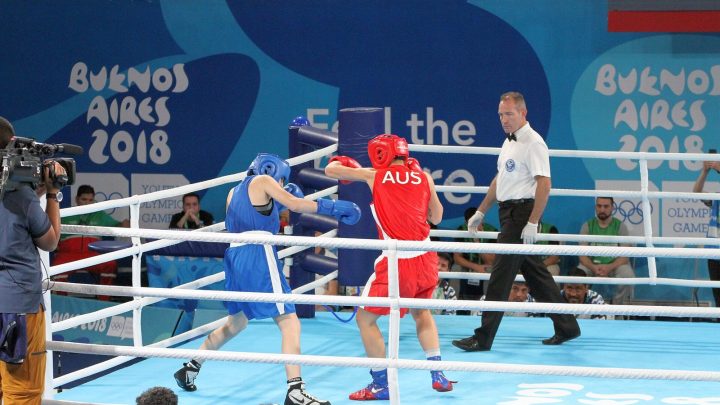
Amateur boxing uses shorter fights. Olympic and Commonwealth Games bouts consist of three rounds of three minutes each with a one-minute interval, and amateur bouts in general are limited to three or four rounds. Shorter fights change strategy: there is little time to “feel out” an opponent, so amateurs tend to start fast and work at a high pace from the opening bell. Youth and novice categories often use shorter rounds still, depending on the national federation.
Amateur and professional boxing differ in other ways too, including scoring, headgear rules and weight classes. We cover those differences in a separate article.
MMA rounds
Under the Unified Rules of Mixed Martial Arts, every round is five minutes long with a one-minute rest between rounds. Non-title fights are normally scheduled for three rounds, although commissions can approve five-round non-title bouts, and championship fights are five rounds. In the UFC, five-round non-title fights are common for main events.
Five-minute rounds are much longer than boxing rounds, and that reflects the sport. Grappling exchanges take time to develop, and a fighter working for a submission or a guard pass needs more than a couple of minutes. The longer rounds also make cardio and pacing a central part of MMA strategy, particularly in five-round fights where the championship rounds (four and five) often decide the result.
Other promotions have used different formats. Under its global rules, ONE Championship uses three five-minute rounds for most bouts and five rounds for world title fights. PRIDE Fighting Championships, the Japanese promotion that operated until 2007, famously used a ten-minute first round followed by two five-minute rounds, with two-minute rest periods. That opening round is one reason PRIDE fights often had a very different rhythm from UFC bouts of the same era.
Because MMA rounds are scored individually under the 10-point must system, round length also affects judging. A long round gives a fighter more time to recover from an early setback and win the round back.
Kickboxing rounds
Kickboxing rules vary by organization, but three-minute rounds are standard. Under GLORY’s official rules (effective March 2026):
- A single match is three rounds of three minutes, and GLORY may approve five-round matches.
- Title matches are five rounds of three minutes, unless the title is contested as part of a tournament, in which case a match may be three rounds.
- Rest periods are one minute.
- If a three-round match is a draw on the scorecards, it goes to a “Sudden Victory” extra round, scored on its own. The rest before extra rounds is one and a half minutes.
- Tournament matches can be two or three rounds of two or three minutes, depending on the format, and an athlete may never fight more than thirteen three-minute rounds in one day.
The short total fight time, nine minutes for a standard bout, is a big reason kickboxing tends to be fast and aggressive from the opening bell.
Muay Thai rounds
According to IFMA, the international federation for amateur Muay Thai, professional Muay Thai matches consist of five rounds of three minutes each, with a two-minute rest between rounds. Amateur bouts may use fewer and shorter rounds.
The five-round structure has a strong influence on pacing in traditional Thai fights. The opening round is often slow, as fighters read each other, and the fight tends to build toward the middle and later rounds. Our article on how Muay Thai is scored explains why early rounds are often quieter and how judges assess the fight as a whole. The pre-fight ritual, the wai kru ram muay, takes place before the first round and is accompanied by traditional live music that speeds up once the fighting begins.
How round length shapes strategy
- Shorter rounds favor pace: two- and three-minute rounds reward fast starts and high output, since there is less time to recover from losing the first exchanges.
- Longer fights reward conditioning: twelve-round boxing and five-round MMA test endurance, and fighters plan how to spend energy.
- Rest periods matter: a two-minute rest, as in Muay Thai, gives more time for recovery and corner advice than a one-minute rest.
- Round-by-round scoring rewards consistency: because each round is scored separately, a fighter who wins many close rounds can beat one who wins a few rounds dramatically.
- The end of the round is a moment: fighters often push in the last seconds of a round to leave a final impression on the judges, and coaches give “ten seconds” signals for that reason.
Common questions
Does the bell save a fighter?
It depends on the rules. In many jurisdictions and organizations, the end of a round does not stop a count in progress, and in some it does. Commission rules vary, so this is one of the details fans should check for a specific event.
Can the number of rounds change during a fight?
Not normally. The scheduled distance is fixed before the fight. The exception is a rule like GLORY’s Sudden Victory round, which adds an extra round only in the event of a drawn decision under specific conditions.
How long does a fight that goes the distance actually take?
Simple arithmetic gives the minimum. A twelve-round men’s boxing match is 36 minutes of fighting plus eleven one-minute rests, so about 47 minutes before any stoppages for fouls or cuts. A five-round MMA title fight is 25 minutes of fighting plus four minutes of rest, about 29 minutes. A three-round GLORY bout is nine minutes of fighting and two minutes of rest. A five-round Muay Thai fight is 15 minutes of fighting plus eight minutes of rest, before counting the wai kru ritual. Broadcast windows are longer because of walkouts, introductions and the reading of the scorecards.
Why do some fights end “between rounds”?
A fighter can retire on his stool, or his corner or the ringside doctor can stop the fight during the rest period. In boxing this is often recorded as a corner retirement (RTD). Our guide to every way a fight can end explains these outcomes.