The History of the UFC: From UFC 1 to a Global Sport
How the UFC went from a one-night 1993 tournament in Denver to a global sport: the no-rules era, the backlash, Zuffa, The Ultimate Fighter and new owners.
The Ultimate Fighting Championship started as a single pay-per-view experiment: put fighters from different martial arts in a cage and see which style worked best. Three decades later it is the world’s dominant MMA promotion, with weight classes, sanctioned rules, ranked divisions and a multibillion-dollar media business. The road between those two points includes a near-death experience, a political campaign against the sport, a rescue purchase and a television gamble that paid off.
This is the story of how it happened, from UFC 1 to the TKO era.
UFC 1: Style Against Style (1993)
UFC 1 took place on November 12, 1993, at McNichols Sports Arena in Denver, Colorado. It was created by Art Davie, Rorion Gracie and John Milius, and backed by Semaphore Entertainment Group (SEG), a company with experience in pay-per-view television.
The concept was an eight-man, one-night tournament. Each fighter represented a discipline:
- Royce Gracie, Brazilian jiu-jitsu
- Gerard Gordeau, savate
- Ken Shamrock, shootfighting
- Kevin Rosier, kickboxing
- Art Jimmerson, boxing
- Teila Tuli, sumo
- Zane Frazier, kenpo
- Patrick Smith, taekwondo
There were no weight classes and no judges. Fights ended by knockout, submission or the corner throwing in the towel. Biting, eye-gouging and groin strikes were banned, but enforced only by fines. Gloves were optional; Jimmerson famously fought Gracie wearing a single boxing glove.
The night opened with Gordeau knocking out Tuli with a head kick in 26 seconds. But the lasting story was Royce Gracie, a slim fighter who won three bouts in one night, finishing Jimmerson, then Shamrock with a rear-naked choke, and Gordeau with another rear-naked choke in the final. For many viewers it was the first time they had seen how a skilled grappler could neutralize bigger, more aggressive strikers. Attendance was about 7,800, and the event drew roughly 86,000 pay-per-view buys.
The “No Rules” Era and the Backlash (1993–2000)
SEG marketed the UFC with the tagline “There are no rules.” That wasn’t strictly true, but the image stuck, and it brought both an audience and enemies.
In 1996, Senator John McCain called the UFC “human cockfighting” and wrote to all 50 state governors urging them to ban it. Many states passed bans on “no-holds-barred” events, and major cable providers dropped UFC pay-per-views. New York’s ban forced UFC 12 to relocate to Dothan, Alabama, at short notice. Without cable distribution, revenue collapsed.
The response, ironically, laid the groundwork for modern MMA. To win over regulators, the UFC began adding rules:
- UFC 12 (1997) introduced weight divisions, initially heavyweight and lightweight.
- UFC 14 made gloves mandatory.
- UFC 21 introduced five-minute rounds.
In 2000, New Jersey’s athletic control board helped develop rules for sanctioned MMA, which grew into the Unified Rules covered in our guide to the Unified Rules of MMA. The first sanctioned US MMA event took place on September 30, 2000, and the UFC’s first sanctioned show, UFC 28, followed in New Jersey about two months later. By then, though, SEG was close to bankruptcy.
The Zuffa Purchase (2001)
In January 2001, casino executives Frank and Lorenzo Fertitta bought the UFC from SEG for $2 million, forming a company called Zuffa, LLC. Dana White, who had managed fighters and knew the Fertittas, became president.
Zuffa’s strategy was to make the UFC a legitimate, regulated sport that could return to mainstream distribution. Nevada sanctioning came in 2001, which opened up Las Vegas, and the promotion leaned into the Unified Rules, weight classes and athletic commission oversight that SEG had started building.
The early Zuffa years were not profitable. The Fertittas invested heavily, and the promotion still struggled to break through beyond a core audience. The solution came from reality television.
The Ultimate Fighter and the Breakthrough (2005–2010)
The Ultimate Fighter, a reality series in which aspiring fighters lived together, trained in teams and fought for a UFC contract, premiered on Spike TV in January 2005. The season one finale between Forrest Griffin and Stephan Bonnar became one of the most important fights in the company’s history. The bout drew a 1.9 overall rating, and Dana White has credited the show with saving the UFC.
The years that followed were the UFC’s boom:
- Consolidation: Zuffa bought World Extreme Cagefighting (WEC) and the World Fighting Alliance in December 2006. In March 2007, the Fertittas agreed to buy the PRIDE brand, Japan’s biggest MMA promotion, bringing many of its stars into the UFC orbit.
- Lighter divisions: WEC’s featherweight and bantamweight fighters were merged into the UFC after the merger was announced in October 2010; WEC’s final card was in December 2010. That expanded the UFC’s divisions downward.
- Stars and pay-per-view: bigger venues, more international events and a growing roster of recognizable champions turned numbered events into major pay-per-view attractions. Our guide to how the UFC works explains the difference between numbered events and Fight Nights.
Going Mainstream (2011–2015)
On August 18, 2011, the UFC announced a broadcast deal with Fox. The first event on network television, UFC on Fox: Velasquez vs. dos Santos on November 12, 2011, averaged 5.7 million viewers, with a peak of 8.8 million. Network exposure brought the sport to audiences that had never ordered a pay-per-view.
In March 2011, Dana White announced the purchase of Strikeforce, the most significant remaining US rival; its final show was in January 2013. With Strikeforce came a key change: on November 16, 2012, White confirmed that the UFC would add women’s MMA, with Ronda Rousey signed as the first female UFC champion. In December 2013, the UFC bought the contracts of 11 female fighters from Invicta FC to launch a women’s strawweight division. Women’s divisions are now a permanent part of the promotion, as our guide to UFC weight classes shows.
The Ultimate Fighter moved from Spike to FX in 2012, and the UFC continued expanding its event calendar, its international reach and its digital distribution.
New Owners: WME-IMG, Endeavor and TKO (2016–present)
The 2016 sale
On July 11, 2016, the UFC announced that Zuffa had been sold to a group led by WME-IMG, the talent and media company later renamed Endeavor. The price was reported at roughly $4 billion; Wikipedia’s coverage cites figures of $4.025 billion and $4.2 billion. It was, at the time, one of the largest sales of a sports property, and a remarkable return on the $2 million the Fertittas had paid in 2001.
Endeavor takes full control
After Endeavor went public in April 2021, it used part of the proceeds to buy out Zuffa’s other shareholders at a value of $1.7 billion, giving it full ownership of the UFC.
The TKO merger
In April 2023, Endeavor announced a merger of the UFC with WWE, the professional wrestling company, under a new publicly traded company, TKO Group Holdings. The merger was completed on September 12, 2023. Dana White remained the face of the UFC’s leadership.
The end of pay-per-view
In 2025, the UFC signed a seven-year media deal with Paramount Skydance, reported at $7.7 billion, starting the following year. The deal ended the UFC’s traditional pay-per-view model, which had defined the business since the SEG era. As of 2026, numbered events are distributed as part of that deal rather than sold one by one.
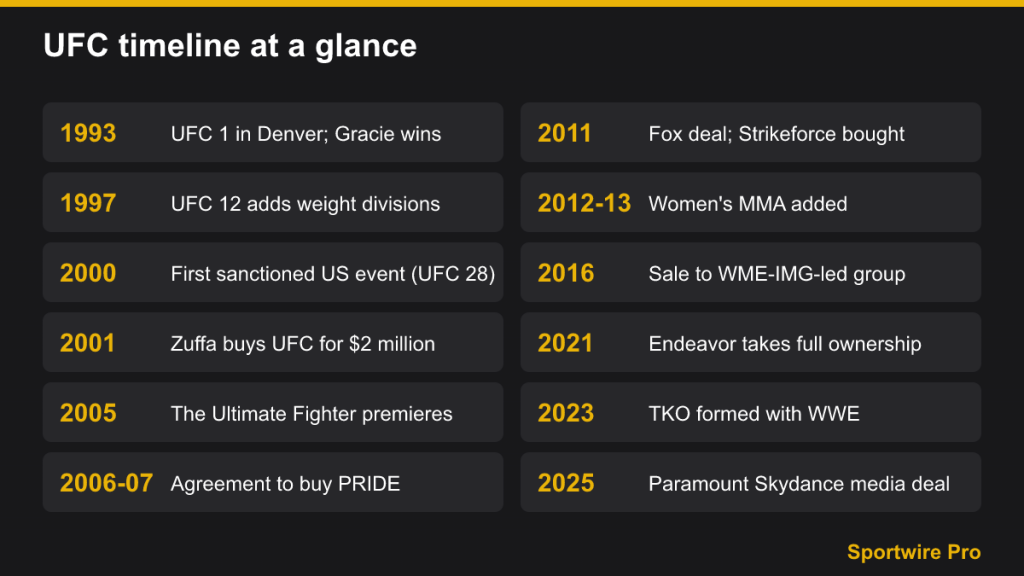
UFC Timeline at a Glance
| Year | Milestone |
|---|---|
| 1993 | UFC 1 in Denver; Royce Gracie wins the eight-man tournament |
| 1996 | Senator John McCain’s “human cockfighting” campaign; state bans and cable losses follow |
| 1997 | UFC 12 introduces weight divisions |
| 2000 | First sanctioned US MMA event; UFC 28 held under New Jersey’s rules |
| 2001 | Zuffa buys the UFC for $2 million; Dana White becomes president |
| 2005 | The Ultimate Fighter premieres on Spike TV |
| 2006–2007 | Zuffa acquires WEC and the WFA, then agrees to buy PRIDE |
| 2011 | Fox broadcast deal; Strikeforce purchased |
| 2012–2013 | Women’s MMA added; strawweight division launched with Invicta FC signings |
| 2016 | Sale to a WME-IMG-led group |
| 2021 | Endeavor takes full ownership |
| 2023 | TKO Group Holdings formed with WWE |
| 2025 | Seven-year Paramount Skydance media deal signed, ending the pay-per-view model |
Why the UFC’s History Matters
Several threads run through the whole story:
- Rules made the sport possible. The early “no rules” image brought attention but nearly killed the company. Weight classes, gloves, rounds and commission oversight turned a spectacle into a sport that regulators could approve.
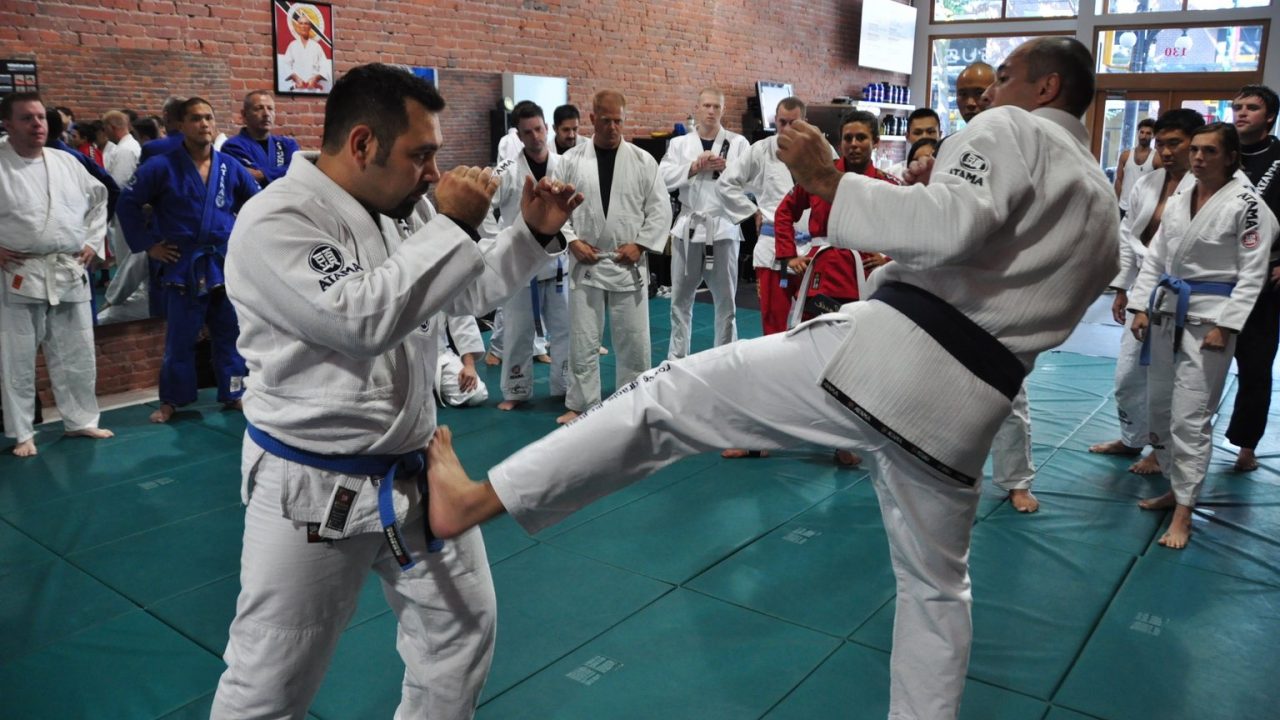
- Grappling changed martial arts. Royce Gracie’s wins at UFC 1 showed how effective submission grappling could be against untrained opponents. Today’s fighters train striking, wrestling and jiu-jitsu together precisely because the early UFC showed that one style was not enough.
- Television decided the business. Cable bans nearly ended the UFC; The Ultimate Fighter, network television and later streaming deals built it.
- Consolidation shaped the sport. Buying WEC, PRIDE and Strikeforce brought talent and divisions under one roof and made the UFC the place where the best fighters are generally measured.
Quick Answers
Who won UFC 1?
Royce Gracie, who won three fights in one night, beating Gerard Gordeau by rear-naked choke in the final.
Why did US states ban the early UFC?
Politicians and regulators saw it as a brutal spectacle. Senator John McCain’s 1996 “human cockfighting” campaign led many states to ban no-holds-barred events and cable providers to drop the broadcasts.
When did the UFC get weight classes?
UFC 12 in 1997 introduced the first weight divisions.
Who owns the UFC now?
As of 2026, the UFC is part of TKO Group Holdings, formed in 2023 when Endeavor merged the UFC with WWE.