How MMA Fights Are Judged: Effective Striking, Grappling and Control
How MMA judges score rounds: effective striking and grappling first, then aggressiveness and area control, what earns a 10-8, and why decisions spark arguments.

Most MMA fights that reach the final bell are decided by three people sitting cageside. Their scorecards can feel mysterious, especially when the crowd boos the result. But MMA judging follows a written framework published by the Association of Boxing Commissions and Combative Sports (ABC), the body that coordinates the Unified Rules of MMA used by commissions across North America. Once you know that framework, most decisions make sense, and the controversial ones become easier to understand.
This article focuses on how MMA rounds are judged under the Unified Rules. MMA uses the same 10-point must system as boxing; if you want the basic mechanics of 10-9 and 10-8 rounds, start with our explainer on how boxing scoring works. Here we cover what is different about MMA: how striking and grappling are weighed together, the order of the criteria, what a 10-8 requires, and why judges and fans so often disagree.
The basic structure
According to the ABC’s MMA judging criteria clarification (2025), all bouts are scored by at least three judges, and each judge scores every round individually in favor of the “more effective” MMA fighter. Rounds in Unified Rules bouts are five minutes long, with non-title fights usually scheduled for three rounds and title fights for five.
Under the 10-point must system, the winner of each round receives 10 points and the loser nine or fewer. At the end of the fight, each judge’s round scores are added up, and the fighter ahead on a majority of the cards wins. That is where unanimous decisions (all three judges agree), split decisions (two judges for one fighter, one for the other) and majority decisions (two judges for one fighter, one scoring a draw) come from.
Two important principles shape everything else:
- Each round stands alone. A judge does not carry over an impression from earlier rounds when scoring the current one.
- Defense is not scored. The ABC states plainly that only offensive actions are scored. Defense allows a fighter to continue; it does not win rounds by itself.
The criteria and their order
The ABC framework lists the judging criteria in priority order. Judges move to a lower criterion only when they cannot separate the fighters on the higher one.
1. Effective striking and effective grappling
This is the main criterion, and the ABC says it will decide the vast majority of rounds.
- Successful striking is defined as legal strikes that result in damage.
- Successful grappling is the execution of grappling skills proven productive by the damage resulting from takedowns, reversals, submission attempts and achieving advantageous positions.
The two are explicitly equal. A fighter who takes his opponent down and lands heavy ground strikes is not penalized because the action happened on the mat, and a fighter who lands harder strikes on the feet is not penalized because he did no wrestling. What matters in both cases is the result.
2. Aggressiveness
If a judge “absolutely cannot determine even a marginal advantage” in striking or grappling, he may look at aggressiveness, defined as consistent offensive effort. This is a tiebreaker, not a primary factor. Walking forward without landing does not, by itself, win a round when the other fighter is landing more effectively.
3. Fighting area control
Also a fallback, fighting area control means dictating the pace, place and position of the bout: who decides whether the fight is at range, against the fence or on the mat. The current ABC guidance says judges should defer to aggressiveness or area control, whichever had the more significant impact, only when striking and grappling cannot separate the fighters.
Older versions of the guidance described the three criteria as a strict ladder in which aggressiveness was considered only if striking and grappling were completely equal, and area control only if both higher criteria were equal. The principle is the same: results first, activity and positioning only as tiebreakers.
Damage, dominance and duration
The ABC uses three linked concepts to measure how effective a fighter was in a round. These ideas are often called “the three Ds.”
- Damage: legal techniques whose results lessen an opponent’s capacity or will to compete. The ABC lists knockdowns, heavy or concussive strikes, strikes that force the opponent to retreat or go purely defensive, strikes or grappling that cause visible injury such as swelling or cuts, submission attempts that hyperextend joints or cause rotational damage, and chokes that cause visible distress. Damage is the most highly valued component because it is a result rather than an action, and immediate damage is given priority over cumulative damage within a round.
- Dominance: sustained supremacy of position, action or volume. Examples include forcing the opponent to defend constantly with no counters, or taking a dominant grappling position and continually threatening fight-ending attacks from it. The guidance adds an important note: merely holding a dominant position is not considered demonstrating dominance.
- Duration: how much of the round one fighter spent imposing effective technique, establishing dominance or causing damage.
When a round is 10-10, 10-9, 10-8 or 10-7
The ABC’s current guidance defines each score:
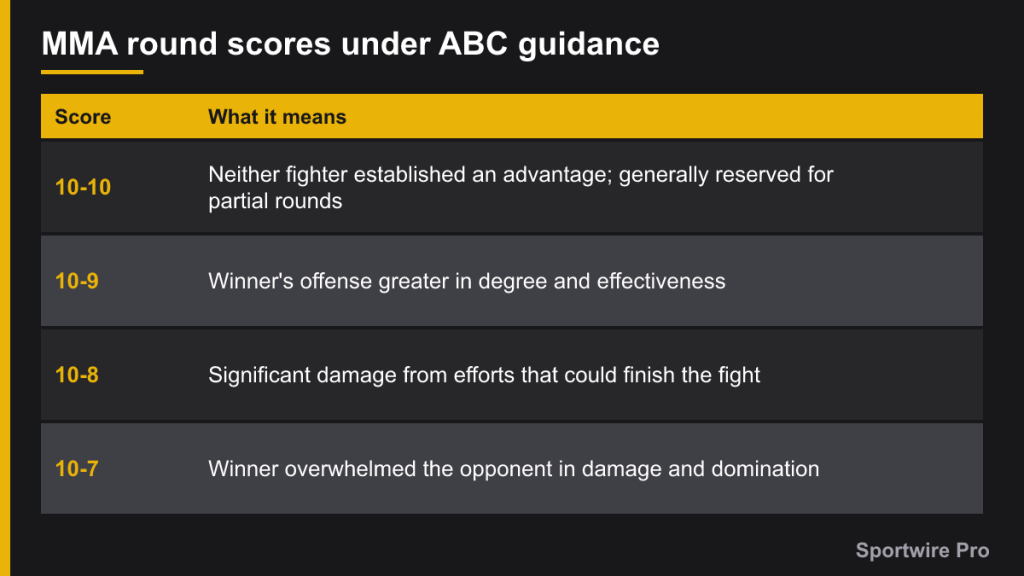
| Score | What it means under ABC guidance |
|---|---|
| 10-10 | Neither fighter established an advantage. Generally reserved for partial rounds; scoring a completed round 10-10 is described as a failure to adjudicate. |
| 10-9 | One fighter won the round with offensive actions greater in degree and effectiveness. Only if no advantage can be found may aggressiveness or area control decide it. |
| 10-8 | The winner’s offense must include significant damage from efforts that could, by their nature, finish the fight. Dominance with duration may also be present. |
| 10-7 | The winner overwhelmed the opponent in both damage and domination throughout the round. |
The guidance adds detail on the 10-8:
- Significant damage is enough by itself to award a 10-8.
- Cumulative damage can count as significant damage when the losing fighter loses energy, confidence, stamina or spirit.
- Significant domination along with some damage, with little or no offense from the losing fighter, may be enough.
- Significant domination such as positional control without damage is not enough.
How the “2017 criteria” changed MMA scoring
For years, many observers complained that MMA judges almost never gave 10-8 rounds unless there was a near stoppage, which meant a fighter who lost one round badly and won two narrowly could still lose the fight. In 2016 the ABC’s rules committee proposed rewritten judging criteria, and the changes were approved at the ABC’s annual meeting that summer. They are widely referred to as the 2017 criteria because commissions applied them from that year onward.
The revision focused judges on the result of actions rather than the actions themselves and greatly expanded the guidance on 10-8 rounds. Judges were told to assess damage (described as “impact” in the version adopted, after some commissions objected to the word “damage”), dominance and duration. Under that version, if two of the three were present, a 10-8 should be considered, and if all three were present, a 10-8 should be awarded. Because the ABC has no direct legal authority, each state or provincial commission decided for itself whether to adopt the changes.
The current ABC clarification (2025) puts even more emphasis on damage: significant damage alone can justify a 10-8, while control without damage cannot. The direction of travel since 2016 has been consistent: judges are asked to reward what actually hurts or threatens to finish an opponent.
How grappling is weighed in practice
Grappling rounds cause more confusion than striking rounds, so it helps to picture a few scenarios under the current guidance.
- A takedown and nothing else: a fighter takes his opponent down and holds him there without strikes or submission attempts. That is an advantageous position, but the guidance says merely holding position is not dominance, and if the other fighter landed damaging strikes earlier in the round, the striker may win it.
- Top control with ground and pound: a fighter takes the opponent down and lands repeated hard strikes that cause swelling and force the bottom fighter to cover up. That is damage and dominance, and depending on degree it could be a 10-9 or even a 10-8.
- A deep submission attempt: an armbar that hyperextends the elbow, or a choke that causes visible distress, counts as damage even if the opponent escapes.
- Active guard: a fighter on his back who is attacking submissions and landing elbows can win a round despite being underneath.
Our explainer on wrestling in MMA covers the takedowns and control positions involved.
Why controversial decisions happen
Even with written criteria, judging is a human judgment of a chaotic event. Common reasons for disputes include:
- Close rounds: when both fighters land similar damage, small differences decide the round, and reasonable judges can see them differently.
- Different viewing angles: judges sit at different points around the cage. A strike that looks clean from one side can look blocked from another, and the broadcast camera sees something different again.
- Volume versus impact: fans often count strikes, but the criteria ask judges to weigh effect. A few heavy shots can outweigh many light ones.
- Grappling literacy: a judge who does not recognize a dangerous submission attempt or a meaningful guard pass may undervalue it.
- Crowd influence and narrative: a loud reaction to a big but ineffective technique can create an impression that does not match the result.
- Round-by-round scoring: a fighter can win more total damage over the fight and still lose on the cards if he lost more individual rounds narrowly. This is a feature of the system, not a mistake by the judges.
- Jurisdictional differences: commissions adopt rules separately, and the training and assessment of judges varies from place to place.
Point deductions also matter. The ABC guidance states that penalties assessed by the referee are deducted from the judges’ scorecards in that round, so a foul can turn a 10-9 round into a 9-9 round and change the outcome.
Technical decisions and partial rounds
When a fight is stopped because of an accidental foul after enough of the fight has been completed, it can go to the scorecards as a technical decision. Under the ABC guidance, if the majority of rounds are completed and the fight becomes a technical decision, the judges must score the incomplete round as well. This is where 10-10 scores are most likely to appear, since a partial round may be too short for either fighter to establish an advantage.
A quick checklist for scoring at home
- Who did more damage this round? Look for knockdowns, hurt reactions, swelling and dangerous submission attempts.
- Was one fighter dominant for a sustained period, forcing the other to defend without answering?
- How much of the round did that dominance or damage last?
- If you genuinely cannot separate them, who was more consistently offensive, and who controlled where the fight happened?
- Did the referee take a point?
Score each round on its own, write it down, and compare your card with the official result. You will often find the “robbery” was a close fight that could have gone either way, and occasionally you will find a decision that really was hard to justify under the criteria.