Illegal Moves: Fouls in Boxing and MMA and How They’re Penalized
The common fouls in boxing and MMA, from low blows and headbutts to eye pokes and illegal knees, and how warnings, deductions, recovery time and DQs work.
Combat sports are controlled violence, and the word that matters is “controlled.” Every rule set draws lines around which strikes and holds are allowed, where they can land and when. Cross one of those lines and you commit a foul. Some fouls are minor and draw a quiet warning; others can cost a fighter points, the fight, or a license.
This guide covers the most common fouls in professional boxing and in MMA under the Unified Rules used by US athletic commissions, and explains how referees and judges deal with them. Rules are adopted state by state, and other promotions and countries use their own variations, so treat this as the standard picture rather than the law everywhere.
Common Fouls in Boxing
Boxing’s rule set is narrow by design: you may strike only with the knuckle part of a closed glove, only to the front and sides of the head and body above the belt line. Most fouls follow from that principle.
- Low blows: punches that land below the belt line, the most frequently called foul in the sport.
- Headbutts: leading with the head or driving it into an opponent. Clashes of heads in close quarters are often ruled accidental, which matters for the outcome if a cut results.
- Rabbit punches: blows to the back of the head or neck, typically thrown when an opponent ducks low or turns away.
- Kidney punches: blows to the back, around the kidneys.
- Holding and hitting: grabbing an opponent with one arm while punching with the other, or excessive clinching to smother action.
- Hitting on the break or after the bell: continuing to punch after the referee has ordered “break” or after a round has ended.
- Using the elbow, forearm or shoulder: pushing with the forearm, elbowing, or shouldering an opponent.
- Thumbing and open-glove strikes: striking with the thumb or laces, or slapping with the inside of the glove.
- Hitting a downed opponent: once a boxer is down, the opponent must go to a neutral corner.
- Spitting out the mouthpiece deliberately: the ABC Unified Rules say points may be deducted if the referee believes the mouthpiece is being purposely spat out.
How Boxing Fouls Are Penalized
For most fouls, referees follow an escalating approach: a general caution, then a hard warning that the next violation will cost a point, then a point deduction, and finally disqualification for repeated or flagrant fouling. Referees have discretion, and a deliberate, dangerous foul can draw an immediate deduction or disqualification.
The ABC’s Unified Rules of Boxing set out what happens when a foul causes an injury, and they draw a clear distinction between intentional and accidental fouls.
Intentional fouls
- If an intentional foul causes an injury severe enough to end the bout immediately, the boxer who fouled loses by disqualification.
- If the injured boxer can continue, the referee must deduct two points from the boxer who fouled. Under the ABC text, point deductions for intentional fouls are mandatory.
- If that injury later forces a stoppage after the fourth round, the injured boxer wins by technical decision if ahead on the scorecards; if behind or even, the result is a technical draw.
- A boxer who hurts himself while trying to foul gets no help from the rules: the injury is treated as though it came from a fair blow.
Accidental fouls
- If an accidental foul (an accidental headbutt is the classic case) causes an injury severe enough to stop the bout before four rounds are complete, the result is a no decision.
- If the stoppage comes after four completed rounds, the bout goes to the scorecards as a technical decision, with partial rounds scored.
Low blows and recovery time
Low blows get special treatment. Under the ABC rules, a boxer hit with an accidental low blow must continue after a reasonable amount of time but no more than five minutes, or he or she will lose the fight. Referees use that time to let the fighter recover, and they may still deduct a point from the offender if the low blows are repeated.
For more on how stoppages and technical results are recorded, see every way a fight can end.
Common Fouls in MMA Under the Unified Rules
MMA allows far more techniques than boxing, so its foul list is longer and more specific. The Unified Rules of Mixed Martial Arts, maintained by the Association of Boxing Commissions, list fouls that include:
- Headbutting
- Eye gouging of any kind, and pointing outstretched fingers toward an opponent’s face or eyes
- Biting or spitting at an opponent
- Hair pulling and fish-hooking
- Groin attacks of any kind
- Putting a finger into any orifice or into a cut or laceration
- Small joint manipulation, such as bending individual fingers or toes
- Strikes to the spine or the back of the head
- Throat strikes of any kind, including grabbing the trachea
- Clawing, pinching or twisting the flesh
- Grabbing the fence, or holding an opponent’s shorts or gloves
- Kicking or kneeing the head of a grounded opponent
- Stomping a grounded opponent
- Spiking an opponent onto the head or neck
- Throwing an opponent out of the cage or ring
- Attacking during a break, after the bell, or while the opponent is under the referee’s care
- Timidity, such as avoiding contact, repeatedly dropping the mouthpiece or faking an injury
- Abusive language, unsportsmanlike conduct, flagrant disregard of the referee’s instructions, and interference by the corner
If you are newer to the sport, our overview of the Unified Rules of MMA explains the round structure, attire and legal techniques around this list.
The 12-6 Elbow and the “Grounded” Rule
Two of MMA’s most discussed rules changed in 2024.
12-6 elbows
For years, the Unified Rules banned the “12-6” elbow, a straight downward elbow strike named for the path of a clock hand from 12 to 6. Many fans and fighters considered the ban illogical, since other elbows were legal. At its annual conference in July 2024, the ABC voted to remove the 12-6 elbow from the list of fouls. The change was set to take effect on November 1, 2024, pending approval by local commissions, because ABC approval does not bind anyone automatically: each state commission or regulator must adopt the updated rules itself. The UFC applied the new rule from its Fight Night event on November 2, 2024. As of 2026, fans should assume 12-6 elbows are legal in jurisdictions that have adopted the revision, but the local rules for a specific event still govern.
Who counts as a grounded fighter
The same 2024 revision redefined a “grounded” fighter, which matters because kicks and knees to the head of a grounded opponent remain illegal. Under the revised wording, a fighter is grounded when any part of the body other than the hands or feet is touching the canvas. The older rule let fighters avoid being “grounded” by placing a hand flat on the mat, which let a crouching fighter dodge knees to the head simply by touching the canvas. The new definition removes that loophole: a fighter with only hands and feet down can now be kneed in the head; one with a knee down cannot.
How MMA Fouls Are Penalized
The referee is the sole judge of whether a foul occurred and how serious it was. A typical sequence is a warning for a first minor foul, then a point deduction for a repeat; flagrant or dangerous fouls can draw an immediate deduction or disqualification. Under the Unified Rules, deductions are usually one point per offense, though the referee may take more.
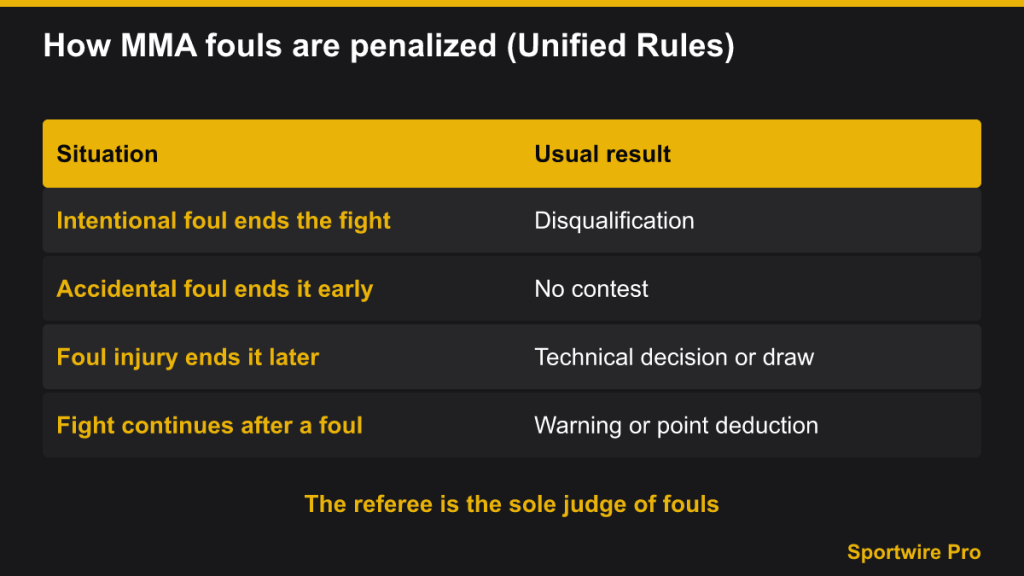
When a foul causes an injury, the result depends on whether it was intentional and on when it happened:
| Situation | Usual result under the Unified Rules |
|---|---|
| Intentional foul that ends the fight | Disqualification of the fouling fighter |
| Accidental foul that ends the fight early | No contest |
| Foul injury that ends the fight later in the bout | Technical decision to the injured fighter if ahead on the cards; otherwise a technical draw |
| Fight continues after a foul | Warning or point deduction at the referee’s discretion |
For an accidental groin strike or eye poke, the referee pauses the action and allows the fouled fighter time to recover before restarting, often after a ringside doctor checks an eye injury. If the fighter cannot continue, the timing and nature of the foul decide whether the bout is a no contest or goes to the scorecards.
Gray Areas Referees Have to Judge
Many controversies come from situations where the rules are clear on paper but hard to apply in real time:
- Fence grabbing vs touching: fighters may put a hand on the fence; holding it, or curling fingers through it to stop a takedown, is the foul. Referees often give a warning first.
- Back of the head: in a scramble, a punch aimed at the side of the head can land behind the ear. Referees look at whether the strike was deliberate and repeated.
- Accidental clash of heads: in both sports, a head clash that opens a cut is usually ruled accidental, and the decision then rests on the four-round line in boxing or the timing rules in MMA.
- Low kicks and groin strikes: in MMA, a leg kick that slides up into the groin is a foul even if unintentional. Repeated accidental fouls can still cost points.
- Eye pokes from open hands: MMA gloves leave fingers free, and extended fingers while pawing at range are a common cause of eye pokes. Referees increasingly warn fighters for open hands before any contact is made.
Why Fouls Matter for Fans and Fighters
Fouls affect more than a single round. A one-point deduction can swing a close fight: on a scorecard where a fighter wins a round 10-9, a deduction makes it 9-9, effectively erasing the round. In a 12-round boxing match or a three-round MMA fight decided by a single round, that can change the winner.
Fouls also explain some confusing results. A fight that ends after a nasty cut might be a TKO win, a technical decision, a technical draw or a no contest depending on whether the cut came from a punch or a headbutt, whether the foul was intentional and how many rounds had been completed. When the official result seems odd, the foul rules usually explain it.
Finally, intentional and repeated fouling can lead to consequences beyond the fight itself, including fines, withheld purses or suspensions imposed by the commission.
Quick Answers
Can you win a fight because your opponent fouled?
Yes. A disqualification win is possible in both boxing and MMA when an intentional foul ends the fight, or when the referee decides repeated fouls warrant it.
Is a knee to the head always illegal on the ground in MMA?
Under the Unified Rules, kicks and knees to the head of a grounded opponent are fouls. Some promotions outside US commission rules, such as ONE Championship’s global rule set, allow knees to the head of a grounded opponent.
Who decides whether a foul was intentional?
The referee. Some commissions allow instant replay review in specific situations, but the call on the night is the referee’s.