How Pro Boxing Works Behind the Scenes: Promoters, Managers and Commissions
Who actually makes a pro boxing fight happen: promoters, managers, matchmakers, commissions, purse bids and the federal Muhammad Ali Boxing Reform Act.

When two boxers touch gloves in the center of the ring, months of negotiation, paperwork and regulation sit behind that moment. Unlike most major sports, professional boxing has no single league office that schedules games and sets the calendar. Instead, every fight is assembled almost from scratch by a loose network of promoters, managers, broadcasters, sanctioning bodies and government regulators, each with different incentives.
That structure explains a lot of what frustrates fans: big fights that take years to make, champions who seem to avoid certain opponents, and belts that change hands outside the ring. This article walks through who does what, how a fight actually gets made, how purse bids work in general terms, and what the federal Muhammad Ali Boxing Reform Act was designed to fix.
The People Around a Professional Boxer
The promoter
The promoter is the business engine of a fight. Promoters organize events: they book venues, sign fighters to promotional agreements, negotiate with broadcasters and streaming platforms, sell tickets and sponsorships, and pay the purses. A promoter with a deep roster of fighters can build entire cards in-house, which is one reason the biggest promotional companies carry so much weight. Promoters take on financial risk, since they guarantee purses before they know how many tickets or subscriptions an event will sell.
The manager
The manager works for the boxer, not the event. In principle, a manager’s job is to guide the fighter’s career: choosing the right promoter, negotiating purses and contract terms, deciding when to step up in competition, and protecting the fighter’s long-term interests. Managers are usually paid a percentage of the fighter’s earnings, and in many states managers must be licensed by the commission. Because the promoter wants to pay as little as possible and the manager wants the boxer paid as much as possible, the two roles are supposed to be on opposite sides of the table.
The matchmaker
Matchmakers, usually employed by the promoter, decide who fights whom on a card. A good matchmaker builds a prospect’s record with opponents who offer the right kind of test at the right time, creates competitive fights that please audiences, and fills undercards with bouts that fit the event’s budget and broadcast window. Matchmaking is part art and part risk management; a prospect matched too hard too soon can be derailed, while one matched too softly may never learn what he needs to learn.
Trainers and cutmen
The trainer, or head coach, prepares the fighter technically and physically and runs the corner on fight night. Assistant trainers, strength coaches and nutritionists often support the camp. The cutman is a specialist who treats swelling and cuts between rounds, wraps the fighter’s hands before the bout, and handles the ice, swabs and approved coagulants that can keep a fight from being stopped on a cut. A skilled cutman can be the difference between a fighter continuing and a referee or doctor ending the bout.
Athletic Commissions: The Regulators
In the United States, professional boxing is regulated at the state level (and in some cases by tribal commissions). Athletic commissions license boxers, referees, judges, seconds, promoters and managers; require medical examinations; approve bouts and official weights; assign officials; supervise hand wraps and gloves; and hold purses or impose suspensions when rules are broken. Commissions also issue medical suspensions after knockouts or serious injuries, which other states are expected to honor.
The Association of Boxing Commissions (ABC) is the umbrella body that coordinates the state commissions and publishes model rules. Its Unified Rules of Boxing set out standards such as three-minute rounds with one-minute rests, three judges using the 10-point must system, a mandatory eight count after knockdowns, and procedures for intentional and accidental fouls. Each commission adopts or adapts these rules, so details can vary from one state to another. Outside the US, national boxing boards perform a similar role, such as the British Boxing Board of Control in the UK.
Commissions are distinct from sanctioning bodies. A commission decides whether a fight can legally take place; a sanctioning body decides whether its title is on the line. Our explainer on the WBA, WBC, IBF and WBO covers that second layer in detail.
How a Fight Gets Made
Most professional fights come together through negotiation rather than a fixed schedule. A simplified version looks like this:
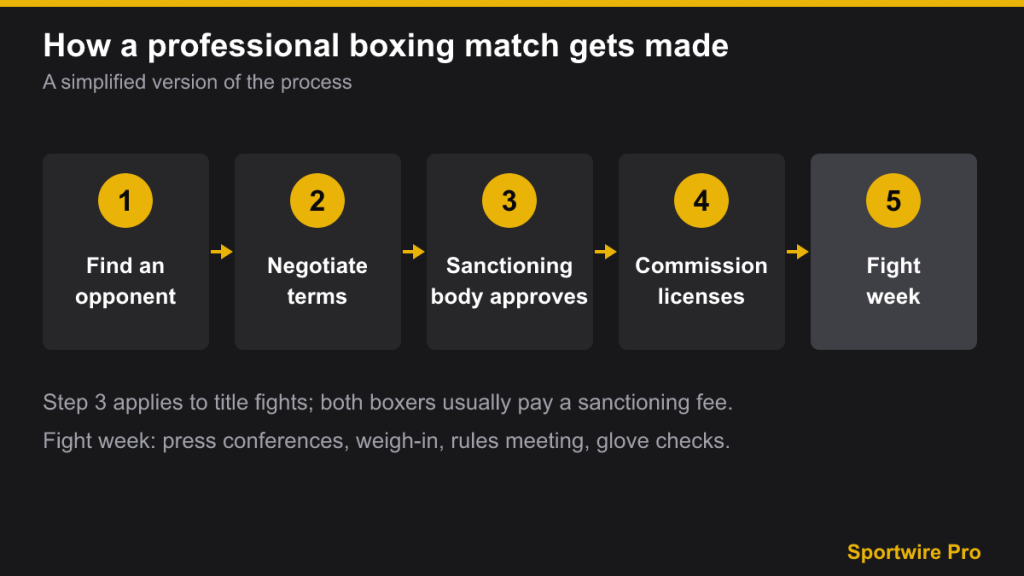
- Someone identifies an opponent. A promoter or matchmaker proposes a matchup that fits the fighter’s career stage, the event’s budget and the broadcaster’s interest.
- The sides negotiate terms. Purses, weight limit, glove brand, date, venue, rehydration clauses, rematch clauses and broadcast obligations are all on the table. In big fights, the split of revenue can take longer to settle than any other detail.
- The sanctioning body approves a title fight. If a belt is involved, the sanctioning body must approve the bout, and both boxers typically pay a sanctioning fee calculated as a percentage of their purses.
- The commission licenses and approves. The state commission checks licenses, medicals and contracts before approving the bout.
- Fight week happens. Press conferences, the official weigh-in, rules meetings and glove checks lead into fight night, where the commission’s officials take charge.
When fighters are with different promoters, or on different broadcast platforms, a “cross-promotional” deal is needed, and that is where many anticipated fights stall. Each side wants its broadcaster, its share of revenue and, often, a rematch clause in its favor.
Mandatory Challengers and Purse Bids
Sanctioning bodies do not let champions pick opponents forever. Each organization requires its champions to face a designated mandatory challenger within a set period. When the champion’s team and the challenger’s team cannot agree terms, the sanctioning body can order a purse bid.
A purse bid is essentially an auction for the right to promote the fight. Registered promoters submit sealed bids, the highest bid wins promotional rights, and the total purse is split between the boxers according to the sanctioning body’s rules. The IBF’s championship rules are a useful example of how specific this gets. Under the version published in 2025:
- The champion and the leading available contender are notified roughly 60 days before the mandatory due date and have 30 days to negotiate before the purse bid procedure applies.
- In a standard mandatory defense, the champion receives 65% and the challenger 35% of the winning bid; for a vacant title, the split is 50/50.
- Where the challenger is ranked No. 3 or lower, the split is 85% to the champion and 15% to the challenger.
- The winning promoter must lodge non-refundable deposits, and a bidder who defaults can be barred from future IBF purse bids.
Other sanctioning bodies use their own percentages and procedures, and they can approve deviations in special circumstances. The broader point is that purse bids exist to stop a mandatory fight from being blocked indefinitely by negotiations, though the threat of one is often enough to push the sides into a deal.
The Muhammad Ali Boxing Reform Act
Because boxing has no national league and fighters often have little bargaining power, Congress has stepped in twice. The Professional Boxing Safety Act of 1996 established federal minimum standards for safety and regulation. The Muhammad Ali Boxing Reform Act, signed by President Bill Clinton on May 26, 2000, built on it to address unfair business practices. Together, the two laws are often referred to simply as the “Ali Act.” The House bill was introduced by Representative Mike Oxley of Ohio; an earlier Senate version had been led by Senator John McCain of Arizona.
The main provisions, in summary:
- Limits on coercive contracts. A boxer cannot be forced into a long-term promotional contract as a condition of getting a title shot or other important bout; such coercive terms are limited to one year.
- A firewall between promoters and managers. A promoter cannot require a boxer to sign with a manager connected to that promoter. The aim is to keep the fighter’s advocate independent from the person paying him.
- Sanctioning body transparency. Ratings organizations must disclose their ratings criteria, policies, bylaws and the people who vote on rankings, and hidden payments to influence rankings are prohibited.
- Financial disclosure. Promoters must disclose financial information to state commissions and provide boxers with information about the revenue generated by their bouts.
- Honoring suspensions. States are expected to respect disciplinary suspensions imposed elsewhere.
- Penalties. Violations can bring fines and, in some cases, prison terms, and boxers can bring private lawsuits.
The Ali Act applies to professional boxing only. Proposals to extend it to MMA and other combat sports, such as a 2016 bill in the House, did not become law.
The Ali Act Debate Today
The law is back at the center of boxing politics. In July 2025, the Muhammad Ali American Boxing Revival Act (H.R. 4624) was introduced in the House. It would allow a new type of entity, called a Unified Boxing Organization, to operate its own rankings and titles independently of the four established sanctioning bodies, while setting requirements such as minimum pay per round and medical and insurance standards. Critics argue that it would also exempt these organizations from some existing Ali Act protections, including revenue disclosure to fighters.
According to the legislative history summarized on Wikipedia, the House passed the bill by voice vote in March 2026 and sent it to the Senate, where a committee hearing was held in April 2026. Supporters include TKO, the company behind the UFC and WWE, while a number of prominent boxing figures have opposed it. Because the bill’s status may change, check the current record on Congress’s website before treating any part of it as settled law.
Why Boxing Is Structured This Way
Boxing’s fragmented structure is the product of history. The sport grew up as a series of independent promotions long before television, and no single authority ever consolidated control the way major team leagues did. The result has advantages: fighters are independent contractors who can, in theory, negotiate freely, and promoters compete for talent. It also has costs: rival promoters and broadcasters can keep the best fighters apart, multiple world titles confuse casual fans, and fighters without strong representation can be exploited.
For fans, knowing the structure makes the news easier to read. When a fight “falls apart in negotiations,” the sticking points are usually money splits, broadcast platform, weight, or rematch terms. When a champion is “stripped,” it is typically a sanctioning body enforcing a mandatory or a rule, not a loss in the ring. And when a fight is called off on short notice for medical reasons, that decision usually comes from a commission doctor rather than either camp.
Common Misconceptions
- “The sanctioning body promotes the fight.” It does not. Sanctioning bodies approve title fights and rank fighters; promoters stage the event.
- “The commission picks the judges based on the promoter’s wishes.” Commissions assign officials, and in championship fights sanctioning bodies may have input. Promoters do not legitimately choose judges.
- “A manager and promoter are the same thing.” They are separate roles with opposing interests, and the Ali Act’s firewall exists precisely to keep them apart.
- “Purse bids happen in every title fight.” Most title fights are negotiated directly. Purse bids are a fallback when negotiations fail.
Understanding the business side also helps explain fight-night decisions; if you are new to judging, start with how the 10-point must system works.