KO, TKO, Submission or Decision: Every Way a Fight Can End
Every way a boxing or MMA fight can end: KO, TKO, RTD, submission, decisions, draws, DQ, no contest and technical decision, explained.

Fight results come with their own shorthand. A record might show “W TKO 7,” “L SD 12,” “NC” or “W SUB 1.” Each of those abbreviations represents a specific rule, and the rules differ between boxing and MMA. Knowing them helps you understand not just who won, but how and why.
This guide covers every common result type, with the rules based on the model rules of the Association of Boxing Commissions and Combative Sports (ABC), which most US commissions use as a baseline. Keep in mind that individual commissions and countries can vary, and promotions outside the US may use their own rule sets.
Knockout (KO)
A knockout is the most decisive result: one fighter is rendered unable to continue by legal strikes.
In boxing
When a boxer is knocked down, the referee sends the opponent to a neutral corner and begins counting. Under the ABC Unified Rules for boxing, a mandatory eight count is standard after any knockdown, meaning the referee counts to at least eight even if the boxer gets up immediately. If the boxer cannot rise and show they are fit to continue before the count of ten, they lose by knockout. Two details often surprise fans:
- No saving by the bell: under ABC boxing rules, a boxer who has been knocked down cannot be saved by the bell in any round. The count continues even if time expires.
- Knocked out of the ring: a boxer knocked through the ropes gets a 20-second count to get back in, unassisted.
In MMA
MMA has no count. Because fighters can follow an opponent to the ground, the referee steps in when a fighter cannot intelligently defend themselves because of strikes. The ABC’s MMA rules define a KO as a referee stoppage because the fighter cannot intelligently defend themselves due to strikes; in practice this usually means the fighter has been rendered unconscious or completely unable to respond. A fighter can be declared knocked out even if they recover moments later.
Technical Knockout (TKO)
A technical knockout means the fight was stopped because one fighter could not safely continue, even though they were not knocked out cold.
Referee stoppage
The most common TKO. The referee stops the fight because a fighter is taking punishment without defending effectively. In MMA, the ABC distinguishes this from a KO by wording: a TKO is when the fighter is not intelligently defending themselves, while a KO is when they cannot.
Doctor stoppage
The ringside physician can advise that the fight be stopped, usually because of a cut, an eye injury or swelling that affects vision, or another injury. In MMA rules this is a “TKO due to medical stoppage.” Under ABC boxing rules, if an injury caused by a fair blow is severe enough to end the bout, the injured boxer loses by TKO.
Corner stoppage and retirement
A fighter’s corner can end the fight, either by throwing in the towel during a round or by informing the referee between rounds that their fighter will not continue. In boxing records, a stoppage between rounds is often noted as RTD (retired) or a corner retirement, and it is generally counted as a form of TKO. In MMA, the ABC lists corner stoppages and failing to answer the bell for the next round as types of TKO.
Three-knockdown rule and standing eight counts
Some jurisdictions and organizations have used a three-knockdown rule, under which three knockdowns in one round end the fight as a TKO, and some have allowed a “standing eight count” for a boxer who is hurt but still on their feet. The ABC Unified Rules for boxing use neither. In other combat sports the rules differ: GLORY kickboxing, for example, uses standing eight counts and ends a fight when a fighter is knocked down three times in one round or four times in the match.
Loss of bodily function
A rule unique to MMA: under the ABC MMA rules, a fighter who visibly loses control of bodily function during a round loses by TKO due to medical stoppage.
Submission
Submissions exist in MMA and grappling sports, not boxing or kickboxing. A fighter applies a choke or joint lock and the opponent concedes. The ABC MMA rules recognize three forms:
- Tap out: the fighter physically taps the opponent, themselves or the mat to signal they want to stop.
- Verbal tap out: the fighter tells the referee they want to stop, or screams in pain or distress.
- Technical submission: the hold causes unconsciousness (common with chokes) or a broken or dislocated bone or joint. The referee stops the fight even though the fighter did not tap.
Submissions are a major part of MMA. Chokes make up the large majority of them, and the rear-naked choke has historically been the single most common submission in the UFC.
Decisions
If a fight goes the full scheduled distance, it is decided by the judges’ scorecards. Professional bouts in both sports are typically scored by three judges using the 10-point must system. For a deep dive on scoring, see how boxing scoring works.
| Result | What the three judges did |
|---|---|
| Unanimous decision (UD) | All three scored the fight for the same fighter |
| Split decision (SD) | Two scored for one fighter, one for the other |
| Majority decision (MD) | Two scored for the same fighter, one scored a draw |
| Unanimous draw | All three scored a draw |
| Majority draw | Two scored a draw, one scored for a fighter |
| Split draw | One scored for each fighter and one scored a draw (or the totals otherwise even out) |
The decision depends on how many judges favor each fighter, not on the combined points across all three cards. A fighter can win a split decision even if the total points on all three cards are higher for the opponent.
Some promotions with five judges, such as GLORY, apply majority logic: three of five judges must favor the same fighter, or the bout is ruled a draw. GLORY also uses extra “sudden victory” rounds to break draws in certain fights.
Technical Decision and Technical Draw
These results cover fights cut short by fouls once enough of the bout has been completed.
Accidental fouls
If an accidental foul, such as an unintentional head clash in boxing or an accidental eye poke in MMA, causes an injury that stops the fight, the result depends on how far the fight has progressed:
- Boxing (ABC rules): if the bout is stopped before four completed rounds, it is a no decision. After four completed rounds, it goes to the scorecards and the boxer ahead wins a technical decision. The partial round is scored.
- MMA (ABC rules): the threshold is two completed rounds in a three-round fight, or three in a five-round fight. Before that, the result is a no contest; after it, a technical decision for whoever is ahead.
Intentional fouls
If an intentional foul causes an injury severe enough to end the fight immediately, the fouling fighter is disqualified. If the injured fighter continues, the offender loses two points. If that injury later causes the fight to be stopped after the threshold, the injured fighter wins a technical decision if ahead on the cards, or the bout is a technical draw if they are behind or even. A fighter who injures themselves while trying to foul gets no benefit; the injury is treated as if caused by a fair blow.
Disqualification (DQ)
A disqualification means one fighter loses because of their own conduct. Common causes include:
- An intentional foul that causes an injury ending the fight.
- Repeated fouls after warnings and point deductions.
- Flagrant disregard of the referee’s instructions.
- Interference from a fighter’s corner, or outside assistance, in some circumstances.
- Unsportsmanlike conduct, such as attacking after the bell or attacking an opponent who is under the referee’s care.
Disqualifications are rare at the top level, and referees typically use warnings and point deductions first.
No Contest (NC)
A no contest means the bout produced no winner and no loser. It is not the same as a draw. Common reasons include:
- An accidental foul ends the fight before enough rounds have been completed for a technical decision.
- Circumstances outside the fighters’ control, such as a venue problem, end the bout early. The ABC MMA rules allow a fight that has to be concluded for unforeseen, non-combat reasons to go to the scorecards only if enough rounds were completed.
- A result is overturned after the fact, for example after a failed drug test or a successful appeal to the commission. Commissions can change a win to a no contest.
In MMA, instant replay can be used under the ABC rules to review a fight-ending sequence, but only after the fight has been stopped, and the fight cannot be resumed afterwards. A review might, for instance, change a TKO into a no contest if the finishing blow turns out to have been an accidental illegal strike.
Boxing vs MMA: The Key Differences in Brief
| Topic | Boxing (ABC rules) | MMA (ABC rules) |
|---|---|---|
| Count after knockdown | Mandatory eight count; KO at ten | No count |
| Submissions | Not applicable | Tap, verbal tap, technical submission |
| Technical decision threshold (accidental foul) | Four completed rounds | Two of three, or three of five rounds |
| Saved by the bell | Not possible after a knockdown | Not applicable; rounds end, fight continues next round |
| Corner stopping between rounds | Often recorded as RTD | TKO (corner stoppage / did not answer the bell) |
Reading the Shorthand
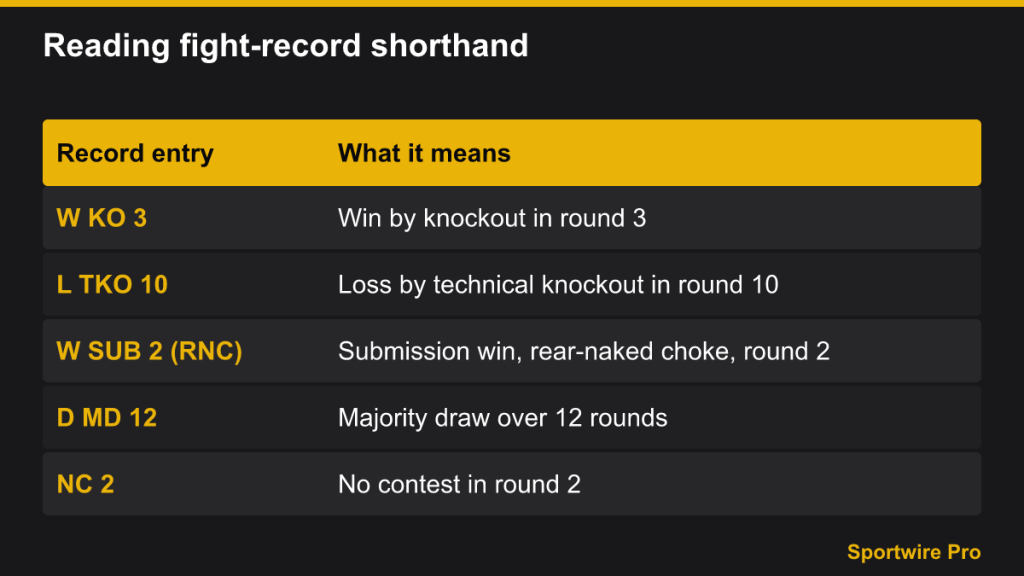
Now you can decode a fight record. “W KO 3” means a win by knockout in the third round. “L TKO 10” means a loss by technical knockout in round ten. “W SUB 2 (RNC)” means a submission win by rear-naked choke in round two. “D MD 12” is a majority draw over 12 rounds, and “NC 2” is a no contest in the second round. Each result tells a story, and now you can read it.