UFC Weight Classes Explained: Every Men’s and Women’s Division
Every active UFC division with its weight limit, the one-pound non-title allowance, catchweights, and the Unified Rules classes the UFC does not use.

The UFC is the biggest mixed martial arts promotion in the world, and almost everything about its matchmaking starts with weight. Each fighter competes in a division, each division has its own rankings and champion, and the scale on the day before a fight can decide whether a title is even on the line. Yet the UFC uses only some of the weight classes written into the sport’s rulebook, and its list of divisions has changed over time.
Here is a clear guide to every active UFC division as of October 2026, how the limits work, and why some classes exist on paper but not in the Octagon.
The Current UFC Divisions
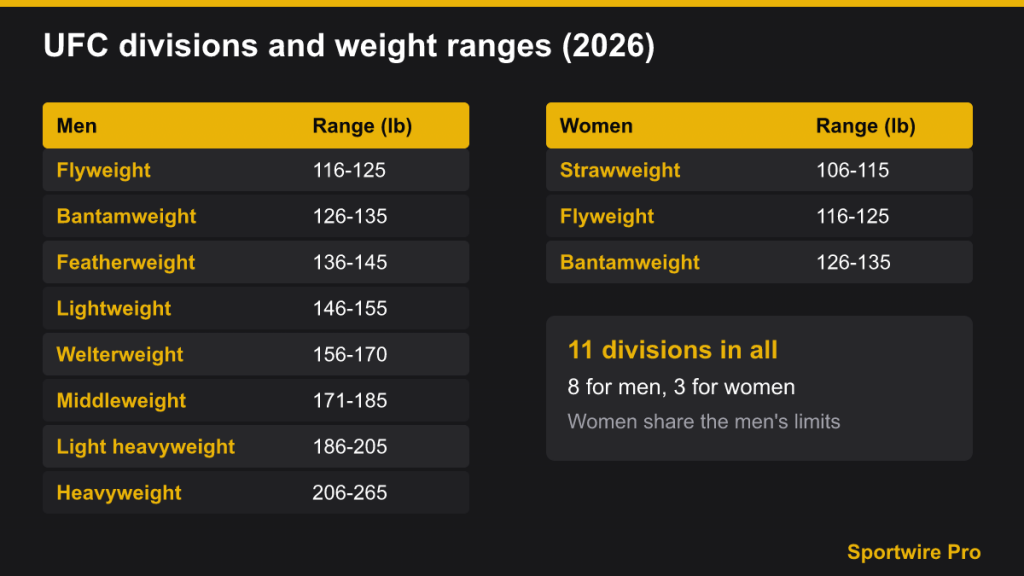
As of 2026 the UFC runs 11 divisions: eight for men and three for women. The limits below are the maximum weight for a championship fight. The lower bound of each division is simply the limit of the division below it.
Men’s divisions
| Division | Weight range (lb) | Approx. kg limit |
|---|---|---|
| Flyweight | 116–125 | 57 |
| Bantamweight | 126–135 | 61 |
| Featherweight | 136–145 | 66 |
| Lightweight | 146–155 | 70 |
| Welterweight | 156–170 | 77 |
| Middleweight | 171–185 | 84 |
| Light heavyweight | 186–205 | 93 |
| Heavyweight | 206–265 | 120 |
Women’s divisions
| Division | Weight range (lb) | Approx. kg limit |
|---|---|---|
| Strawweight | 106–115 | 52 |
| Flyweight | 116–125 | 57 |
| Bantamweight | 126–135 | 61 |
A few things stand out. The men’s divisions are mostly 10 pounds apart in the lighter classes, then widen to 15 pounds between lightweight and welterweight and between welterweight and middleweight, 20 pounds up to light heavyweight, and a full 60 pounds for heavyweight. Heavyweight is the only UFC division with a big internal range, which is why heavyweight bouts can feature fighters of very different sizes. The women’s divisions share their limits with the matching men’s divisions.
What Happened to Women’s Featherweight?
For several years the UFC had a fourth women’s division. Women’s featherweight (136–145 lb) was introduced in late 2016, and its first title fight took place at UFC 208 on February 11, 2017. The division never developed much depth, and it was effectively built around a handful of fighters.
When Amanda Nunes, the last women’s featherweight champion, announced her retirement in June 2023, the title was vacated on June 20, 2023. The UFC did not crown a new champion, and women’s featherweight no longer appears in the official UFC rankings. As of 2026 it is listed as a defunct title, leaving the UFC with three women’s divisions.
The One-Pound Allowance for Non-Title Fights
One detail that confuses new fans is that a fighter can weigh slightly more than the division limit and still “make weight.” The UFC’s own explainer sets out the rule: in non-title bouts, fighters get a one-pound allowance above the division limit. So a lightweight in a non-title fight may weigh up to 156 pounds, a welterweight up to 171, and a heavyweight up to 266.
Title fights are different. For a championship bout, both fighters must weigh at or under the exact limit. There is no allowance. Being even half a pound over matters: at UFC 274, Charles Oliveira weighed 155.5 pounds for a lightweight title fight and was stripped of the title on the scale, meaning only his opponent could have won the belt that night.
What happens when a fighter misses weight
Official UFC weigh-ins normally happen the morning before fight night. Depending on the athletic commission and how much weight remains, a fighter who misses on the first attempt may be given up to an extra hour to try again. If they still miss, the UFC describes three typical outcomes:
- The fighter forfeits a percentage of their purse to the opponent.
- The bout is renegotiated as a catchweight fight.
- The fight is canceled.
In title fights, a champion who misses weight loses the title, while a challenger who misses typically becomes ineligible to win it. A well-known example came in 2020, when Deiveson Figueiredo weighed 127.5 pounds for a flyweight title fight; only his opponent, Joseph Benavidez, was eligible to win the vacant belt, so when Figueiredo won, the title stayed vacant.
Catchweights Explained
A catchweight is a bout contested at a weight that does not match a standard division limit. In the UFC, catchweights usually appear in two ways:
- After a missed weight. If one fighter is over, both camps may agree to proceed at a catchweight instead of canceling.
- By prior agreement. Occasionally a bout is booked at a non-standard weight from the start, often on short notice when a replacement opponent cannot make the original limit in time.
The Unified Rules, which US commissions use, add safety limits. According to the current Association of Boxing Commissions rules, when a fighter misses a contracted weight and the two athletes end up in different weight classes, the heavier fighter should not exceed the lighter fighter by more than five pounds. Commissions can also refuse a catchweight bout if they consider the weight difference a safety risk.
Catchweight bouts are never for a UFC title, and fans often view a catchweight booking as a sign that something went wrong during fight week.
Unified Rules Divisions the UFC Does Not Use
The UFC’s divisions come from a longer list written into the Unified Rules of Mixed Martial Arts, which we covered in our guide to the Unified Rules of MMA. The ABC rulebook lists 15 weight classes. The UFC uses some of them and ignores others:
| Unified Rules class | Limit (lb) | Used by UFC? |
|---|---|---|
| Atomweight | up to 105 | No |
| Strawweight | 115 | Women only |
| Flyweight | 125 | Yes |
| Bantamweight | 135 | Yes |
| Featherweight | 145 | Men only (women’s defunct) |
| Lightweight | 155 | Yes |
| Super lightweight | 165 | No |
| Welterweight | 170 | Yes |
| Super welterweight | 175 | No |
| Middleweight | 185 | Yes |
| Super middleweight | 195 | No |
| Light heavyweight | 205 | Yes |
| Cruiserweight | 225 | No |
| Heavyweight | 265 | Yes |
| Super heavyweight | over 265 | No |
The newer classes, such as super lightweight (165), super welterweight (175), super middleweight (195) and cruiserweight (225), were added to the Unified Rules partly to reduce the large jumps between traditional divisions. Supporters argue that they would let fighters compete closer to their natural weight and reduce extreme weight cutting. Any promotion can adopt them, and some smaller promotions do, but the UFC has kept its traditional structure. Adding a division also means splitting a roster, creating new rankings and introducing a new champion, which is a business decision as much as a sporting one.
Super heavyweight (over 265) appears in the rulebook but is rarely used in modern professional MMA, and the UFC has not had a super heavyweight division in the modern era.
How the Divisions Developed
The UFC did not always have weight classes. Its earliest events in the 1990s were open-weight tournaments, where size mismatches were part of the spectacle. Weight classes were introduced as the sport moved toward regulation. After the Zuffa purchase in 2001, the UFC operated five men’s divisions for several years: lightweight, welterweight, middleweight, light heavyweight and heavyweight.
The lighter men’s classes and the women’s divisions were added later, largely as the UFC absorbed other promotions’ talent and as women’s MMA grew. Men’s featherweight, bantamweight and flyweight were added to the original five, and the women’s bantamweight, strawweight and flyweight divisions followed, with women’s featherweight briefly joining them before being dropped.
The BMF title, first contested at UFC 244 in November 2019, is sometimes mentioned alongside the divisions, but it is a symbolic belt rather than a division championship. It has been fought for in more than one weight class and does not come with its own rankings.
Why Fighters Change Divisions
Fighters move up or down for several reasons:
- Weight cutting becomes unsustainable. As fighters age or grow, cutting to a lower limit can become harder and riskier, so moving up may protect performance and health.
- Bigger opportunities. A crowded division may push a fighter to seek a quicker title path elsewhere.
- Two-division ambitions. Holding titles in two divisions at once is one of the most prestigious feats in the UFC, and several fighters have pursued it.
- Size disadvantages. Fighters who are consistently outsized may drop down to face opponents closer to their frame.
Rankings are listed separately for each division, and a fighter can appear in more than one division’s rankings if they compete across classes.
Common Questions About UFC Weight Classes
Why is heavyweight so wide?
Heavyweight starts at 206 pounds and ends at 265. The cap exists for safety under the Unified Rules, and the gap is large because the UFC does not use the cruiserweight class at 225.
Do fighters really fight at the weight they weigh in at?
No. Because official weigh-ins happen the day before the fight, most fighters rehydrate and regain weight overnight. Many fighters compete well above their division limit. This is legal under current UFC and commission rules, though the health effects of extreme cuts are widely debated.
Can a champion hold two belts at once?
Yes. A fighter may hold titles in two divisions simultaneously, although the UFC has often asked double champions to choose one division after a period of time.
What is the difference between a weight class and a weigh-in limit?
The weight class is the division a fighter competes in, with its official upper limit. The weigh-in limit for a particular bout can be slightly different: in a non-title fight it includes the one-pound allowance, and in a catchweight fight it is whatever number was agreed in the contract. That is why you may see a lightweight weigh in at 156 pounds without any penalty.
Why don’t fighters just compete at their natural weight?
Many fighters believe that being the bigger athlete on fight night is an advantage, so they cut to the lowest division they can make and rehydrate after the weigh-in. Whether that trade-off is worth it is one of the sport’s long-running debates, and it is one reason the Unified Rules added intermediate classes that the UFC has not adopted.
Are women’s and men’s limits the same?
Yes. Women’s strawweight, flyweight and bantamweight use the same limits as the corresponding classes in the Unified Rules, and women’s flyweight and bantamweight match the men’s UFC limits exactly.