Essential Submissions in MMA: Chokes, Armbars and Leg Locks Explained
How MMA's main submissions work, from the rear-naked choke and guillotine to the armbar, kimura and heel hook, and which ones have been most common in the UFC.
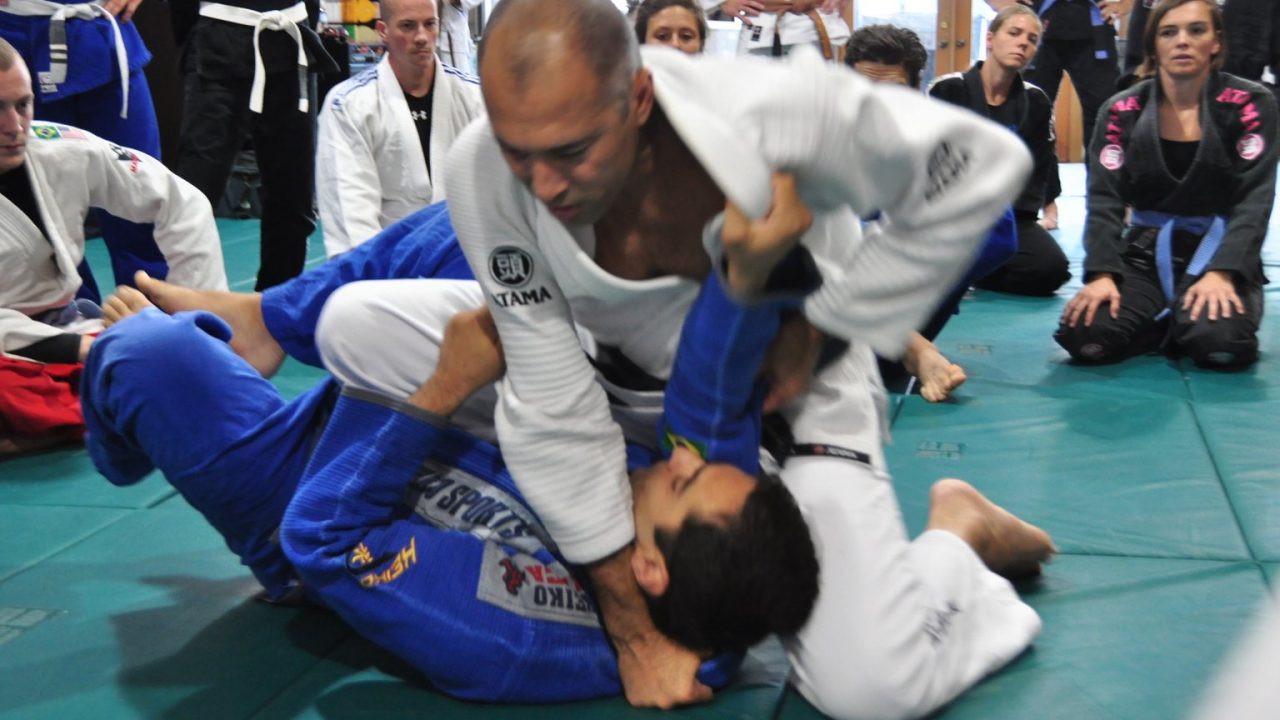
A submission is one of the most dramatic ways an MMA fight can end. One moment two fighters are scrambling on the mat; the next, one of them is tapping. To a new fan, it can be hard to tell what happened. To an experienced viewer, the finish was often visible several seconds earlier, as one fighter isolated an arm or slid behind the opponent’s back.
This article explains the main families of submissions, how each one works in principle, and why some are far more common than others in the UFC. It is an explanation for viewers, not an instructional guide: submissions can cause serious injury, and they should only ever be practiced under a qualified coach, with partners who know to release immediately when someone taps.
How Submissions End Fights
Under the Unified Rules of MMA, a fight ends by submission when a fighter taps out physically, taps out verbally (including crying out in pain or distress), or suffers a technical submission, when the hold causes unconsciousness or a broken or dislocated bone or joint. The referee watches closely and will stop the fight if a fighter goes unconscious or can no longer defend themselves, even without a tap.
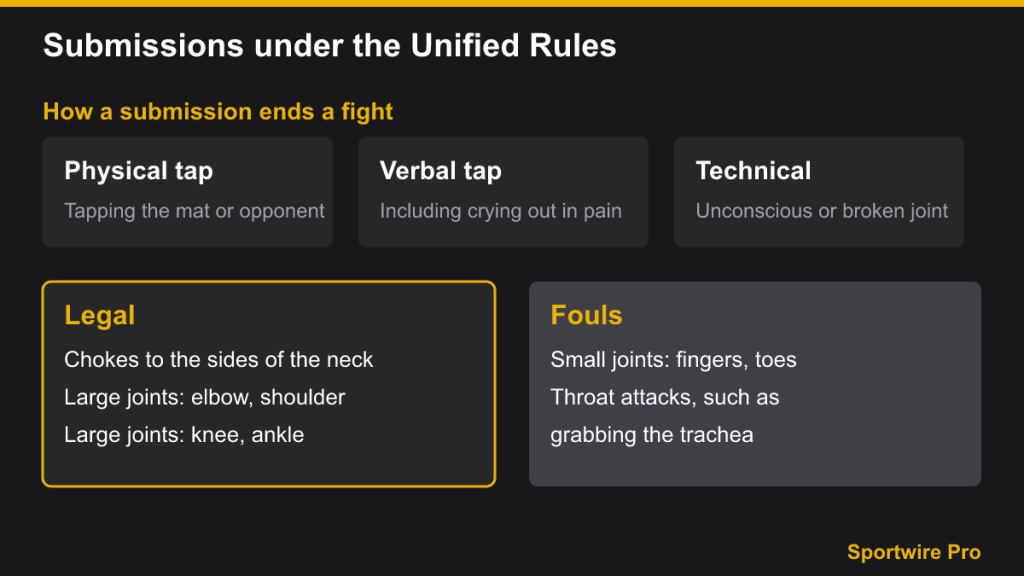
The rules also shape which submissions are allowed. Large-joint attacks on the elbow, shoulder, knee and ankle are legal, but small joint manipulation, attacking individual fingers or toes, is a foul. Throat attacks such as grabbing the trachea are illegal too, which is why MMA chokes work on the sides of the neck rather than crushing the windpipe directly. For the full set of rules, see our guide to the Unified Rules of MMA.
There are two broad families of submissions: chokes (also called strangles) and joint locks.
Chokes: Why They Dominate MMA
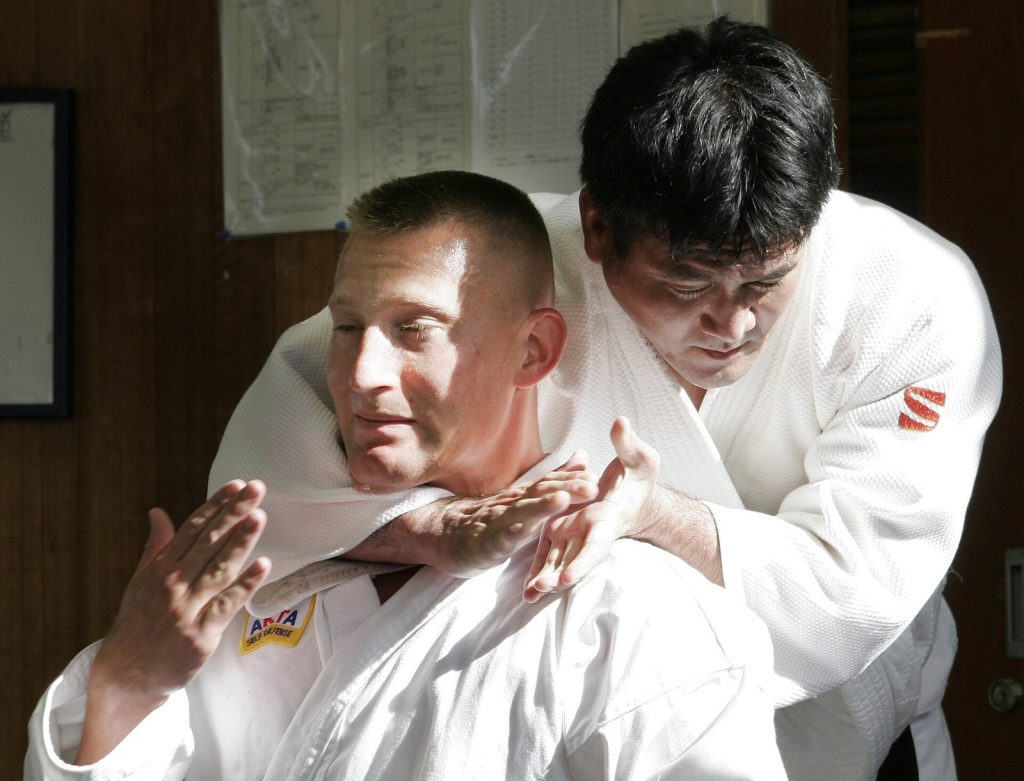
Most MMA chokes are “blood chokes.” Rather than blocking the airway, they compress the sides of the neck, restricting blood flow to the brain. Applied correctly, they can force a tap or cause unconsciousness quickly. Chokes are effective in MMA because they do not depend on a fighter’s flexibility or pain tolerance; there is no “toughing out” a well-applied choke.
The numbers back this up. A physician-led analysis of fight-ending chokes in UFC history, by Dr. Samuel Stellpflug and colleagues, found that chokes accounted for 15.5% of all UFC fight outcomes and about 76% of submission finishes through the period studied. Of those chokes, roughly half were rear-naked chokes, followed by the guillotine. The study also found that about 11% of fight-ending chokes resulted in loss of consciousness; most of the rest ended with a tap.
Rear-naked choke
The rear-naked choke (RNC) is the most common submission in UFC history, accounting for about 49% of fight-ending chokes in that analysis. The attacker is behind the opponent, usually with “hooks” (legs) in for control. One arm wraps around the neck so the elbow is under the chin, and the other arm locks behind the opponent’s head. Squeezing compresses both sides of the neck.
It is so effective because back control is the most dominant position in MMA: the defender cannot strike back effectively and has to fight hands and chin to stop the arm from sliding under the chin. When you see a fighter tuck their chin and grab the attacker’s wrist from the back, they are defending the RNC.
Guillotine
The guillotine is a front choke: the attacker wraps an arm around the opponent’s neck from the front, often when the opponent shoots for a takedown with their head low. Variants include the classic guillotine and the “arm-in” guillotine, where one of the opponent’s arms is trapped inside the hold. Together, guillotine variations were the next most common chokes in the UFC analysis. The guillotine is especially relevant in MMA because wrestlers who shoot carelessly can drive their own neck into it.
Triangle choke
The triangle uses the legs. From the bottom, the attacker traps the opponent’s head and one arm between their legs, then locks the legs in a figure-four shape. The opponent’s own shoulder presses into one side of the neck while the attacker’s thigh presses the other. It is a classic guard attack and a reason why being in an opponent’s guard is never completely safe.
Arm-triangle choke
The arm-triangle, or head-and-arm choke, traps the opponent’s head and one arm together using the attacker’s arms, usually from side control or mount. The opponent’s shoulder is pushed into their own neck. It is common in MMA because fighters often end up in top positions after takedowns. The D’Arce and anaconda chokes are related variations that are often hit from front headlock positions.
Joint Locks: Arms
Joint locks attack a joint by forcing it beyond its normal range of motion. Opponents usually tap because of pain and the obvious threat of injury, before damage occurs. A fighter who refuses to tap risks a technical submission by broken or dislocated joint.
Armbar
The armbar is the best-known arm lock. The attacker isolates the opponent’s arm, controls it between their legs with the thumb pointing up, and uses the hips as a fulcrum to hyperextend the elbow. It can be applied from the guard, from mount or in scrambles. Because the attacker uses their whole body against a single arm, the leverage is enormous.
Kimura and americana
The kimura is a shoulder lock. The attacker grabs the opponent’s wrist and uses a figure-four grip, with their other arm reaching behind the opponent’s arm to grab their own wrist, to rotate the opponent’s arm behind their back, twisting the shoulder. The americana works on a similar principle but rotates the arm in the opposite direction, typically from top positions. The kimura grip is also a powerful control tool, used to sweep or to transition to the back even when it does not finish the fight.
Joint Locks: Legs
Leg locks have a long history in grappling, but their use in MMA has fluctuated. They are less common than chokes as finishes, but they are dangerous, and some fighters specialize in them.
Straight ankle lock
The attacker traps the opponent’s foot under their armpit and arches back, putting pressure on the ankle and Achilles area. It is one of the more accessible leg attacks, and it is often attempted in scrambles.
Kneebar
Essentially an armbar applied to the leg: the attacker isolates the opponent’s leg and hyperextends the knee using the hips.
Heel hook
The heel hook is one of the most feared submissions in grappling. Despite the name, it attacks the knee: the attacker traps the leg and twists the heel, rotating the lower leg and putting torsion on the knee ligaments. Because damage can occur before pain warns the defender, heel hooks are banned in many beginner and lower-level grappling competitions. They are legal under the Unified Rules of MMA. Fans often notice that fighters caught in heel hooks tap quickly; that is why.
Why leg locks are less common in MMA
Attacking legs often means giving up top position. In MMA, if the attempt fails, the attacker may end up on the bottom taking punches, which is a bigger risk than in pure grappling. That risk-reward calculation is one reason leg locks are relatively uncommon as MMA finishes compared with chokes.
How Submissions Are Set Up
Submissions rarely come out of nowhere. Most follow a chain of events, and knowing the chain makes them easier to read as a viewer:
- Position first. Fighters work to dominant positions, such as mount or back control, where submissions are easier to finish. The grappling maxim “position before submission” is widely taught.
- Strikes create openings. In MMA, ground and pound forces the defender to cover their face, which can expose the neck or arms. Many rear-naked chokes happen after a fighter turns away from strikes and gives up their back.
- Scrambles and transitions. Submissions often appear when a fighter is moving between positions, such as standing up from the bottom, or when a takedown attempt fails.
- Fatigue. Late in fights, tired fighters defend less carefully, and submissions become more likely.
How Fighters Defend Submissions
- Against the rear-naked choke: tuck the chin, fight the attacker’s hands and wrists and try to turn into the attacker or escape to a position where the back is no longer exposed.
- Against the guillotine: keep the head up and posture good when shooting for takedowns; when caught, fighters work to relieve pressure on the neck, control the attacker’s hands and reposition until the head can come free.
- Against the triangle: keep posture, avoid leaving one arm in and one arm out of the opponent’s legs, and stack the opponent to relieve pressure.
- Against arm locks: keep elbows close to the body and hands connected, and avoid extending the arms when striking from the top.
- Against leg locks: fighters try to hide the heel, free the knee line and avoid rolling in the wrong direction.
Most of all, defending submissions means recognizing danger early. The best defense is not getting caught in a bad position in the first place.
Common Misconceptions
- “Tapping is quitting.” Tapping is the correct, safe response to a locked-in submission, and fighters at every level tap. Refusing to tap to a joint lock risks long-term injury, and refusing to tap to a choke leads to unconsciousness.
- “Submissions only happen on the ground.” Guillotines and some arm-in chokes are regularly attempted from standing, especially when an opponent shoots for a takedown.
- “Big fighters can’t be submitted.” Strength helps with defense, but leverage-based techniques work across weight classes, which is why submissions happen in every division, including heavyweight.
- “The person on bottom is losing.” In grappling exchanges, the bottom fighter may be the one attacking, as with triangles and armbars from the guard.
Reading Submissions as a Fan
Next time a fight goes to the ground, watch the neck and limbs rather than just the punches. Ask: has someone taken the back? Is an arm isolated? Is a fighter’s head low as they shoot for a takedown? Those clues tell you a submission may be coming. Our guide to watching MMA explains the ground positions that make these situations possible, and our article on every way a fight can end covers how submission results are recorded.