How the UFC Works: Rankings, Title Shots and Event Formats
How UFC numbered events and Fight Nights differ, how the media-voted rankings work, how title shots and interim belts happen, and how fighters get into the UFC.
Unlike boxing, where four sanctioning bodies crown champions and promoters compete for fighters, the UFC is a single company that does almost everything in-house. It signs the fighters, makes the matches, stages the events, owns the titles and publishes the rankings (with outside media voting). That concentration makes the UFC easier to follow than boxing in one sense, but it also means many important decisions, especially about title shots, come down to the promotion’s own judgment.
This guide explains the structure behind the fights: the types of events, how rankings are produced, how a contender becomes a challenger, and how a fighter gets a UFC contract in the first place.
Who Runs the UFC
A quick bit of background helps. In 2001, brothers Frank and Lorenzo Fertitta bought the UFC and formed Zuffa, LLC, with Dana White as president. In 2016 Zuffa was sold to a group led by WME-IMG (later Endeavor). In September 2023 the UFC merged with WWE to form TKO Group Holdings, which now owns and operates the promotion.
The UFC is a promoter, not a regulator. When it stages an event in the United States, the relevant state or tribal athletic commission regulates the bouts: it licenses fighters and officials, runs the weigh-ins and enforces the rules. Outside the US, local regulators or bodies appointed under local law play that role. The rules themselves are usually the Unified Rules of MMA, which we cover in our guide to the Unified Rules.
Event Formats: Numbered Events vs Fight Nights
The UFC holds a large number of events every year; its event list shows dozens of cards in each recent calendar year. They fall into a few broad types.
Numbered events
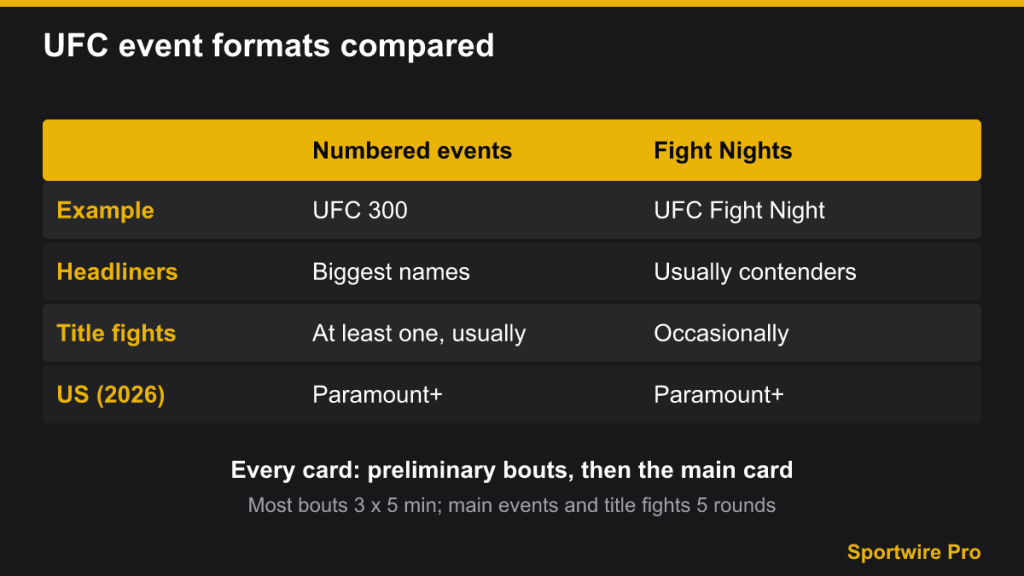
Numbered events, such as “UFC 300,” are the promotion’s flagship cards. They usually feature at least one title fight and the biggest names available. For most of the UFC’s modern history, numbered events in the US were sold as pay-per-view broadcasts. That changed with the UFC’s media agreement with Paramount, which began in 2026: numbered events and Fight Nights now stream on Paramount+ in the United States, and the traditional US pay-per-view model has ended. Outside the US, broadcast arrangements vary by country.
Fight Nights
UFC Fight Night events are the promotion’s regular, lower-profile cards. They are usually headlined by contenders rather than champions, though title fights occasionally appear. Fight Nights are often named after their main event fighters or their location. Historically some cards were branded after their broadcaster, such as “UFC on Fox,” “UFC on ESPN” or “UFC on ABC,” which is why you will see those names in older records.
Special events
The UFC has also held other branded cards, including finales for its reality series The Ultimate Fighter (more on that below). These follow the same rules and count on fighters’ official records.
Inside a fight card
Every event is divided into a main card and preliminary bouts (prelims), sometimes with an early prelim section. Bouts are typically three five-minute rounds, while main events and title fights are five rounds. Fighters are paid according to their contracts, and the UFC also hands out performance bonuses at each event for standout performances and the best fight of the night.
How UFC Rankings Work
UFC rankings are published on UFC.com for every division, plus men’s and women’s pound-for-pound lists. They are not computed by a formula. According to UFC.com, they are generated by a voting panel made up of media members, who vote for the top fighters in each weight class and pound-for-pound.
Key points about the system:
- Eligibility: only fighters in active status with the UFC can be ranked.
- Champions are separate: the champion and any interim champion sit at the top of their division and are not voted on for that division’s rankings, though they can receive pound-for-pound votes.
- Multiple divisions: a fighter can appear in more than one division’s rankings if they compete in more than one weight class.
- Usually top 15: each division lists a champion and ranked contenders, generally numbered 1 to 15.
Rankings update after events, and big wins can move fighters several spots. Because the panel is made up of journalists, the rankings reflect informed opinion rather than an official sporting table, and fans argue about them constantly.
What rankings are used for
Rankings shape matchmaking. Ranked fighters generally want to fight opponents ranked above them, because beating a higher-ranked opponent is the fastest way up. Unranked fighters usually need to beat ranked opponents to break into the list. Rankings also give fans a sense of who is close to a title shot, but they are not binding: the UFC is not obliged to give the No. 1 contender the next title fight.
How Title Shots Happen
In boxing, a sanctioning body can order a mandatory challenger. The UFC has no equivalent formal rule. Title fights are made by the promotion’s matchmakers, and several factors usually play a part:
- Ranking and recent results. A contender on a strong winning streak against ranked opponents is the most common route to a title shot.
- Availability and timing. Injuries, scheduling and fighters’ willingness to accept a date all matter.
- Stylistic and commercial appeal. A highly marketable fight can jump ahead of a strictly merit-based order.
- Former champions and divisional moves. Former champions and champions from neighboring divisions sometimes receive title shots without working their way through the rankings.
Some fights are labeled “title eliminators,” meaning the promotion has signaled that the winner should be next. Even then, plans can change.
Interim titles
When a champion is unable to defend for an extended period, typically because of injury, the UFC may create an interim title. Two contenders fight for it, and the interim champion is expected to face the full champion when they return. If the champion vacates or retires, the interim champion is often elevated to full champion. Interim titles have been used in many divisions over the years, and several interim champions went on to become undisputed champions.
Losing a title outside the cage
A champion can lose the title without losing a fight. The most common ways are missing weight for a title fight, vacating the belt (for example, by retiring or moving to another division), or being stripped by the promotion. Under UFC rules, a champion who weighs in over the limit for a title fight cannot retain the belt that night.
How Fighters Get Into the UFC
No one walks into the UFC without a track record. Most fighters build professional records in regional promotions first, then get noticed. The main routes are:

Dana White’s Contender Series
Launched on July 11, 2017, in Las Vegas, the Contender Series (originally called Dana White’s Tuesday Night Contender Series) is a dedicated scouting show. Fighters without UFC contracts compete in Las Vegas, and those who impress can be awarded UFC contracts on the night. A win is not a guarantee: performance, finishing ability and potential all matter. The series has run every year since 2017, with dozens of contracts awarded in recent seasons, and several of its alumni have gone on to become UFC champions.
The Ultimate Fighter
The Ultimate Fighter (TUF) is a reality series that debuted in January 2005. In its classic format, fighters live together in a house in Las Vegas, split into two teams coached by well-known UFC fighters, and compete in an elimination tournament. The finalists meet at a live finale, and the winner earns the title of “The Ultimate Fighter” and a UFC contract. The first season’s finale is widely remembered for Forrest Griffin vs Stephan Bonnar, a bout often credited with boosting the UFC’s popularity. The show has continued for more than 30 seasons, with changes in format and broadcaster over time.
Direct signings and short-notice opportunities
Fighters can also be signed directly, often as champions or top prospects from other promotions. Another common entry point is the short-notice replacement: when a UFC fighter withdraws during fight week or the weeks before, the promotion needs an opponent quickly, and a regional fighter who accepts and performs well can earn a longer contract.
Contracts, Releases and Activity
UFC fighters are generally signed to multi-fight contracts that specify a number of bouts and a pay structure. Fighters are typically paid a base amount for showing up and making weight, with a bonus for winning, plus the event performance bonuses mentioned earlier. The exact terms are private and vary widely.
Fighters who lose several fights in a row, especially early in their UFC run, are at risk of being released. That is a key difference from boxing, where a fighter can rebuild with different promoters at their own pace. In the UFC, a single organization decides who stays on the roster.
Activity matters too. Fighters who stay inactive for long periods can drop out of the rankings or lose their place in title queues, and champions are expected to defend reasonably often.
Reading the UFC Landscape as a Fan
- Check the event type. A numbered event usually signals title stakes; a Fight Night usually means contender-level matchups.
- Use the rankings as a guide, not a rulebook. They show who is in contention, but the UFC decides who gets the shot.
- Watch the weigh-ins for title fights. Missing weight can change what is at stake before the first punch.
- Follow the pipeline. Contender Series and regional champions are where future UFC stars come from.
A common misunderstanding
New fans often assume that the No. 1 ranked contender is automatically next in line, as a mandatory challenger would be in boxing. In the UFC that is not guaranteed. A fighter ranked lower might get the shot because of a spectacular recent win, a timing advantage or a bigger fan following, while the top contender waits or takes another fight. Equally, a contender can be passed over because they are injured or already booked. Rankings tell you who is in the conversation; the promotion decides who gets the call.
Once you know the structure, the UFC’s matchmaking decisions become much easier to understand, even when you disagree with them.