A Beginner’s Guide to Watching MMA: Understanding What Happens in the Cage
A new fan's guide to the phases of an MMA fight, the ground positions that matter, why being on top isn't always winning, and how to read a fight card.
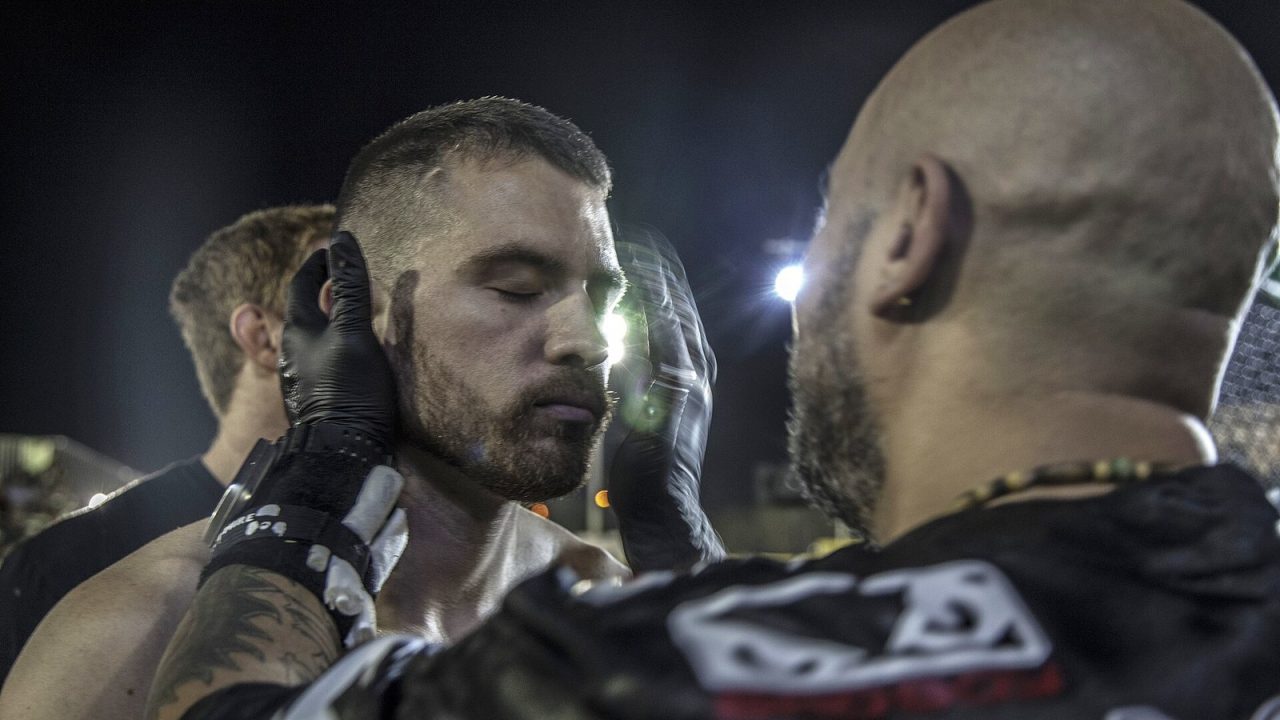
Mixed martial arts asks fighters to be good at almost everything: punching, kicking, wrestling, grappling and defending submissions, often switching between them in seconds. That variety is what makes the sport exciting, and also what makes it confusing to watch at first. A fight can go from a kickboxing match to a wrestling scramble to a grappling exchange on the mat before a new viewer has worked out what happened.
This guide breaks a fight down into its phases, explains the ground positions you will hear commentators name, and shows you what judges are actually looking for. If you want the full rulebook first, start with our explainer on the Unified Rules of MMA.
The Four Phases of an MMA Fight
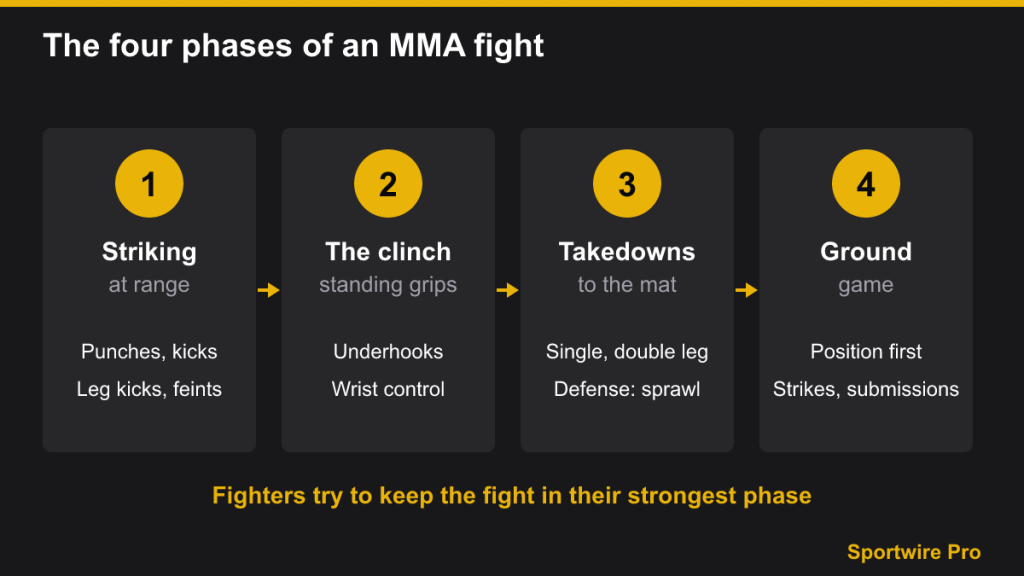
A useful way to watch MMA is to think of every fight as moving between four phases. Fighters try to keep the fight in the phase where they are strongest and away from the phase where their opponent is strongest.
1. Striking at range
Both fighters are standing apart, exchanging punches and kicks. This looks a lot like kickboxing, but the threat of takedowns changes everything. Fighters usually stand a little more upright and keep their weight balanced so they can defend a takedown, which means they cannot always commit to strikes the way a kickboxer might. Watch for leg kicks, which slow an opponent down, and for feints, which fighters use to disguise both strikes and takedown attempts.
2. The clinch
When fighters close the distance and grab each other while standing, they are in the clinch. In MMA it often happens against the cage. From the clinch, fighters can throw knees, short punches and elbows, attempt takedowns, or simply control the opponent and drain their energy. Much of the clinch is a battle for hand position: who has the underhooks (arms under the opponent’s armpits), who controls the wrists, and who is pinning whom against the fence.
3. Takedowns and the transition to the ground
A takedown brings the fight to the mat. Common takedowns include single-leg and double-leg attacks, body-lock trips and throws from the clinch. The main defense is the sprawl, in which the defender throws their legs back and drops their hips onto the attacker to stop the shot. Takedowns matter in judging, but what happens after the takedown matters more.
4. The ground game
Once on the ground, fighters work for position, strikes (ground and pound) and submissions. Grappling has a clear hierarchy of positions, and understanding it is the single biggest step in learning to watch MMA.
Ground Positions Explained
Commentators assume you know these terms. Here they are, roughly from least to most dominant for the fighter on top.
Guard
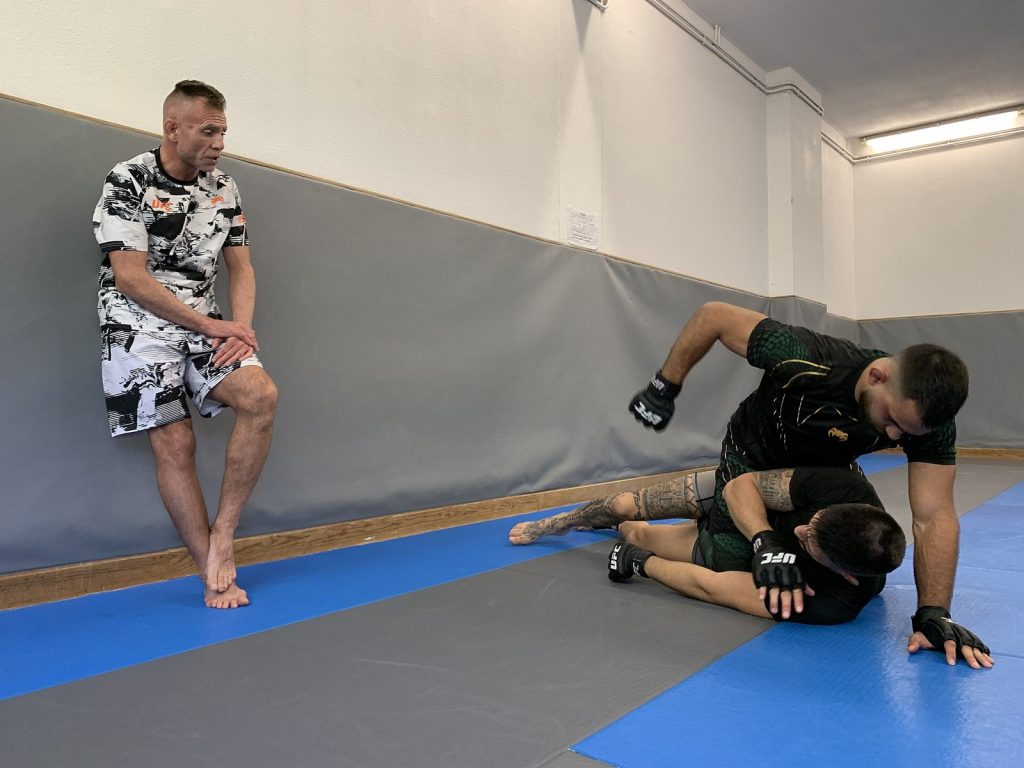
The bottom fighter is on their back with their legs between themselves and the opponent. In closed guard, the bottom fighter’s legs are wrapped around the top fighter’s waist with the ankles locked. In open guard, the legs are unlocked and used to push, pull and control. Butterfly guard uses the feet hooked inside the opponent’s thighs, which is useful for sweeping the opponent over. The guard is not simply a bad position for the bottom fighter: many submissions, such as the triangle choke and armbar, are attacked from the guard. In MMA, though, the top fighter can strike from inside the guard, which makes it riskier than in pure grappling.
Half guard
The bottom fighter traps only one of the top fighter’s legs. It is a step forward for the top fighter, who has partly passed the guard and can strike more freely, but the bottom fighter still has ways to recover guard or sweep.
Side control
The top fighter has passed the legs completely and is lying across the opponent’s chest, perpendicular to them. It is a strong position for control, short strikes and submissions such as the kimura or arm-triangle.
Knee on belly and north-south
Variations of top control. In knee on belly, the top fighter pins the opponent with a knee across the stomach while staying mobile. In north-south, the top fighter lies chest to chest but facing the opposite direction, head toward the opponent’s hips.
Mount
The top fighter sits astride the opponent’s torso. This is one of the most dominant positions in MMA, because the top fighter can punch downward with full weight while the bottom fighter has limited ways to strike back. Escaping mount is a fundamental defensive skill.
Back control
Often considered the most dominant position of all. The attacking fighter is behind the opponent, usually with both legs wrapped around the waist (“hooks in”) or a body triangle. From here the attacker can threaten the rear-naked choke, the most common submission finish in UFC history, while the defender can barely strike back.
Turtle
The bottom fighter is on hands and knees, curled up to protect themselves. It is often a transitional position, but it exposes the back and is generally vulnerable.
Sweeps, reversals and passes
A guard pass is when the top fighter gets past the bottom fighter’s legs into a better position, such as half guard or side control. A sweep or reversal is when the bottom fighter flips the situation and ends up on top. Both are valued in judging because they change who is in control.
Why the Fighter on Top Can Still Lose the Round
New fans often assume that whoever spends more time on top wins the round. That is not how MMA is judged. Under the Unified Rules, judges score each round using the 10-point must system and consider, in order:
- Effective striking and grappling, judged by impact: damage from legal strikes, and grappling that achieves something meaningful, such as takedowns, submission attempts, advancing to dominant positions and reversals.
- Effective aggressiveness, meaning genuine attempts to finish the fight, only considered if the first criterion is even.
- Control of the fighting area, meaning who dictates the pace, place and position, only considered if the first two are even.
The rules state that merely holding a dominant position should not be a primary factor; what the fighter does from that position is what counts. So consider a round where Fighter A takes Fighter B down and holds them against the cage for three minutes without landing much, while Fighter B lands hard elbows from the bottom and nearly locks in a triangle choke. Fighter B may well win that round, because their offense had more effect.
Likewise, a fighter can lose most of a round on the feet and still win it with one moment of serious damage, such as a knockdown. Damage tends to outweigh volume.
How rounds and fight lengths work
Professional MMA rounds last five minutes with one minute of rest. Most bouts are scheduled for three rounds; title fights and many main events are five. If the fight goes the distance, three judges’ totals decide the result.
How to Read a Fight Card
An MMA event is made up of a series of bouts, generally arranged with the most important at the end:
- Early prelims and prelims: the opening bouts, often featuring newer or lower-ranked fighters.
- Main card: the higher-profile fights, including the co-main event and main event.
- Main event: the headline fight, often a title fight or a matchup between top contenders.
Next to each fighter’s name you will usually see a record written as wins-losses-draws, sometimes with no contests in brackets, for example 15-3-0 (1 NC). Broadcasts also show each fighter’s height, reach, age and fighting stance. Rankings are listed for each division, and a number next to a name, such as “#5,” indicates the fighter’s position in the promotion’s rankings. Our guide to how the UFC works explains how those rankings and title shots are determined.
A fighter’s weight class also matters. MMA divisions are narrower than many fans expect, and each has its own champion; see our UFC weight classes guide for the full list.
What to Watch For in the Cage
- Who wants the fight where? A wrestler will try to close distance and take the fight down; a striker will try to keep it standing and stay off the fence. Watch who is succeeding.
- Cage position. The fighter with their back to the cage usually has fewer options. Watch how fighters circle away from it or pin opponents against it.
- Getting up. After a takedown, see whether the bottom fighter can get back to their feet quickly. A fighter who stands up repeatedly may tire out the wrestler.
- Submission threats. Watch the neck and arms. A fighter defending a choke or an armbar may be forced to give up position to escape.
- Fatigue. MMA is exhausting. Wrestling and grappling drain energy fast, and fighters who slow down in later rounds become easier to take down and hit.
- The referee’s role. The referee stands fighters up if action stalls on the ground, separates them if there is no meaningful work, and stops the fight when a fighter can no longer intelligently defend themselves.
Common Beginner Questions
Why do fighters sometimes lie on their back on purpose?
Some grapplers are comfortable fighting from their back, using the guard to threaten submissions and sweeps. Others may invite an opponent into their guard to drag them into a grappling exchange. It is a legitimate tactic, though judges will not reward passivity.
What is “ground and pound”?
Striking an opponent on the ground, usually from top position. It is one of the main ways wrestlers finish fights.
Can you kick someone who is on the ground?
Under the Unified Rules, kicks and knees to the head of a grounded opponent are fouls, though strikes to the body and punches to the head are allowed. The definition of “grounded” is specific, and some promotions outside the Unified Rules use different rules.
Why did the referee stop the fight when the fighter seemed fine?
Referees are looking for whether a fighter is intelligently defending. A fighter covering up without fighting back while taking unanswered strikes will usually be stopped, even if they protest afterwards.
After a few events, these phases and positions become second nature, and you will start spotting the moments that decide fights long before the commentators call them.