GLORY Kickboxing Rules Explained: Scoring, Clinch and Fouls
How GLORY kickboxing works: rounds, legal strikes, the one-knee clinch rule, knockdown limits, scoring criteria and fouls, plus a K-1 comparison.
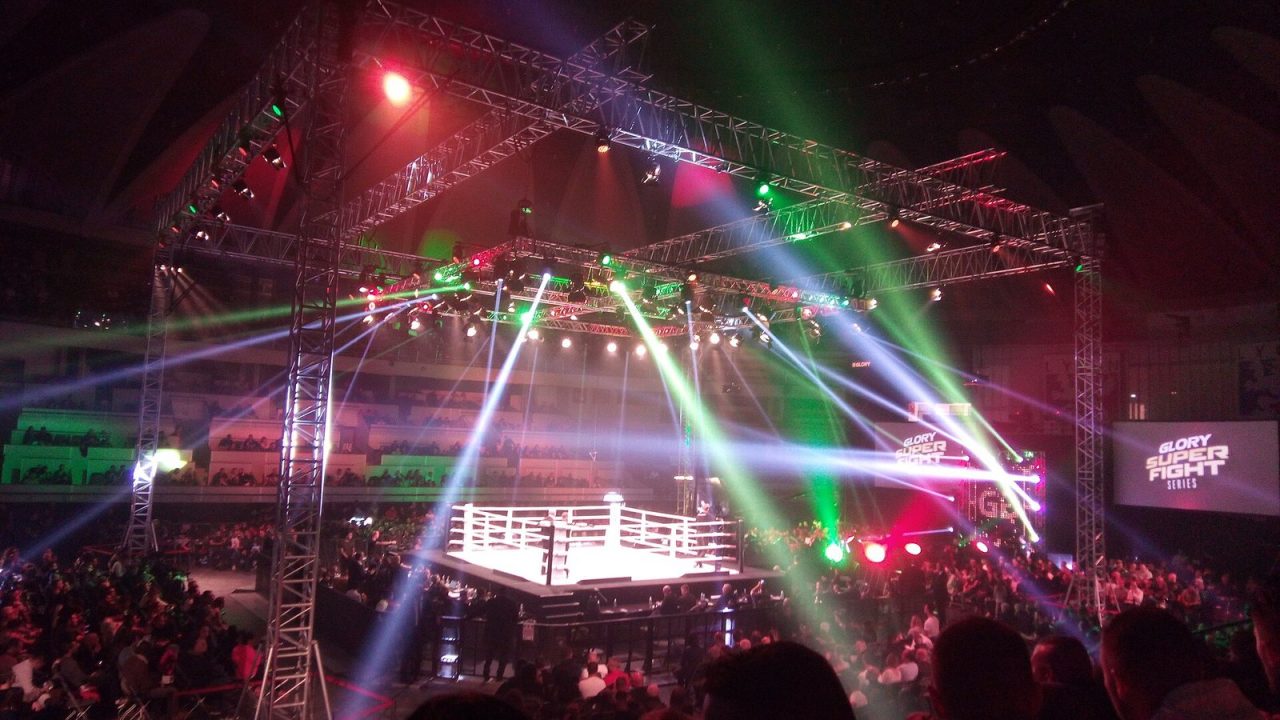
GLORY is one of the world’s leading kickboxing promotions, and its rulebook is designed around one idea: keep the fighters striking. Elbows are banned, clinching is nearly eliminated, and the scoring criteria put damage ahead of everything except knockdowns. The result is a fast, high-output version of the sport that differs noticeably from Muay Thai and even from some other kickboxing rule sets.
This guide walks through GLORY’s official rules, as published by the promotion (the version updated in March 2026), covering bout formats, legal techniques, the famous clinch rule, knockdowns, scoring and fouls. If you are new to the different kickboxing styles, our comparison of kickboxing and Muay Thai is a helpful starting point.
Bout Format and Weight Classes
Rounds
- Standard bouts: three rounds of three minutes, with one-minute breaks between rounds. GLORY may approve a five-round bout.
- Title fights: five rounds of three minutes, unless the title fight is part of a tournament, in which case it may be three rounds at GLORY’s discretion.
- Tournament bouts: two or three rounds of two or three minutes, depending on the tournament format.
- Extra rounds: some drawn bouts go to a “sudden victory” round (see the scoring section), and the break before an extra round is extended to one and a half minutes.
- Daily limit: a fighter may never fight more than thirteen three-minute rounds in one day, which matters in one-night tournaments.
Weight classes
GLORY uses a small number of broad, kilogram-based divisions:
| Division | Limit |
|---|---|
| Featherweight | up to 65 kg |
| Lightweight | over 65 kg up to 70 kg |
| Welterweight | over 70 kg up to 77 kg |
| Middleweight | over 77 kg up to 85 kg |
| Light heavyweight | over 85 kg up to 95 kg |
| Heavyweight | over 95 kg |
Catchweights can be agreed between GLORY and both fighters. Weigh-ins take place the day before the event. If a fighter misses weight and the fight goes ahead, they can forfeit up to 20% of their purse to the opponent for a miss of 1 kg or less, and up to 30% for a bigger miss. In title fights, a champion who misses weight forfeits the title; if the challenger misses, the champion keeps the belt regardless of the result.
Gloves and ring
Fighters wear boxing gloves supplied by GLORY: 8 ounces for weight classes under 65 kg and 10 ounces for all others. Bouts take place in a square, roped ring. Mouthguards are mandatory, and male fighters must wear groin protection.
Legal Strikes
GLORY’s rules spell out which techniques count for scoring. To score, a strike must be thrown with full power, from the correct distance and body position, and land on a legal target.
- Punches: straight punches, hooks and uppercuts with the padded part of the glove, plus the spinning backfist, but only if it lands with the padded back of the glove.
- Kicks: front kicks, low kicks to the inside and outside of the leg, middle kicks, high kicks, side kicks, back kicks, axe kicks, spinning kicks and jumping kicks.
- Knees: front knees, roundhouse knees, jumping knees and knees to the inside and outside of the leg, subject to the clinch limits below.
There is an important limit on leg attacks: linear or thrusting kicks to the legs, such as a front kick, side kick or back kick to the knee, are fouls. Only kicks that arc, like a roundhouse or hooking kick, may target the legs.
The Clinch Rule
The clinch rule is GLORY’s defining feature. Under the official rules, grabbing, clinching or holding for any reason is a foul, with one exception: a fighter may grab the opponent to immediately throw a single legal knee strike, and must then release the clinch immediately.
That means:
- No holding to rest or to smother an opponent’s punches.
- No extended knee exchanges in the clinch, as in Muay Thai.
- No pulling the opponent forward with both arms around the lower back.
Catching kicks
The same logic applies to catching a kick. A fighter may grab an opponent’s leg only to throw a single, immediate legal strike, and may take one step in any direction while doing so. The leg must then be released. Holding on without striking is a foul.
Sweeps and throws
Throws, leg sweeps, foot sweeps and pushing to off-balance or ground an opponent are all fouls. Wrestling and judo techniques, strangles and submissions are, of course, also banned. Any attempt to knock an opponent down with something other than a legal strike can be treated as a foul.
In practice, this rule pushes fighters to win at range and in punching exchanges, rather than in the clinch. Referees separate fighters quickly with the command “break,” and fighters must take a step back before resuming.
Knockdowns and Stoppages
What counts as a knockdown
A fighter is “down” when, as a result of a damaging attack, any part of their body other than the feet touches the floor, or would have done if not for the ropes or holding the opponent. GLORY also uses the standing eight count: the referee can count a fighter who is still standing but appears weakened and in danger after a damaging attack.
The count
The opponent is sent to the farthest neutral corner and the referee counts. The count to eight is mandatory, after which the referee decides whether the fighter can continue. A fighter who cannot continue loses by knockout (if counted out to ten) or technical knockout (if the referee checks at eight and stops it). If time runs out during a count, the bell waits until the count of eight is completed, so there is no “saved by the bell” mid-count.
The knockdown limits
- Single bouts and tournament finals: three knockdowns in one round, or four in the whole fight, end the bout as a TKO.
- Other tournament bouts (including reserve bouts): two knockdowns in one round, or three in the fight, end it as a TKO.
Other stoppages
The referee or ring doctor can stop the fight if a fighter cannot safely continue, and the doctor’s decision is final. A corner can throw in the towel, though not while the referee is counting. A double knockout, where both fighters are down and neither beats the count, is a draw.
How GLORY Scores Fights
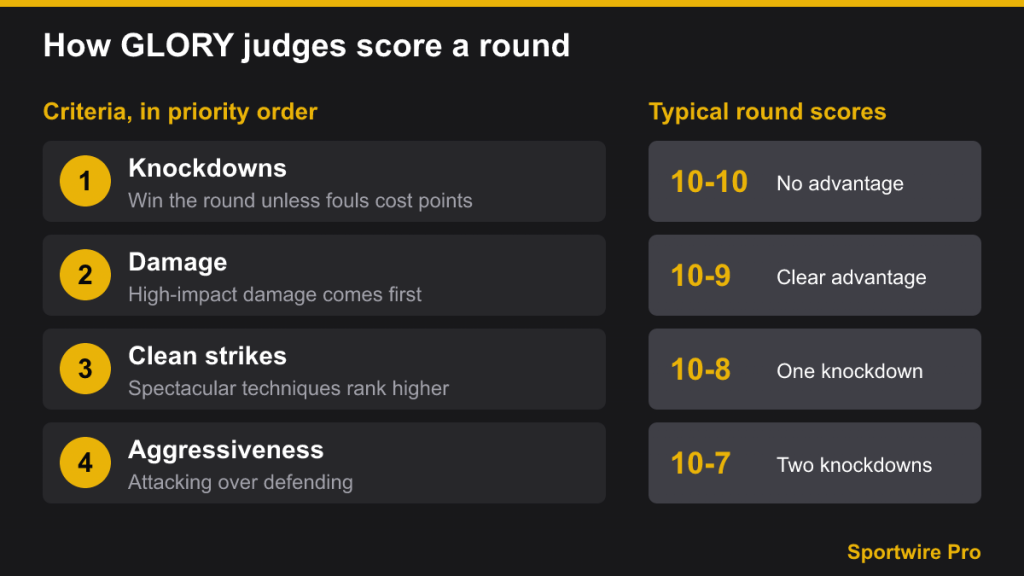
GLORY uses the 10-point must system, with five judges (or three if GLORY approves), and it uses open scoring, meaning judges’ scores are made public after each round.
The criteria, in priority order
- Knockdowns. A fighter who scores one or more knockdowns wins the round, unless they lose points for fouls. The other criteria then decide whether it is 10-9 or 10-8.
- Damage. “High Impact Damage,” meaning a wobble, a stagger or reduced functionality caused by a legal strike, is prioritized over all other damage. Damage is scored cumulatively.
- Number of clean strikes. Spectacular techniques, such as flying and spinning strikes, are prioritized over ordinary ones.
- Aggressiveness or ring domination. Attacking is prioritized over defending.
GLORY’s guidelines say one visibly damaging strike outweighs a high volume of clean but ineffective strikes, but also that a fighter who lands one big shot and then goes passive for the rest of the round will be penalized in the scoring.
Typical round scores
- 10-10: no advantage can be determined.
- 10-9: one fighter has shown an advantage.
- 10-8: one fighter won with a knockdown, or with high-impact damage plus significant dominance.
- 10-7: one fighter won with two knockdowns.
Decisions and draws
The winner is decided by how many judges favor each fighter based on each judge’s total, not by the total number of rounds won. With five judges, at least three must agree on a winner; otherwise the bout is a draw. Draws in three-round bouts go to one “sudden victory” extra round, in which only that round counts and judges may not score it even. In title fights involving a defending champion, a draw after five rounds means the champion keeps the belt. Vacant title fights, five-round main events and official title eliminators go to an extra round if drawn.
Fouls and Penalties
Beyond the clinch and sweep rules, GLORY’s fouls include:
- Headbutts and elbow strikes, including strikes with any part of the arm above the padded glove.
- Strikes to the back of the head, the back or the groin.
- Biting and stomping on the opponent’s foot.
- Hitting with an open glove or thumbing the eye.
- Attacking a fighter who has anything other than their feet on the ground, or who is outside the ring or tangled in the ropes.
- Striking after “break” or “stop.”
- Holding the ropes, pushing an opponent out of the ring or over the ropes.
- Stalling and passivity: repeatedly raising the front leg or extending the front arm without attacking, fighting only when the opponent attacks, deliberately falling down, leaving the ring or spitting out the mouthguard.
Penalties escalate. A minor, accidental foul gets a caution; repeated or intentional fouls get an official warning; after a warning, or for an intentional and severe foul, the referee deducts a point. A fighter who has received two point deductions and commits another foul, or commits a flagrant foul, is disqualified.
If an accidental foul stops a fight before two rounds of a three-round bout (or three of a five-round bout) are complete, the result is a no contest. Later in the fight, the judges’ scores decide it, without counting the round in which the foul happened.
GLORY vs K-1 Rules
GLORY’s rules descend from the “K-1 rules” codified by the Japanese promotion K-1, founded in 1993. The two are similar in their core: punches, kicks and knees are legal, elbows are banned, and knockdowns weigh heavily in scoring. The main differences:
| Rule | GLORY | Classic K-1 |
|---|---|---|
| Clinch | One immediate knee, then release | Brief clinching allowed (around five seconds) |
| Sweeps | Banned | Permitted under K-1’s rules |
| Scoring criteria | Knockdowns, damage, clean strikes, aggressiveness | Knockdowns, damage, clean strikes, aggressiveness |
| Knockdown TKO | Three in a round / four in a fight (two/three in tournament bouts) | Three in a round (two in tournament bouts) |
| Draws | Sudden victory extra round in most formats | Extension round |
Both rule sets are designed to reward aggressive, damaging striking, which is why they produce such exciting fights. GLORY’s near-total ban on clinching is the clearest sign of that philosophy.