What ‘Undisputed Champion’ Means in Boxing and Who Has Achieved It
What makes a boxer undisputed in the two-, three- and four-belt eras, why it's so rare, and every four-belt undisputed champion through 2025.
“Undisputed” is the most prestigious word in boxing. It means there is no argument about who the champion of a weight class is, because one fighter holds every major world title at once. In a sport where several organizations crown their own champions, that is surprisingly hard to achieve, and for long stretches of boxing history some divisions went decades without an undisputed king.
This guide explains what the term means, how its definition has changed as new sanctioning bodies appeared, why it is so rare, how it differs from being the “lineal” champion, and who has held all four major belts through 2025.
Undisputed vs Unified: The Definitions
Two terms get mixed up constantly:
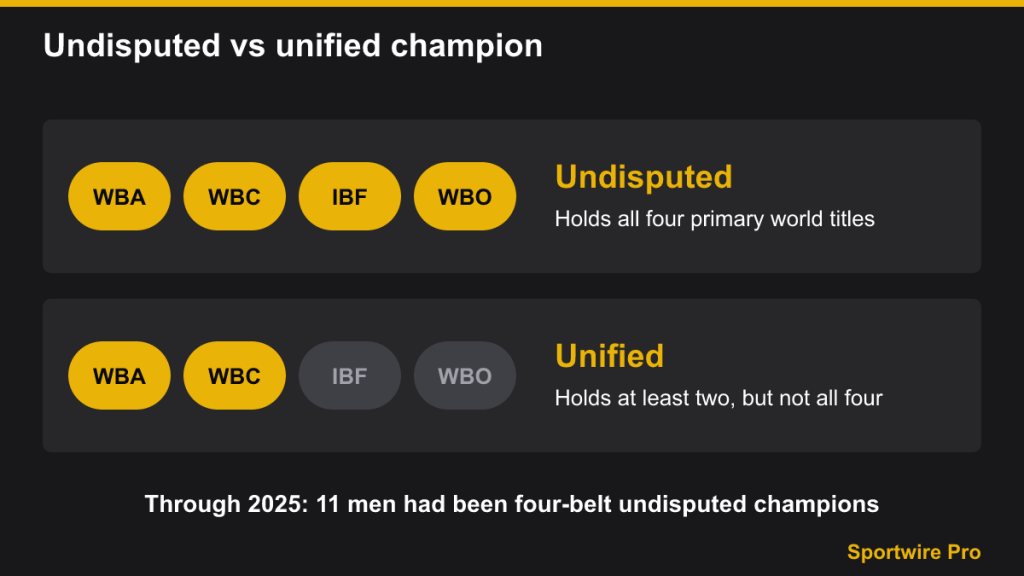
- Undisputed champion: a boxer who simultaneously holds the world titles of all the major sanctioning organizations in a weight class. Today that means the WBA, WBC, IBF and WBO.
- Unified champion: a boxer who holds at least two of those titles in the same division, but not all of them.
So every undisputed champion is unified, but most unified champions are not undisputed. A boxer who holds the WBA, WBC and IBF belts while someone else holds the WBO title is a unified champion with one belt still to collect.
A small complication: sanctioning bodies sometimes create extra titles, such as “super,” “regular,” “interim” or “franchise” champions. When people talk about undisputed status, they mean the primary world title of each organization. Our guide to how boxing’s four sanctioning bodies work explains those secondary belts in more detail.
How the Definition Changed: Two, Three and Four Belts
The number of belts required to be undisputed has grown as new organizations gained acceptance. A common way of dividing boxing history, used by Wikipedia’s list of undisputed champions, looks like this:
| Era | What “undisputed” required |
|---|---|
| 1921–1963 | The NYSAC (New York State Athletic Commission) and NBA (National Boxing Association) titles |
| 1963–1983 | The WBA and WBC titles |
| 1983–2007 | The WBA, WBC and IBF titles |
| 2007–present | The WBA, WBC, IBF and WBO titles |
The two-belt eras
In boxing’s early decades, champions were often recognized by acclaim and there was little dispute. The New York commission began recognizing champions in 1920 and the National Boxing Association in 1927, and the two sometimes backed different fighters. The NBA became the World Boxing Association in 1962, and the World Boxing Council was founded in February 1963. From then until the early 1980s, holding the WBA and WBC belts made a boxer undisputed.
The three-belt era
The International Boxing Federation formed in 1983, and its title quickly became accepted as a major championship. From that point, the standard rose to three belts. Mike Tyson’s heavyweight unification series in 1986 and 1987 produced the first undisputed heavyweight champion since Leon Spinks in 1978. That heavyweight title split again in 1992.
The four-belt era
The World Boxing Organization was established in 1988, but it took years for its titles to be treated as equal to the others. The IBF had recognized the WBO by February 2007, which is why 2007 is commonly used as the start of the four-belt era. That creates a historical wrinkle: Bernard Hopkins unified all four middleweight belts in September 2004 by knocking out Oscar De La Hoya in the ninth round, becoming the first boxer to hold all four. At that time, though, the WBO was not yet recognized by the other three bodies. Jermain Taylor took all four belts from Hopkins by split decision in July 2005. Both are now commonly counted among the men who have held all four belts at once.
Why Undisputed Champions Are So Rare
Holding every belt sounds like the natural goal for any champion, so why does it happen so infrequently? Several structural reasons stand in the way:
- Mandatory challengers: each sanctioning body requires its champion to defend against a mandatory challenger at regular intervals. A boxer holding four belts faces four separate sets of obligations, and they can clash. Failing to meet one can mean being stripped of that title.
- Promotional and broadcast rivalries: the best fighters in a division are often tied to rival promoters or broadcasters. Making unification fights means getting competing businesses to agree on dates, venues and money.
- Sanctioning fees: a champion pays a fee to each organization whose title is on the line, which adds cost to every defense.
- Short shelf life: once a fighter becomes undisputed, the clock starts on mandatory defenses for every belt. Many undisputed reigns end not with a defeat but with a title being stripped or vacated.
- Moving up: many fighters who reach undisputed status move up in weight soon after, looking for bigger fights, and vacate the belts.
Jermain Taylor’s reign is a classic example. He was later stripped of the IBF title for agreeing to a rematch with Hopkins instead of facing the IBF’s mandatory challenger.
Men’s Four-Belt Undisputed Champions Through 2025
The following list covers men who held the WBA, WBC, IBF and WBO world titles in the same division simultaneously, through the end of 2025. Dates are when each reign began.
| Boxer | Division | Became undisputed |
|---|---|---|
| Bernard Hopkins | Middleweight | September 2004 |
| Jermain Taylor | Middleweight | July 2005 |
| Terence Crawford | Light welterweight | August 19, 2017 |
| Oleksandr Usyk | Cruiserweight | July 21, 2018 |
| Josh Taylor | Light welterweight | May 22, 2021 |
| Canelo Álvarez | Super middleweight | November 6, 2021 |
| Jermell Charlo | Light middleweight | May 14, 2022 |
| Devin Haney | Lightweight | June 5, 2022 |
| Naoya Inoue | Bantamweight | December 13, 2022 |
| Terence Crawford | Welterweight | July 29, 2023 |
| Naoya Inoue | Super bantamweight | December 26, 2023 |
| Oleksandr Usyk | Heavyweight | May 18, 2024 |
| Artur Beterbiev | Light heavyweight | October 12, 2024 |
| Dmitry Bivol | Light heavyweight | February 22, 2025 |
| Canelo Álvarez (second reign) | Super middleweight | May 3, 2025 |
| Oleksandr Usyk (second reign) | Heavyweight | July 19, 2025 |
| Terence Crawford | Super middleweight | September 13, 2025 |
Standout achievements
- Terence Crawford became undisputed in three divisions: light welterweight, welterweight and super middleweight. His super middleweight win came against Canelo Álvarez, who was the undisputed champion at the time.
- Oleksandr Usyk was undisputed at both cruiserweight and heavyweight. His 2024 heavyweight unification made him the first undisputed heavyweight champion of the four-belt era.
- Naoya Inoue became undisputed at bantamweight, then vacated those belts to move up and became undisputed at super bantamweight about a year later.
- Light heavyweight produced back-to-back undisputed champions: Artur Beterbiev unified in October 2024, and Dmitry Bivol took the belts from him in their February 2025 rematch.
That’s 11 men in total, several of them more than once. Some divisions, as of the end of 2025, had not yet produced a four-belt undisputed men’s champion, including the lighter divisions from minimumweight through super flyweight. For the full list of weight classes and their limits, see our guide to boxing weight classes.
Women’s Four-Belt Undisputed Champions Through 2025
Women’s boxing has produced undisputed champions at a fast rate in recent years, helped by the sport’s growth and by unification-minded fighters and promoters. Through 2025, the four-belt women’s champions were:
| Boxer | Division(s) | Became undisputed |
|---|---|---|
| Cecilia Brækhus | Welterweight | September 2014 |
| Claressa Shields | Middleweight; light middleweight; heavyweight | April 2019 (and October 2022); May 2021; February 2025 |
| Katie Taylor | Lightweight; light welterweight | June 2019; November 2023 |
| Jessica McCaskill | Welterweight | August 2020 |
| Franchón Crews-Dezurn | Super middleweight | April 2022 |
| Chantelle Cameron | Light welterweight | November 2022 |
| Amanda Serrano | Featherweight | February 2023 |
| Alycia Baumgardner | Super featherweight | February 2023 |
| Savannah Marshall | Super middleweight | July 2023 |
| Seniesa Estrada | Minimumweight | March 2024 |
| Gabriela Fundora | Flyweight | November 2024 |
| Tina Rupprecht | Atomweight | April 2025 |
| Cherneka Johnson | Bantamweight | July 2025 |
Cecilia Brækhus was the first boxer of either sex to hold all four belts in the four-belt era when she unified the welterweight titles in 2014. Claressa Shields stands out for doing it in three divisions, including heavyweight. The women’s list continued to grow in 2026.
Undisputed vs Lineal Champion
“Undisputed” is about belts. “Lineal” is about lineage. The lineal champion is the fighter who beat the fighter who beat the fighter, an unbroken chain going back to a recognized champion. The idea is often summed up as “the man who beat the man.”
A lineal title can only change hands in the ring. If a lineal champion retires, a new line usually has to be established, often when the top two contenders meet. Sanctioning-body belts, by contrast, can be stripped, vacated or awarded without the champion losing a fight.
The two can diverge. A fighter can be undisputed without being lineal if the line passed elsewhere, and a lineal champion may hold only one belt, or none, if the organizations have stripped them. The Ring magazine’s championship is the best-known title built around the lineal idea: it is generally awarded when the top fighters in a division meet, rather than through mandatory challengers and sanctioning fees.
Common Questions
Does an undisputed champion have to defend all four belts every time?
To remain undisputed, yes: all four titles must be on the line and the champion must keep meeting each body’s requirements. In practice, this is the hardest part, and many undisputed reigns end with a belt being stripped or vacated rather than lost in the ring.
Is “undisputed” an official title?
Not as a separate belt from a single body. It describes a situation: one boxer holding every major title in a division at once. Some promoters and organizations present special belts for the occasion, but the status comes from the four world titles.
Why do some lists differ?
Lists vary on when the WBO should be counted and on how to treat earlier eras. Hopkins and Jermain Taylor held all four belts before 2007, when the WBO’s recognition by the other bodies was still incomplete. Most modern lists include them, which is why they appear here.