WBA, WBC, IBF and WBO: How Boxing’s Four Sanctioning Bodies Work
How boxing's four sanctioning bodies began, rank fighters and order mandatories, what super, interim and franchise titles mean, and The Ring belt.
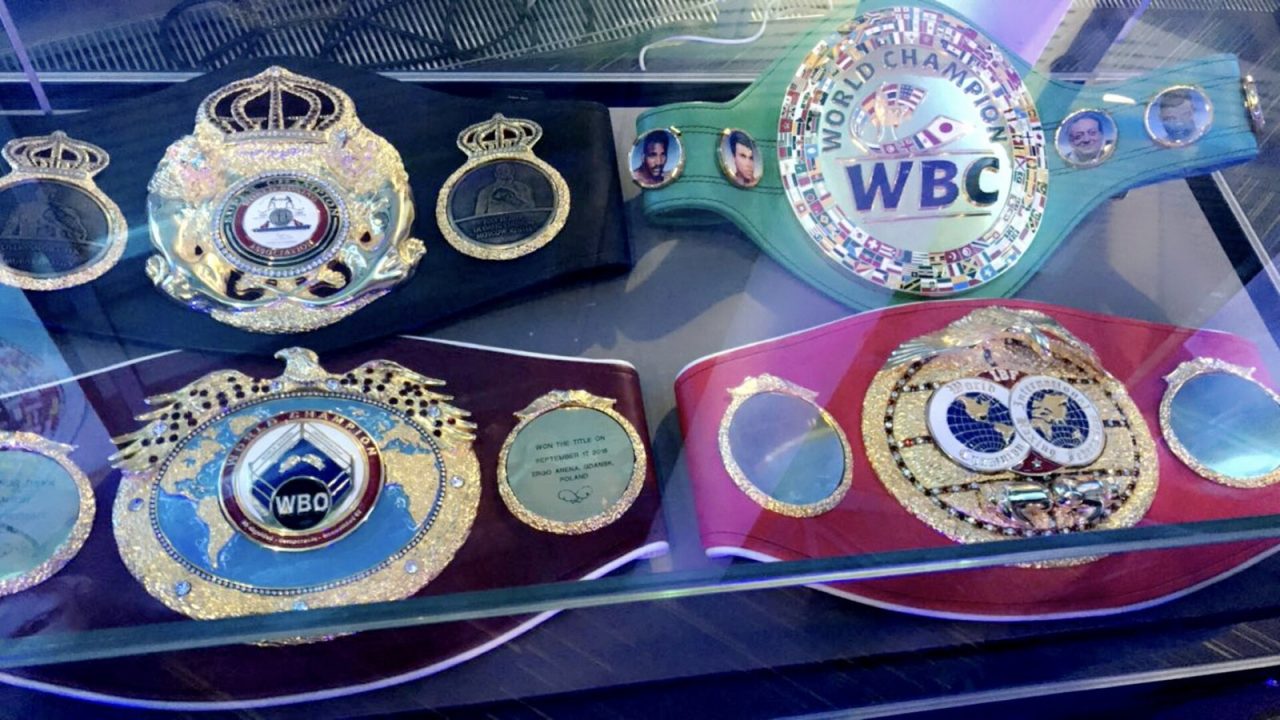
Ask a casual fan who the middleweight champion of the world is, and the honest answer is often “which one?” Professional boxing has no single governing league. Instead, four major sanctioning bodies each crown their own world champions: the World Boxing Association (WBA), the World Boxing Council (WBC), the International Boxing Federation (IBF) and the World Boxing Organization (WBO). Each publishes its own rankings, orders its own mandatory defenses and awards its own belts.
Understanding how these organizations work explains much of what happens in the sport, from why certain fights get made to why some champions are stripped of belts they never lost in the ring.
What a Sanctioning Body Actually Does
A sanctioning body is not the same as an athletic commission. Commissions are government regulators: they license fighters, appoint or approve officials, run medical checks and enforce safety rules in their jurisdiction. Sanctioning bodies are private organizations that decide who is entitled to fight for their championship.
In broad terms, every major sanctioning body:
- Publishes rankings in every division, usually monthly, listing the contenders it considers eligible for its title.
- Sanctions title fights, approving the matchup and supervising it (with the commission still regulating the event itself).
- Orders mandatory defenses, requiring champions to face a designated top contender within a set period.
- Charges sanctioning fees, generally a percentage of the fighters’ purses for a title bout. Exact rates vary by organization and are not always public.
- Strips or vacates titles when champions fail to meet their obligations, such as refusing a mandatory or missing weight.
Sanctioning bodies also often have their own regional and continental titles. Winning one can move a fighter up that organization’s rankings, which is part of the path to a world title shot.
The Four Major Organizations
WBA: the oldest
The World Boxing Association traces its roots to the National Boxing Association (NBA), founded in the United States in 1921 by representatives of 13 states. It was formed partly as a counterweight to the influence of the New York State Athletic Commission. On August 23, 1962, the NBA renamed itself the World Boxing Association as it began admitting members from other countries. The WBA is headquartered in Panama City, Panama.
WBC: the green belt
The World Boxing Council was founded in 1963. Representatives from 11 countries met in Mexico City on February 14, 1963, at the invitation of Mexico’s president at the time, Adolfo López Mateos, to create an organization that would unify commissions worldwide. The WBC is headquartered in Mexico City and is known for its green championship belt, which displays the flags of its member countries. The WBC has also been associated with safety changes; most notably, after the death of Kim Duk-koo from injuries suffered in a 1982 fight, the WBC cut its title fights from 15 rounds to 12 in 1983, and other organizations soon followed.
IBF: born from a convention dispute
The International Boxing Federation grew out of the United States Boxing Association (USBA), a regional body. After Bobby Lee lost a bid for the WBA presidency at the 1983 convention, he and others set up a world-level organization. It was first known as USBA-International and was renamed the International Boxing Federation on November 6, 1983. It is based in New Jersey. The IBF’s early history includes a serious scandal: in 1999 Lee was indicted on racketeering charges related to accepting payments in exchange for favorable rankings, and he was later convicted of money laundering and tax evasion. The organization continued under new leadership.
WBO: the youngest of the four
The World Boxing Organization was founded in 1988 by Puerto Rican and Dominican businessmen who broke away from the WBA’s annual convention in Isla Margarita, Venezuela, over disputes about its rules. It is headquartered in San Juan, Puerto Rico. The WBO took time to gain full acceptance, but the International Boxing Hall of Fame recognizes it as one of the four major world championship groups alongside the WBA, WBC and IBF.
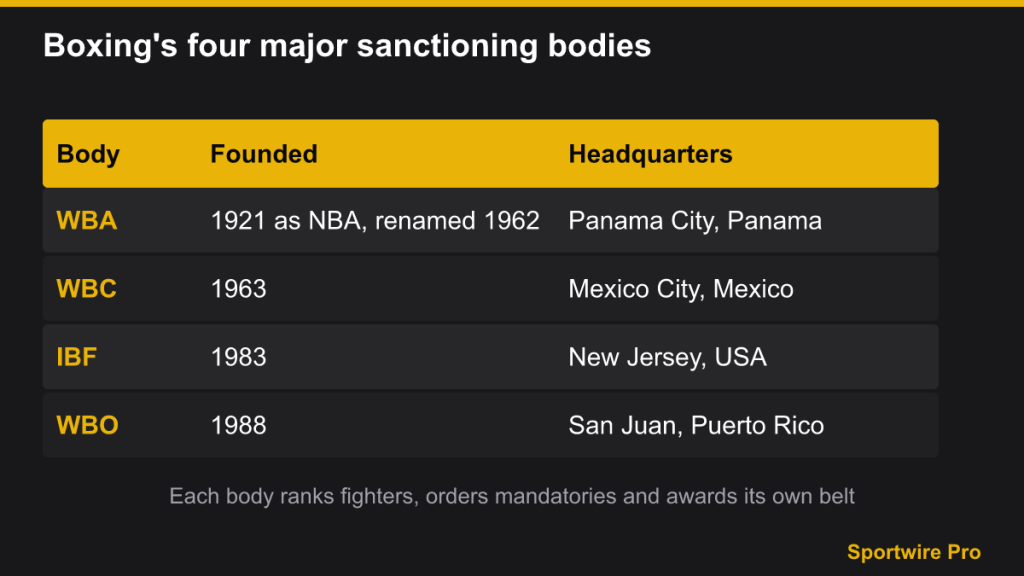
| Organization | Founded | Headquarters |
|---|---|---|
| WBA | 1921 (as NBA); renamed 1962 | Panama City, Panama |
| WBC | 1963 | Mexico City, Mexico |
| IBF | 1983 | New Jersey, USA |
| WBO | 1988 | San Juan, Puerto Rico |
Rankings and Mandatory Challengers
Each organization ranks contenders in every division. The rankings committees consider results, quality of opposition and activity, and they often give weight to fighters who win that organization’s regional titles. The WBO, for example, publishes monthly rankings and gives priority to winners of regional championships from its affiliated bodies. Rankings are not determined by a formula anyone can reproduce, which is why they are frequently debated.
The mandatory challenger is the contender the organization says the champion must face next, usually within a deadline. Mandatories exist so that champions cannot simply pick easy opponents forever. Under WBC rules, for example, a champion must defend against a mandatory challenger at least once a year.
When a mandatory is ordered, the two sides usually get a negotiation period. If they cannot agree on terms, the organization can call a purse bid, in which promoters submit sealed bids for the right to stage the fight, and the purse is split between the fighters according to the organization’s rules. A champion who refuses a mandatory can be stripped, which is the most common reason a fighter “loses” a belt outside the ring.
Organizations can also order eliminators, fights between ranked contenders whose winner becomes the mandatory challenger.
Secondary Titles: Super, Regular, Interim and Franchise
This is where boxing becomes truly confusing. Over the years several organizations have created extra title categories, meaning there can be more than one champion in a division from the same organization.
WBA Super and Regular champions
The WBA introduced its “Super” champion category in 2000. A fighter can be upgraded to Super champion by also holding another major organization’s title, or by making five or more WBA title defenses. When a fighter is elevated, the WBA may fill a separate “Regular” title in the same division, creating two WBA champions at once. Until 2021 the WBA could recognize as many as four champions in one division. In August 2021, the Association of Boxing Commissions criticized multiple titles as misleading to the public and the boxers, and the WBA announced plans to reduce to one champion per division. That consolidation did not last: by 2024 the WBA had resumed sanctioning interim and regular titles in divisions that already had a champion.
Interim champions
An interim title is used when the full champion cannot defend in a reasonable time, typically because of injury or inactivity. The interim champion is usually positioned as next in line to face the full champion, or to be elevated if the title becomes vacant. Most organizations have used interim titles at one point or another.
WBC Franchise, Silver and Diamond titles
The WBC has its own range of special belts:
- Franchise champion, introduced in 2019, is an honorary status for dominant champions who have represented the WBC. A franchise champion vacates the regular WBC title in that division, so the WBC can crown a new champion while the star keeps a special relationship with the organization.
- Silver titles, created in 2010 as a replacement for interim titles, but without automatically inheriting the full title when it becomes vacant.
- Diamond belts, created in 2009 as honorary titles for historic fights between elite boxers.
- Emeritus status, awarded to some former champions, allowing them to return and fight for the title.
WBO Super Champion
The WBO has awarded an honorary “Super Champion” status since the early 2000s. It works more like a lifetime achievement award: it cannot be lost in the ring and can be kept after moving divisions.
The practical rule for fans is simple: when a broadcaster says “world champion,” check which organization and which category. The undisputed champion in a division holds the main title from all four.
The Ring Magazine Belt
The Ring is not a sanctioning body in the traditional sense. It is a boxing publication founded in 1922 by Nat Fleischer, which began awarding championship belts that same year; the first went to heavyweight Jack Dempsey. The magazine stopped awarding belts in the 1990s and reintroduced its championship in 2002.

The Ring title was designed as a lineal-style championship, meant to identify “the man who beat the man.” Under its original modern policy, a Ring title could be won only by beating the reigning Ring champion, or by winning a fight between the magazine’s No. 1 and No. 2 contenders (sometimes No. 3). A champion could lose it by losing a fight, moving divisions or retiring. A controversial 2012 revision added more ways to award and lose the belt, including inactivity; after criticism, the policy was tightened again so that vacant belts are filled mainly by No. 1 vs No. 2 matchups.
The magazine has changed hands several times. In November 2024 it was acquired by Turki Alalshikh, and it moved from being a neutral publication toward an active promotional brand, staging its own events from 2025. Some observers argue this blurs its old role as an independent arbiter, so it is worth knowing the context when you see a Ring belt on the line.
Why Four Bodies, and Is It Good for Boxing?
There are honest arguments on both sides.
In favor: multiple organizations create more title opportunities, more meaningful fights and more paydays for fighters, many of whom never earn large purses. Competition between bodies can also push innovations, such as the WBC’s move to 12 rounds.
Against: multiple belts confuse casual viewers, sanctioning fees take a cut of every title fight, and conflicting mandatories can prevent the biggest fights from happening or force champions to vacate belts. Secondary titles multiply the number of “world champions” even further.
The flip side of fragmentation is that unification fights carry enormous significance. When one fighter collects the WBA, WBC, IBF and WBO titles in a division, they become undisputed champion, which is rare precisely because it requires navigating four sets of rankings, mandatories and politics at once.
A Quick Checklist for Reading a Title Fight
- Which organization or organizations are sanctioning the fight?
- Is it the full title, or a secondary title such as interim, regular, silver or gold?
- Is the challenger the mandatory, or is this a voluntary defense?
- Can both fighters win the belt, or did one miss weight?
- Is The Ring title involved, and is it vacant?
Combine that with an understanding of how fights are scored and the weight classes, and you will be able to follow almost any title fight announcement.