Muhammad Ali’s Legacy: The Fights and Moments That Defined Him
Muhammad Ali's career from Rome 1960 gold to his final fight: the Liston upset, the exile, the Frazier trilogy, Kinshasa and what made his style unique.
Muhammad Ali’s fame reached far beyond boxing, but his reputation starts in the ring. He won an Olympic gold medal at 18, took the heavyweight title as a heavy underdog at 22, lost more than three years of his prime to a ban, and came back to win the championship twice more. Along the way he fought a run of rivals, Sonny Liston, Joe Frazier, Ken Norton and George Foreman among them, that defined an era of heavyweight boxing.
This article follows his career through the fights that mattered most, with a focus on what they meant for boxing and how his style worked.
From Louisville to Rome (1942–1960)
Ali was born Cassius Marcellus Clay Jr. on January 17, 1942, in Louisville, Kentucky. He developed into a fast, rangy amateur, and at the 1960 Olympic Games in Rome he won the light heavyweight gold medal, beating Zbigniew Pietrzykowski of Poland in the final. He was 18.
He turned professional soon after, making his pro debut on October 29, 1960, with a six-round decision over Tunney Hunsaker. Over the next few years he built an unbeaten record and a reputation for brash predictions, rhymes and showmanship that made him one of the most talked-about young fighters in the sport.
The Liston Upset and a New Name (1964–1965)
On February 25, 1964, in Miami Beach, Clay challenged heavyweight champion Sonny Liston. Liston was feared for his punching power, and Clay entered as a heavy underdog, around 8 to 1 by the betting line of the day. Clay used his speed and movement to frustrate the champion, and Liston did not come out for the seventh round. At 22, Clay was the heavyweight champion of the world.
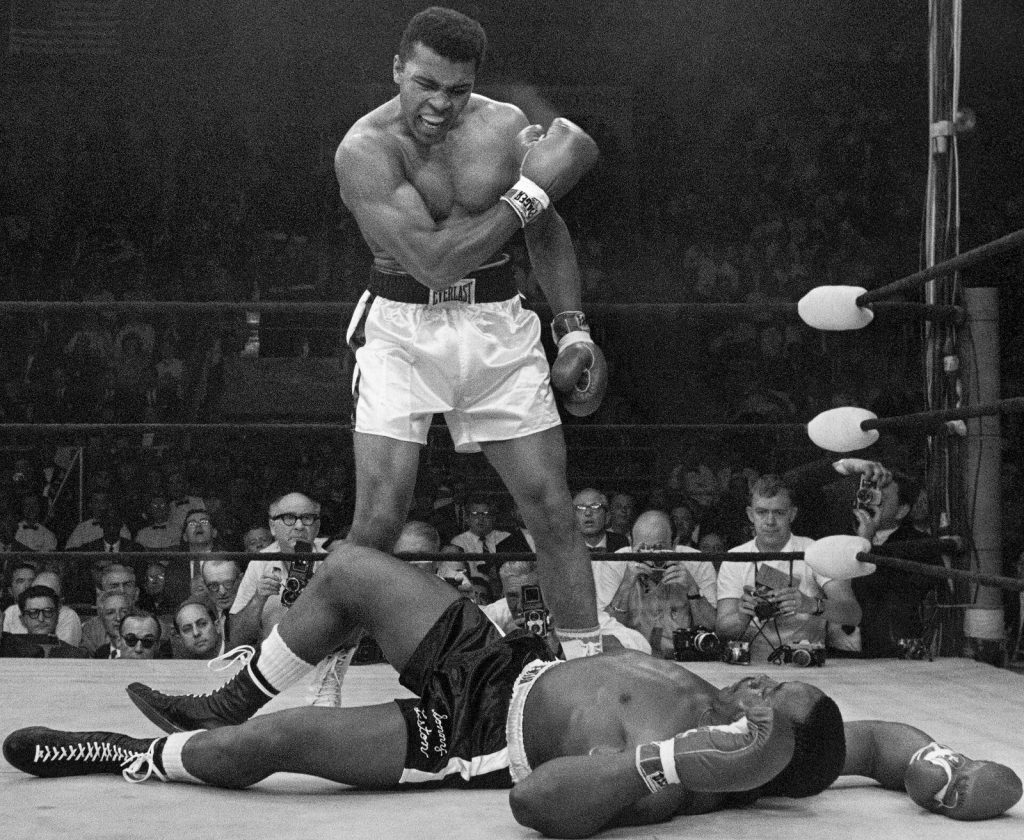
Shortly after the fight, he announced his membership in the Nation of Islam, briefly used the name Cassius X, and then became Muhammad Ali, describing his birth name as a “slave name.”
The rematch, in May 1965 in Lewiston, Maine, was over in the first round. Ali knocked Liston down with a short right hand that many in the arena didn’t see, and the fight became known as the “phantom punch” bout. It remains one of the most debated finishes in boxing history.
The Exile (1967–1970)
On April 28, 1967, in Houston, Ali refused induction into the US Army, citing his religious beliefs and opposition to the Vietnam War. The consequences were immediate. The New York commission suspended his license, the WBA stripped him of its title, and he was soon convicted of draft evasion, sentenced to five years in prison and fined $10,000. He remained free while appealing.
Ali didn’t fight for more than three years, the period widely regarded as what would have been his athletic peak. In August 1970 he was licensed in Atlanta, and on October 26, 1970, he returned with a win over Jerry Quarry, who was stopped after three rounds. On June 28, 1971, the US Supreme Court overturned his conviction in Clay v. United States by an 8-0 vote.
The exile shaped his legacy in two ways. In boxing terms, it took away the years when his speed and reflexes were sharpest. Outside the ring, it turned him into a symbol of conscience for many people around the world, which is a large part of why his fame endures.
The Frazier Trilogy (1971–1975)
Joe Frazier had become heavyweight champion during Ali’s absence, and their rivalry became one of the greatest in sports.
The Fight of the Century (1971)
On March 8, 1971, at Madison Square Garden, two unbeaten heavyweights met in an event billed as the “Fight of the Century.” Frazier’s relentless pressure and left hook won the day. He floored Ali with a left hook in the 15th round, and although Ali was up in about three seconds, Frazier won a unanimous decision. It was the first professional loss of Ali’s career.
The Norton interlude
Before the rematch, Ali lost again in 1973, to Ken Norton, who broke Ali’s jaw and won a decision. Ali won their second fight later the same year, beginning a three-fight rivalry of its own.
Ali-Frazier II (1974)
On January 28, 1974, again at Madison Square Garden, Ali beat Frazier by unanimous decision. No title was at stake, since Frazier had lost the championship to George Foreman a year earlier.
The Thrilla in Manila (1975)
The third fight, on October 1, 1975, in Manila, is widely considered one of the most brutal heavyweight fights ever. Fought in heat approaching 100 °F, it swung back and forth for 14 rounds. Before the 15th, Frazier’s trainer Eddie Futch stopped the fight, with Frazier’s eyes badly swollen. Ali won by stoppage, retaining the title he had regained in Kinshasa.
The Rumble in the Jungle (1974)
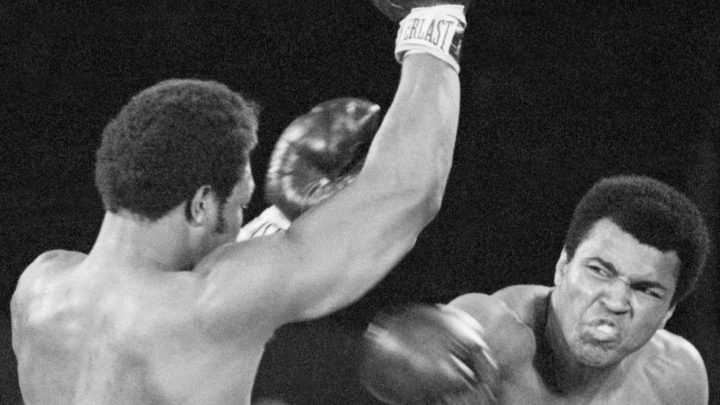
Between the second and third Frazier fights came the most famous win of Ali’s career. On October 30, 1974, in Kinshasa, Zaire, he challenged George Foreman, who was unbeaten and had demolished both Frazier and Norton in two rounds each. Ali was 32 and a clear underdog.
Instead of dancing, Ali leaned on the ropes, covered up and let Foreman punch himself out, a tactic Ali called the “rope-a-dope.” In the eighth round, Ali knocked Foreman down with a right hand, and the referee stopped the fight. At 32, Ali was champion again, seven years after being stripped. The tactics of that night are covered in detail in our upcoming breakdown of the Rumble in the Jungle.
Three-Time Champion and the Final Fights (1978–1981)
By the late 1970s, Ali was slowing down. In February 1978 he lost the title by split decision to Leon Spinks, a far less experienced professional, in one of the biggest upsets of his career. In September 1978, at the Superdome in New Orleans, Ali won the rematch by unanimous decision, becoming the first heavyweight to win the championship three times.
He announced his retirement afterward, but returned. On October 2, 1980, at Caesars Palace in Las Vegas, he challenged Larry Holmes, then the reigning heavyweight champion. Ali was badly outclassed, and trainer Angelo Dundee stopped the fight after the tenth round. It was the only stoppage loss of Ali’s career. He fought once more, losing a ten-round decision to Trevor Berbick on December 11, 1981, in Nassau, Bahamas.
His final professional record was 56 wins, 37 by knockout, and 5 losses. In 1984 he disclosed a diagnosis of Parkinson’s syndrome. Ali died on June 3, 2016, in Scottsdale, Arizona, at 74.
What Made Ali’s Style Different
Ali didn’t fight like the heavyweights before him. His approach is still studied by coaches today.
- Speed at heavyweight: his hand and foot speed were closer to a middleweight’s. He could throw fast combinations and be out of range before an opponent could answer.
- Footwork and movement: in his early career he circled constantly, changed direction and made opponents chase him, using the whole ring.
- The jab: a quick, frequent jab let him control distance and score while moving.
- Unorthodox defense: he often carried his hands low and avoided punches by leaning or pulling back from them, relying on reflexes and distance rather than a high guard. This is generally considered risky and not something coaches teach beginners.
- Adaptability: after the exile, with less speed in his legs, he showed a different skill set: toughness, clinching, ring intelligence and the ability to absorb punishment, most famously in Kinshasa.
- Psychological warfare: his predictions, poems and taunts were part of his game, designed to unsettle opponents and build huge audiences for his fights.
If you’re new to analyzing fights, our beginner’s guide to watching boxing covers what to look for in footwork, distance and the jab, all of which help explain why Ali was so hard to hit in his prime.
Ali’s Place in Heavyweight History
Several points make Ali’s boxing record stand out even apart from his cultural fame:
- Quality of opposition: he fought in a golden era of heavyweights and faced most of its best fighters, including Liston, Frazier, Norton, Foreman, Holmes and many leading contenders.
- Comebacks: he regained the title twice, in 1974 and 1978, after losing it outside and then inside the ring.
- Rivalries: his trilogies with Frazier and Norton show how evenly matched the top of the division was, and how often Ali found a way to win.
- Belt politics: his title was stripped in 1967 because of the draft refusal, not lost in the ring. That chapter is one reason fans distinguish between sanctioning-body belts and lineal championships, a difference explained in our guide to what “undisputed” means.
The late-career losses and the toll of his long career are also part of his legacy, and have fed into ongoing conversations about fighter safety and knowing when to retire.
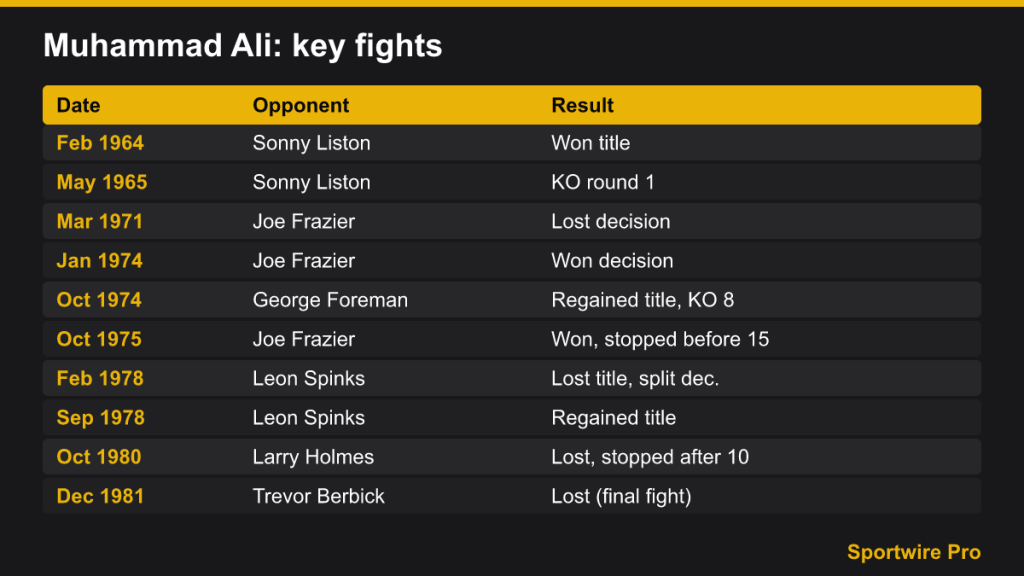
Key Fights at a Glance
| Date | Opponent | Result |
|---|---|---|
| February 25, 1964 | Sonny Liston | Won title; Liston retired after six rounds |
| May 1965 | Sonny Liston | KO in round 1 |
| March 8, 1971 | Joe Frazier | Lost unanimous decision |
| January 28, 1974 | Joe Frazier | Won unanimous decision |
| October 30, 1974 | George Foreman | Regained title; KO in round 8 |
| October 1, 1975 | Joe Frazier | Won; Frazier’s corner stopped it before round 15 |
| February 1978 | Leon Spinks | Lost title by split decision |
| September 1978 | Leon Spinks | Regained title by unanimous decision |
| October 2, 1980 | Larry Holmes | Lost; corner stopped it after round 10 |
| December 11, 1981 | Trevor Berbick | Lost ten-round decision (final fight) |