Boxing Weight Classes Explained: All 17 Divisions From Minimumweight to Heavyweight
All 17 professional boxing divisions with limits in pounds and kilograms, their alternate names, how the Original Eight grew, and where bridgerweight stands.

Boxing has always been a sport of size. A good big fighter usually beats a good small fighter, so the sport divides boxers into weight classes, or divisions, to keep matchups competitive and safer. Today professional boxing recognizes 17 standard divisions, running from minimumweight at 105 pounds to the unlimited heavyweight class. On top of that, one sanctioning body maintains an extra division between cruiserweight and heavyweight.
This guide lists every division with its limit, explains the confusing alternate names, and shows how the sport went from a handful of weight classes to the crowded map it has now.
The 17 Professional Divisions at a Glance
Each division is defined by an upper limit. A boxer competing in a division must weigh no more than that limit at the official weigh-in, and more than the limit of the division below. Here are the 17 divisions recognized by the four major sanctioning bodies (WBA, WBC, IBF and WBO), from lightest to heaviest:
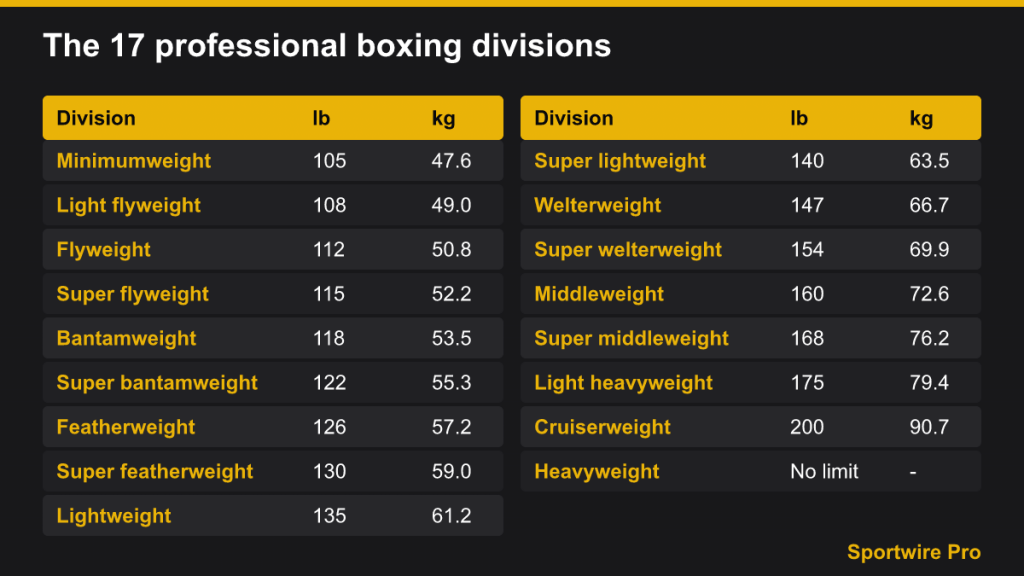
| Division | Upper limit (lb) | Upper limit (kg, approx.) | Other names you will see |
|---|---|---|---|
| Minimumweight | 105 | 47.6 | Strawweight, mini flyweight |
| Light flyweight | 108 | 49.0 | Junior flyweight |
| Flyweight | 112 | 50.8 | — |
| Super flyweight | 115 | 52.2 | Junior bantamweight |
| Bantamweight | 118 | 53.5 | — |
| Super bantamweight | 122 | 55.3 | Junior featherweight |
| Featherweight | 126 | 57.2 | — |
| Super featherweight | 130 | 59.0 | Junior lightweight |
| Lightweight | 135 | 61.2 | — |
| Super lightweight | 140 | 63.5 | Junior welterweight, light welterweight |
| Welterweight | 147 | 66.7 | — |
| Super welterweight | 154 | 69.9 | Junior middleweight, light middleweight |
| Middleweight | 160 | 72.6 | — |
| Super middleweight | 168 | 76.2 | — |
| Light heavyweight | 175 | 79.4 | — |
| Cruiserweight | 200 | 90.7 | Junior heavyweight |
| Heavyweight | No limit | No limit | — |
Pounds are the official unit in most professional boxing, which is why limits land on round numbers like 147 or 160 and the kilogram figures look awkward. In practice, commentators and fighters almost always talk in pounds.
Why are there so many alternate names?
The names differ because the sanctioning bodies never fully agreed on what to call the divisions they added. “Junior” and “super” mean the same thing in boxing: the new division sits just below or just above an established one. So a 140-pound fighter might be called a super lightweight by one organization and a junior welterweight by another, even though the weight limit is identical. “Light” is used the same way, as in light welterweight or light middleweight. The minimumweight class has had the most names of all, including strawweight, mini flyweight (the WBO’s term) and, in its early days, paperweight.
When you read a fight poster or a record, it helps to remember that the number matters, not the label. If two names share a limit, they are the same division.
The Original Eight
Early prizefighting had no weight classes at all. Anyone could fight anyone, and the heaviest men usually dominated. Standard limits arrived gradually. Britain’s National Sporting Club set standard weights in 1909, and New York’s Walker Law of 1920 helped standardize divisions in the United States.
The divisions that existed through much of the 20th century are often called the “Original Eight,” or the traditional or glamour divisions:
- Flyweight
- Bantamweight
- Featherweight
- Lightweight
- Welterweight
- Middleweight
- Light heavyweight
- Heavyweight
For decades there was essentially one recognized world champion in each of these eight classes. That scarcity is a big part of why titles from that era carry so much prestige in boxing history. Being “the” middleweight champion meant something very specific.
How Eight Became Seventeen
The gaps between the original eight divisions were large. The jump from lightweight (135) to welterweight (147) is 12 pounds, and from middleweight (160) to light heavyweight (175) is 15 pounds. A fighter who sat naturally between two limits either had to cut a lot of weight or give up size to bigger opponents.
The so-called “tweener” divisions were created to fill those gaps. They took years to be taken seriously, and recognition came in stages. According to the historical record summarized on Wikipedia, sanctioning bodies recognized super lightweight and super featherweight around 1959, super welterweight in 1962, light flyweight in 1975, super bantamweight in 1976, cruiserweight in 1979 and super flyweight in 1980. Minimumweight was the last of the 17 to arrive: the IBF crowned the first champion in June 1987, the WBC followed in October 1987, the WBA in January 1988 and the WBO in August 1989.
The cruiserweight story
Cruiserweight is a good example of how a new division evolves. It was created to give boxers too heavy for light heavyweight but too small for modern heavyweights a home. The WBC sanctioned its first cruiserweight title fight in December 1979, with an original limit of 190 pounds. The WBA initially used the name “junior heavyweight” when it crowned its first champion in 1982. The limit was later raised and today stands at 200 pounds.
Why more divisions also meant more champions
Divisions multiplied at the same time as sanctioning bodies did. With four major organizations each crowning a champion in 17 divisions, there can be dozens of “world champions” at once, before counting secondary titles. Supporters say smaller weight gaps are fairer and safer because fighters do not have to cut as much weight. Critics say the sport became harder for casual fans to follow. Both points have some truth, and they explain why fans place extra value on fighters who unify belts in a single division.
Bridgerweight: The Division Between Cruiserweight and Heavyweight
As heavyweights grew bigger over the decades, the gap between the 200-pound cruiserweight limit and the unlimited heavyweight class became enormous. A 205-pound fighter could find himself facing an opponent of 250 pounds or more.
The WBC responded by announcing a new division on November 9, 2020, covering boxers from 200 up to 224 pounds (about 101.6 kg). It named the division “bridgerweight” in honor of Bridger Walker, a six-year-old American boy who protected his younger sister from a dog attack in July 2020. The WBC’s first bridgerweight world title fight took place on October 22, 2021.
The division’s acceptance has been limited:
- WBC: created the division and continues to crown a bridgerweight champion.
- WBA: introduced a 224-pound division of its own in December 2023, but on June 30, 2026 it announced it would stop recognizing the class to streamline its championship structure.
- IBF and WBO: have not adopted it.
So as of October 2026, bridgerweight is effectively a WBC-only division. That is why most references, including the headline of this article, still describe professional boxing as having 17 divisions, with bridgerweight treated as an addition rather than a universally accepted 18th class.
How Weight Classes Work in Practice
The weigh-in
Professional boxers typically weigh in the day before the fight. Making weight means hitting the division limit (or a contracted lower weight) on the official scale. Because the fight happens the next day, boxers often step into the ring several pounds heavier than the division name suggests. A super middleweight might weigh noticeably more than 168 pounds by fight night. This is why some organizations have introduced additional checks; we will cover weigh-in rules in more detail in a dedicated article.
What happens when a fighter misses weight
If a boxer comes in over the limit, the consequences depend on the commission, the contract and whether a title is at stake. Common outcomes include a financial penalty paid to the opponent, a bout that goes ahead as a non-title fight, or a cancellation. In title fights, a champion who misses weight usually loses the belt on the scale, and in many cases only the opponent can win it in the ring.
Catchweights
A catchweight is a negotiated limit that does not match a standard division, agreed before the weigh-ins. Catchweights often appear when fighters from different divisions meet, or when one side uses its bargaining power to make a bigger opponent come down in weight. Fans sometimes criticize catchweights for that reason, but they are a normal part of matchmaking.
Moving Between Divisions
Many of the most celebrated boxers in history built their reputations by winning titles in multiple weight classes. A “two-division champion” or “four-division champion” has won world titles at that many different weights. Moving up usually means giving away natural size and punch resistance to bigger opponents. Moving down can leave a fighter drained from cutting weight. Good teams weigh up a fighter’s frame, power and durability before making a jump.
A few practical points for fans:
- Naturally bigger is not always better. A boxer who is huge for a division may be draining himself to get there, which can affect stamina and durability.
- Speed and power scale differently. Speed often carries up well; one-punch power sometimes does not.
- Heavyweight is a special case. Because there is no upper limit, heavyweights vary widely in size, and smaller heavyweights must find ways to deal with much larger opponents.
Professional vs Amateur Weight Classes
Amateur and Olympic boxing use their own, smaller set of weight classes measured in kilograms, and they are revised more often than the professional divisions. A boxer turning professional will usually find a pro division close to their amateur weight, but the numbers do not map exactly. The professional system described here applies to pro bouts sanctioned by the major organizations.
If you are new to the sport, our guide on how boxing scoring works is a good companion to this one, since scoring and weight classes are the two rule areas fans ask about most.
Quick FAQ
What is the most popular weight class?
There is no official measure, but heavyweight has historically drawn the biggest attention, while divisions such as welterweight and middleweight have produced many of the sport’s most famous champions.
Is there a division above heavyweight?
Not in professional boxing among the four major bodies. Heavyweight has no upper limit. Some amateur systems have used a super heavyweight category, but that is separate from the pro system.
Do men and women use the same divisions?
Professional women’s boxing generally uses the same named divisions and limits, although not every division is equally active.