The Rumble in the Jungle Explained: How Ali Beat Foreman With the Rope-a-Dope
How Muhammad Ali beat George Foreman in Kinshasa in 1974: the context, the delay, the rope-a-dope, the eighth-round knockout and why the fight is still studied.
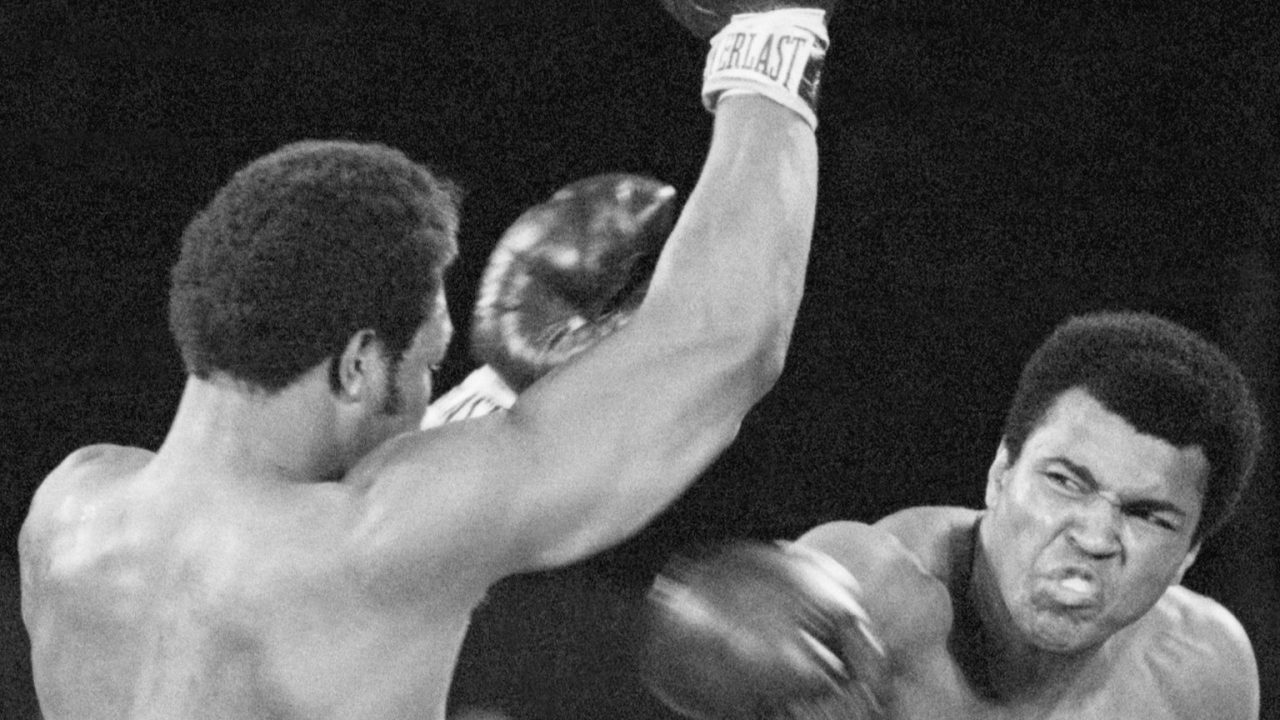
On October 30, 1974, in Kinshasa, Zaire, a 32-year-old former champion beat an unbeaten heavyweight who was seven years younger and had flattened everyone in his path. Muhammad Ali’s win over George Foreman is one of the most famous fights ever, but it is also one of the most instructive. Ali won not by out-punching or out-running Foreman, but by doing what almost nobody expected: standing on the ropes and letting the hardest puncher in the world hit him.
This article looks at the fight itself: the setup, the delay, the tactics round by round and why trainers still talk about it. For the rest of Ali’s career, see our guide to Muhammad Ali’s legacy.
The Context: Two Very Different Heavyweights
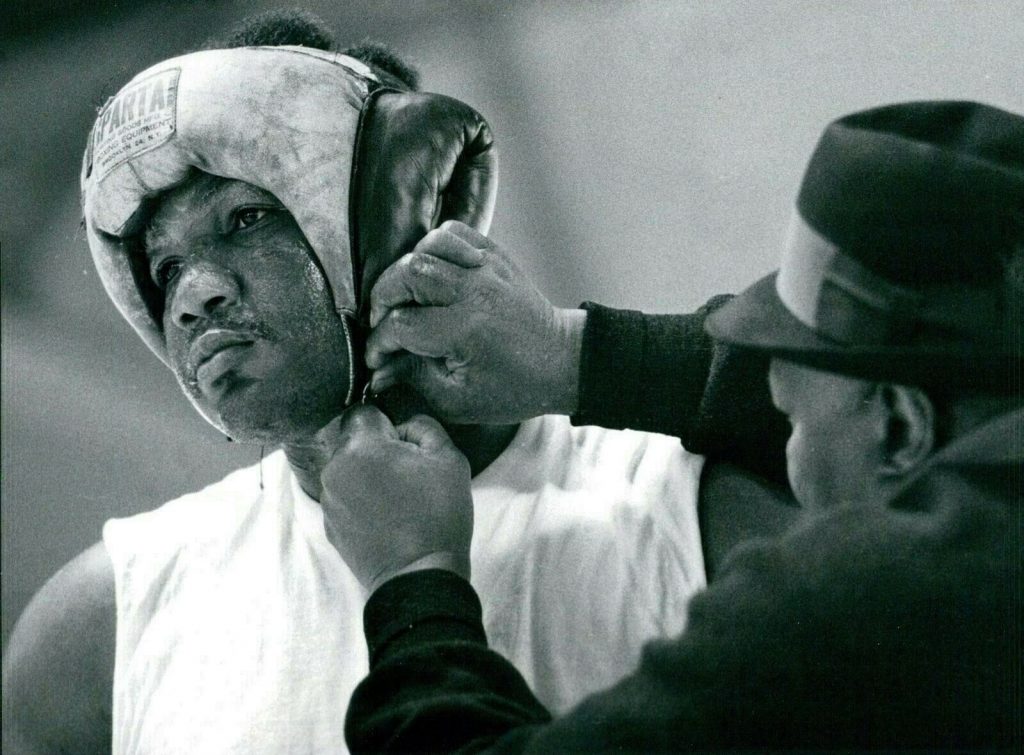
George Foreman, the champion
Foreman had won heavyweight gold at the 1968 Olympics in Mexico City. As a professional he was a destroyer. On January 22, 1973, in Kingston, Jamaica, he took the title from Joe Frazier, knocking him down six times in two rounds. On March 26, 1974, in Caracas, he stopped Ken Norton in the second round. Both men had beaten Ali. Foreman entered Kinshasa with a record of 40-0 with 37 knockouts, holding the WBA and WBC titles along with The Ring and lineal heavyweight championship. He was 25.
Muhammad Ali, the challenger
Ali was 32, with a record of 44-2 and 31 knockouts. His two losses were to Frazier and Norton, the two men Foreman had demolished. He was more than three years removed from his exile, his legs no longer as quick as they had been in the 1960s. He entered the fight as roughly a 4-to-1 underdog, and many observers feared for his health.
On paper, the matchup looked grim for Ali. The fighters who had given him his hardest nights had lasted barely two rounds against Foreman.
Kinshasa, the Delay and the Setting
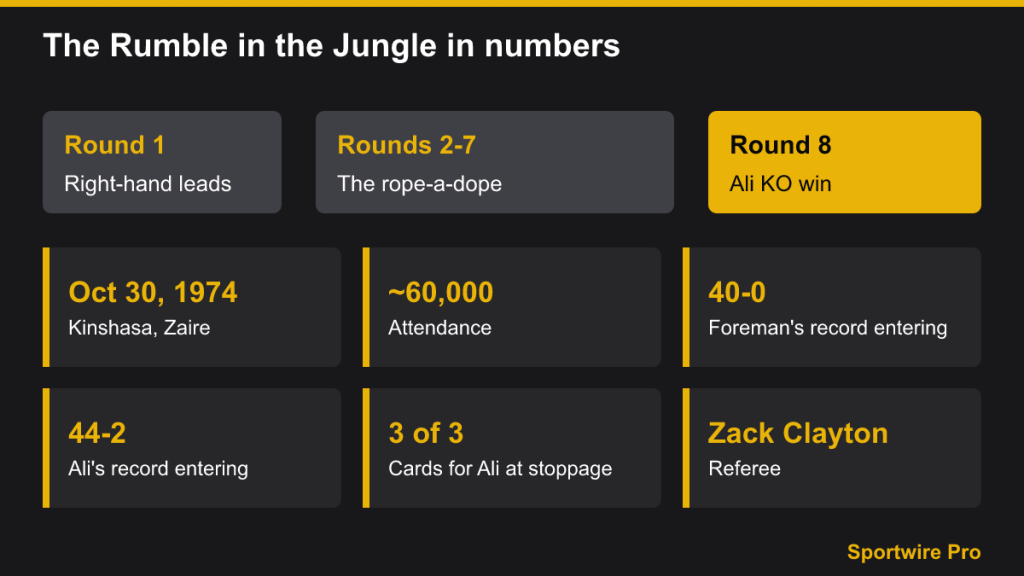
The fight was promoted by Don King, and Zaire’s president, Mobutu Sese Seko, agreed to host it. Each fighter was paid $5 million. The venue was the Stade du 20 Mai in Kinshasa, with a crowd of about 60,000.
The fight was originally scheduled for September 25, 1974. Eight days before, Foreman was cut above the eye by an accidental elbow from a sparring partner and needed 11 stitches. The fight was pushed back five weeks to October 30. A music festival, Zaire 74, featuring artists including James Brown and B.B. King, went ahead as planned in September.
The delay had consequences. Both fighters stayed in Zaire, and Ali used the extra weeks to win over the local public. By fight night, the crowd chanted “Ali, boma ye,” translated as “Ali, kill him.” Foreman, by contrast, had become an outsider in a stadium full of Ali supporters.
To air live in prime time on the US East Coast, the fight was held at around 4 a.m. local time. An estimated one billion people watched worldwide.
The Fight, Round by Round
Round 1: The right-hand leads
Ali surprised Foreman immediately by attacking with right-hand leads, a punch most trainers consider risky because it is thrown from the rear hand without a jab to set it up. The idea was to hit Foreman with something he wasn’t expecting and to show he was not afraid. By the end of the round, Foreman had begun to close the distance, and it was clear that Ali couldn’t simply dance away for 15 rounds in the African heat.
Rounds 2 to 7: The rope-a-dope
From the second round, Ali did something that alarmed his own corner. He went to the ropes, leaned back, covered up with his arms and gloves high, and let Foreman throw. Foreman pounded his arms and body. Ali clinched, tied up Foreman’s arms, leaned his weight on the bigger man, and talked to him constantly, reportedly taunting him to throw harder.
Ali later called it the “rope-a-dope.” To many ringside, it looked like a man surviving rather than a man winning. But between Foreman’s bursts, Ali fired quick, straight counters, especially when Foreman’s punches missed or his hands dropped. Round after round, Foreman expended enormous energy, and his punches lost their snap.
Round 8: The finish
Late in the eighth round, with Foreman exhausted and still pressing, Ali came off the ropes with a fast combination capped by a straight right hand. Foreman went down, and referee Zack Clayton waved the fight off before Foreman got back to his feet. At the time of the stoppage, Ali was ahead on all three cards: 68-66, 70-67 and 69-66.
Ali had regained the heavyweight title, seven years after it had been stripped from him.
Why the Rope-a-Dope Worked
The rope-a-dope is often described as a trick. It was really a combination of conditions and skills that rarely line up.
- Foreman’s style: Foreman threw heavy, wide punches and was used to finishing fights early. He had rarely needed to pace himself, and he had rarely been past the early rounds as a professional.
- The heat and the hour: conditions in Kinshasa punished anyone who burned energy. The fighter doing the work suffered more than the fighter absorbing it.
- The ropes: leaning on the ropes allowed Ali to absorb some of the force of Foreman’s shots by moving with them, while keeping his hands high. The tension of the ropes became a point of controversy afterward.
- Ali’s defense on the ropes: with gloves and forearms high, many of Foreman’s power shots landed on arms and shoulders rather than cleanly on the head.
- Clinching and leaning: each time Ali tied Foreman up and leaned on him, Foreman carried Ali’s weight, adding to his fatigue.
- Counters: Ali didn’t just cover up. His sharp counters kept scoring and made Foreman pay for over-committing.
- The mental battle: Ali’s constant talking needled Foreman into throwing more and harder, exactly what Ali wanted.
It is important to stress that this was an enormously dangerous strategy. It depended on Ali’s ability to take punishment, his reading of Foreman’s fatigue and conditions specific to that night. Coaches study it as an example of tactical adaptation, not as a template for beginners.
The Ropes Controversy
Foreman later claimed that Ali’s trainer, Angelo Dundee, had loosened the ropes before the fight, allowing Ali to lean further back and away from punches. Dundee’s account was the opposite: he said the heat had made the ropes slack, that he had tried to tighten them, and that the rope-a-dope was Ali’s own idea. Foreman also later claimed he had been drugged by his own trainer before the bout. None of these disputes changed the result, and Foreman himself, years later, reflected simply that “it just wasn’t my night.”
What Trainers Learn From the Fight
The Rumble in the Jungle is studied for reasons that go beyond the famous finish.
Adapting the game plan
Ali’s camp had talked publicly about dancing and outboxing Foreman. Once Ali felt how quickly Foreman cut off the ring, he switched approach within the first round. Recognizing that a plan isn’t working and changing it is one of the hardest skills in boxing.
Pacing and energy
Foreman’s power was unquestioned, but he had little experience of long fights. The fight is a lesson in how conditioning and energy management can neutralize raw power. A fighter who wins the first five rounds and fades badly can still be stopped.
Attacking the opponent’s confidence
Ali’s taunts, his ability to take punches and his refusal to look hurt eroded Foreman’s belief. By the middle rounds, Foreman was hitting his opponent with his best shots and seeing nothing happen. That is psychologically draining for any fighter.
Using the ropes
For most boxers, being on the ropes is a bad place to be: it limits movement and invites combinations. Ali turned it into a defensive base. Modern boxers who fight comfortably on the ropes, using shoulders, forearms and counters, owe something to that night, though very few would choose to spend seven rounds there.
If you’re learning to read fights, our beginner’s guide to watching boxing covers ring cutting and distance, the exact battle Foreman was winning in round one and losing by round eight.
The Legacy of Kinshasa
The fight’s reach was enormous. Beyond the estimated one billion viewers, about 50 million people watched via closed-circuit and pay-per-view, and the event was estimated to have grossed around $100 million worldwide. It confirmed Don King as a major promoter and brought world championship boxing to Africa on a scale never seen before.
The documentary When We Were Kings (1996), built around the fight and its build-up, won the Academy Award for Best Documentary Feature, introducing the story to a new generation.
For Foreman, the loss was a turning point. He eventually retired, returned years later, and on November 5, 1994, at 45, knocked out Michael Moorer in the tenth round to regain the heavyweight title, one of the great comebacks in the sport. Foreman died on March 21, 2025, at 76.
Quick Facts
| Detail | Fact |
|---|---|
| Date | October 30, 1974 |
| Venue | Stade du 20 Mai, Kinshasa, Zaire (now the Democratic Republic of the Congo) |
| Attendance | About 60,000 |
| Records entering | Foreman 40-0 (37 KOs); Ali 44-2 (31 KOs) |
| Result | Ali by knockout in round 8 |
| Referee | Zack Clayton |
| Cards at stoppage | 68-66, 70-67, 69-66, all for Ali |
| Original date | September 25, 1974, postponed after Foreman’s sparring cut |