Pound-for-Pound Rankings Explained: How They Work and Who Makes Them
What "pound for pound" means, where the term came from, who publishes P4P lists in boxing and MMA, the criteria they use and why every list is subjective.
Combat sports divide fighters by weight, so a flyweight and a heavyweight will never meet. Yet fans have always wanted to know who is the best fighter, period. “Pound for pound” is the answer the sport invented: a way to compare fighters across divisions by imagining that they were all the same size.
This guide explains what the term means, where it came from, who publishes the best-known lists in boxing and MMA, the criteria those lists use and why they will always be argued about. It deliberately avoids current rankings, which change after almost every big fight.
What “Pound for Pound” Means
A pound-for-pound (P4P) ranking ranks fighters regardless of weight class. The thought experiment is simple: if every fighter were the same size, who would be the best? Since that can never be tested, P4P lists rely on judging a fighter’s skill, achievements and level of competition relative to their own division.
In practice, that means a P4P list is not a ranking of who would win a fight between two listed fighters. A heavyweight ranked fifth would almost certainly beat a flyweight ranked first in a real fight. The list is a measure of excellence, not of who is the most dangerous person in the building.
Because the fighters on a P4P list never fight each other across weight classes, the ranking always requires subjective judgment. Different lists often disagree, sometimes sharply.
Where the Term Came From
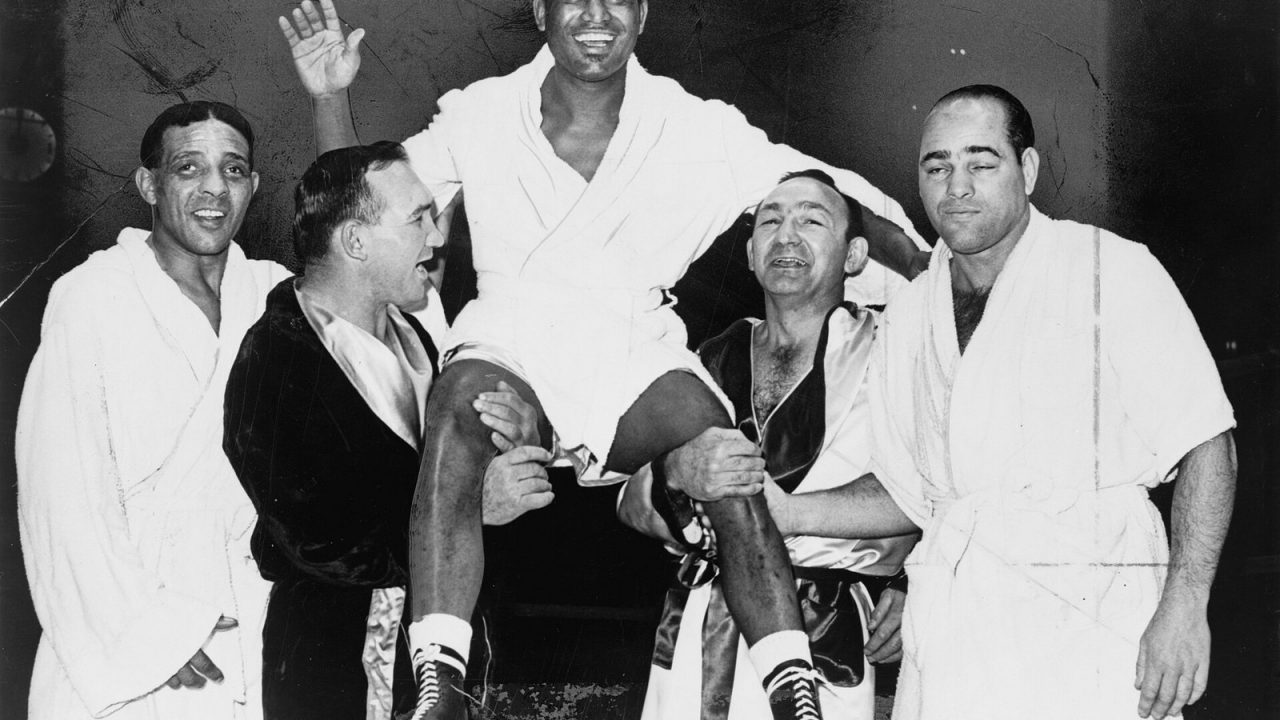
The idea of comparing fighters “pound for pound” is historically associated with two boxers in particular: lightweight great Benny Leonard and, above all, Sugar Ray Robinson.
The term was a way of recognizing fighters who were widely seen as the most skilled of their era but who weren’t heavyweights. For much of boxing history, the heavyweight champion was the most famous and best-paid fighter in the sport. Calling a smaller fighter the best “pound for pound” was a way to say that skill, not size, made him the greatest boxer around.
Robinson is the fighter most closely linked to the phrase. Sportswriters used it during his career to express that he was the best boxer in the world, despite fighting at welterweight and middleweight. His credentials helped: he won the vacant world welterweight title in December 1946, held it until 1951, and then became the first boxer to win a divisional world championship five times, all at middleweight. Over a professional career from 1940 to 1965, his record is listed as 174 wins, 19 losses and 6 draws, with 109 knockouts, though record figures vary slightly by source. Fighters including Muhammad Ali, Joe Louis, Roberto Durán and Sugar Ray Leonard have named Robinson the greatest pound-for-pound boxer ever, and in 1997 The Ring named him the best pound-for-pound fighter in history.
Who Publishes Pound-for-Pound Lists
The Ring (boxing)
The Ring magazine’s list is the best-known in boxing. The magazine began naming a pound-for-pound top 10 in 1989, and its first No. 1 was heavyweight champion Mike Tyson. The list is set by editorial consensus rather than a points formula, and updates follow major fights or significant changes in a boxer’s activity or level of competition, rather than a fixed schedule.
Because the list is editorial, its keepers sometimes make judgment calls that a formula never would. In 2012, for example, members of the magazine’s editorial board chose to vacate the No. 1 position Manny Pacquiao had held, a call that a points formula would never make. Decisions like that show the list for what it is: a considered opinion from people who watch the sport closely, rather than a mechanical output. That’s also why it carries weight with fans: the people behind it are known, and their reasoning is usually explained in print.
Media outlets
Major outlets such as ESPN publish their own boxing and MMA pound-for-pound lists, typically built from the ballots of a panel of writers and analysts. Other sites and data-driven services publish MMA and kickboxing P4P rankings too.
Promotions (MMA)
In MMA, promotions publish official lists themselves. The UFC has had pound-for-pound rankings since 2013, and ONE Championship has published rankings across its sports since 2020. The UFC’s rankings are generated by a voting panel of media members, and only fighters with active status in the UFC are eligible. Champions and interim champions automatically occupy the top spots in their own divisions, but they can be voted on for the pound-for-pound list. The UFC publishes separate men’s and women’s P4P lists. For more on how these rankings feed into title shots, see our guide to how the UFC works.
Why there’s no official boxing P4P list
Boxing’s sanctioning bodies rank fighters within divisions, not across them. A pound-for-pound list in boxing is therefore always the opinion of a magazine, outlet or panel, never an official ranking that determines who gets title shots.
The Criteria Behind the Lists
Every list sets its own standards, but most consider some combination of the following:
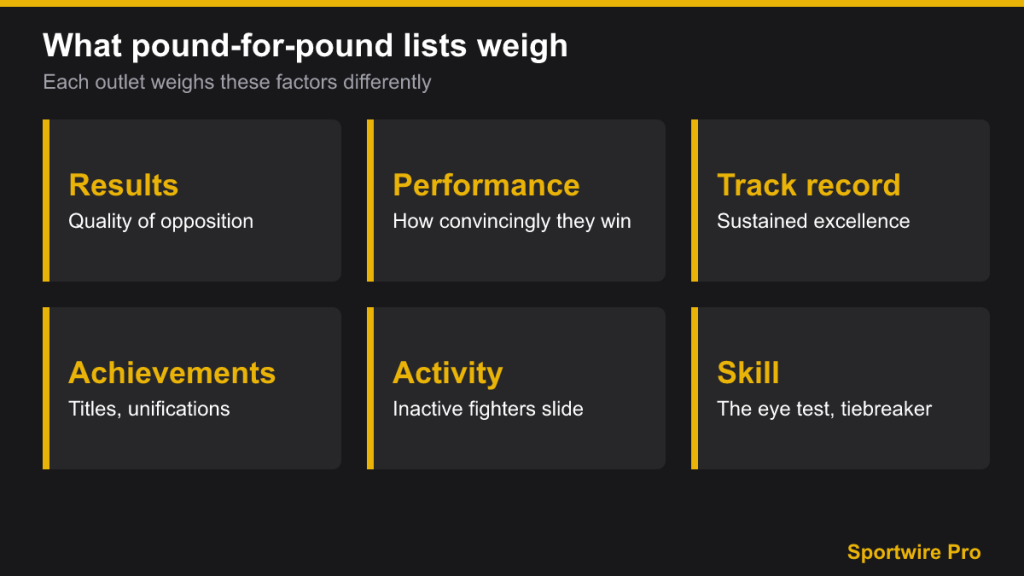
- Results and quality of opposition: who a fighter has beaten, and how good those opponents were at the time. Beating top contenders and other champions counts far more than a long unbeaten run against modest opposition.
- Performance: how convincingly a fighter wins. A dominant performance against an elite opponent moves a fighter up more than a narrow, disputed decision.
- Track record: sustained excellence over several years, rather than a single big night.
- Achievements: world titles, unifications, undisputed status and success in multiple weight classes. Our guide to what “undisputed” means explains why holding every belt in a division is so rare.
- Activity: fighters who don’t compete for long periods tend to slide down or drop off lists.
- Skill and versatility: the “eye test” of how complete a fighter is, often a tiebreaker between fighters with similar records.
Different outlets weigh these factors differently. Some lean heavily on recent results; others give more credit to a fighter’s whole body of work.
Why Pound-for-Pound Lists Are Always Subjective
P4P debates are among the most heated in combat sports, and they will never be settled. Some built-in reasons:
- No head-to-head test: the fighters on the list typically never meet, so there is no direct evidence of who is better.
- Division depth varies: a champion in a deep division with many strong contenders may be judged differently from one in a thin division, but measuring depth is itself subjective.
- Moving up in weight: fighters who move up and win titles in heavier divisions often get large boosts, because beating bigger opponents is seen as a sign of skill. Whether that should count more than dominating one division is debated.
- Recency and visibility: fighters who compete on big stages are more visible to voters, and recent performances tend to loom larger than older ones.
- Size bias: some critics argue that lists overrate lighter fighters or underrate heavyweights; others argue the opposite.
- Different priorities: one voter may value an unbeaten record; another may value a willingness to take tough fights and occasionally lose.
None of this makes P4P lists meaningless. They are useful snapshots of expert opinion and great conversation starters. They just aren’t measurements.
How Pound-for-Pound Lists Affect the Sport
Even though they’re unofficial in boxing and have no bearing on title eligibility, P4P rankings matter:
- Marketing: promoters use a fighter’s P4P status to sell fights, and fighters often cite it in negotiations and interviews.
- Superfights: P4P debates help create demand for fights between champions in neighboring divisions, which can lead to moves up or down in weight.
- Legacy: being recognized as the sport’s No. 1 pound-for-pound fighter is often seen as the highest individual accolade in boxing and MMA, beyond any single belt.
- Fan engagement: updates after major fights create discussion and draw attention to fighters in lighter, less heavily promoted divisions.
How to Read a P4P List
A few tips for getting the most out of any pound-for-pound ranking:
- Check who made it. An editorial board, a panel of media voters and a promotion’s own list may have very different priorities.
- Check the methodology. Panel-based lists sometimes publish individual ballots; editorial lists usually explain movement in an accompanying article.
- Compare lists. Fighters who appear near the top on several independent lists are the ones experts broadly agree on.
- Look at the date. P4P lists change quickly. A ranking from a year ago may not reflect who has fought, won or retired since.
- Remember the weight classes. A refresher on boxing’s 17 weight classes helps put achievements like multi-division titles in context.
Above all, understanding who made a list and how is the best defense against reading too much into a single position.
Quick Answers
Who invented the term “pound for pound”?
No single person is credited. Sportswriters used it during Sugar Ray Robinson’s career, and it is historically associated with Robinson and with Benny Leonard.
When did The Ring start its P4P list?
The Ring began naming a pound-for-pound top 10 in 1989, with Mike Tyson as its first No. 1.
Does being No. 1 pound for pound earn a title?
No. P4P status is recognition, not a championship. It doesn’t affect mandatory challengers or title eligibility in boxing.
Does the UFC have an official P4P ranking?
Yes. The UFC has published pound-for-pound rankings since 2013, voted on by a media panel, with separate lists for men and women.