A Beginner’s Guide to Watching Boxing: What to Look For in a Fight
New to boxing? How fight night is structured, what the referee and judges do, and what to watch: the jab, distance, body work and ring cutting.
Boxing can be one of the most rewarding sports to watch, but it is also one of the easiest to misread. To a newcomer, a round where neither fighter lands anything big can look like nothing happened, while an experienced fan sees one boxer quietly taking control. The difference is knowing what to look for.
This guide walks you through a typical fight night, explains who does what inside and around the ring, and gives you a simple framework for reading a fight as it unfolds.
How a Fight Card Is Structured
A boxing event, or card, is a series of bouts staged on the same night. They are usually arranged so that the most important fights come last.
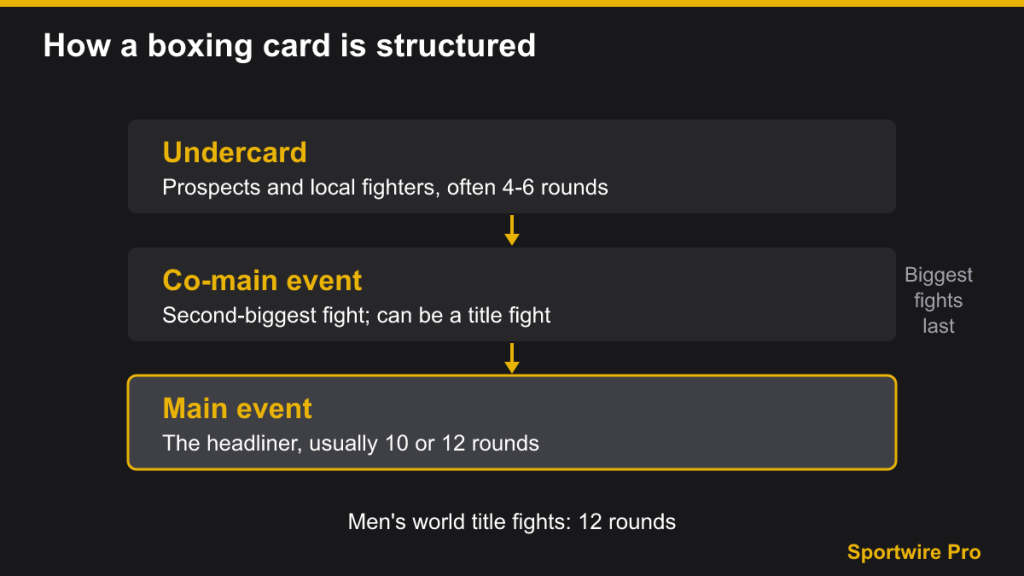
- Undercard: the early bouts. These often feature prospects building their records, local fighters and short four- to six-round contests. Many future champions start out here.
- Co-main event: the second-most important fight, just before the headliner. It can be a title fight in its own right.
- Main event: the headline bout the card is built around, usually scheduled for 10 or 12 rounds. Men’s world title fights are 12 rounds; women’s title fights have generally been 10 rounds.
Broadcasts often show only part of the card, so the bouts you see on television or streaming may be a selection of the night’s action. Start times for the main event are notoriously hard to predict, because they depend on how long the earlier fights last. A string of early knockouts can bring the headliner forward; a run of fights that go the distance pushes it back.
Fight Night From Start to Finish
Ring walks
Before a main event, each fighter walks to the ring with their team, usually to music of their choice. Ring walks are part of the spectacle, but they also tell you something: watch how relaxed or tense each fighter looks.
Introductions and instructions
The ring announcer introduces both fighters with their records and weights. The referee then brings them to the center of the ring for final instructions, reminding them to protect themselves at all times and to obey commands such as “break.”
The rounds
Professional rounds last three minutes for men, with one minute of rest between rounds. Women’s professional bouts have generally used two-minute rounds, with a maximum of 10 rounds. Between rounds, each fighter sits in the corner while the trainer gives instructions and the cutman treats any swelling or cuts.
The result
A fight ends either inside the distance, by knockout, technical knockout, disqualification or another stoppage, or it goes the full scheduled distance and is decided by the judges. The announcer reads the scorecards and the result. We explain every type of result in a dedicated article later in this series.
Who Is Who: The Officials
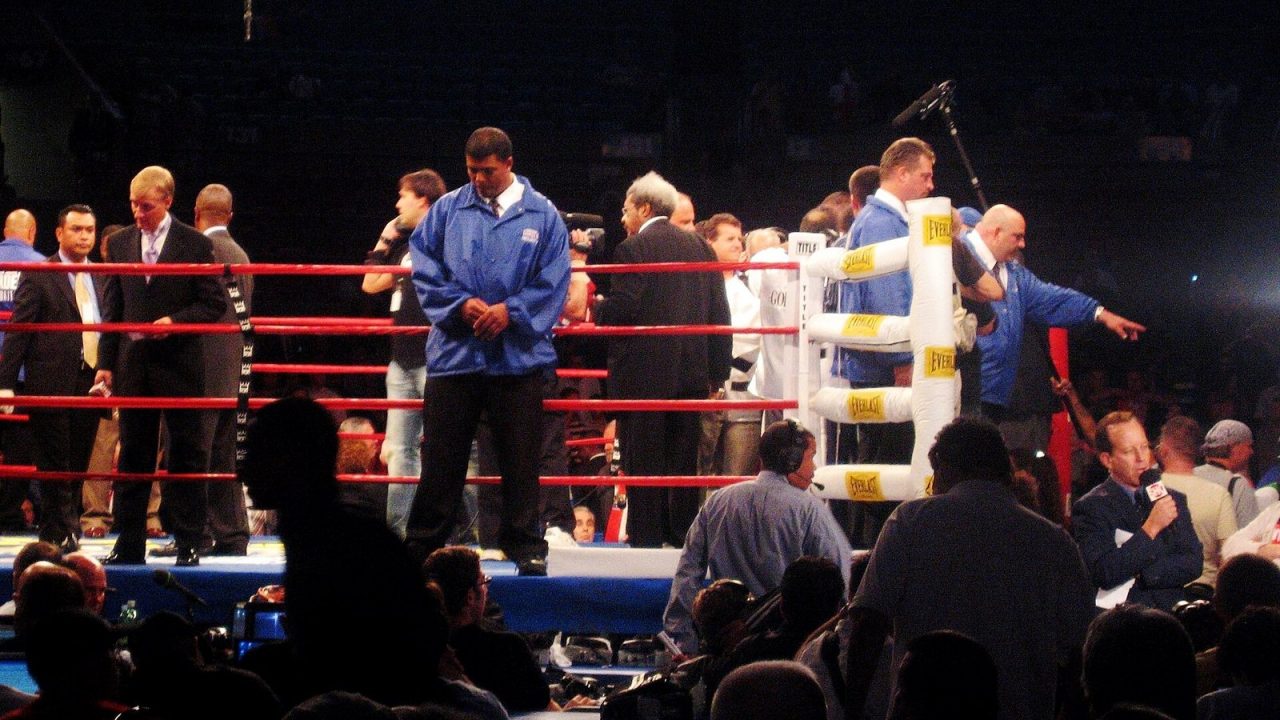
The referee
The referee is the only official inside the ring. Their job is to enforce the rules and, above all, protect the fighters. They separate boxers when they hold, warn or deduct points for fouls, administer knockdown counts and stop the fight when a boxer can no longer defend themselves. A good referee is barely noticed; a bad stoppage, too early or too late, becomes the story of the night.
The judges
Three judges sit at ringside, usually on different sides of the ring, and score each round independently using the 10-point must system. The winner of a round gets 10 points and the loser 9 or fewer. Knockdowns and point deductions widen the margin. If the bout goes the distance, the judges’ totals decide the winner. Our full guide on how boxing scoring works covers this in detail, including what judges look for and how split and majority decisions happen.
The ringside doctor and the commission
A ringside physician is present to assess injuries, especially cuts, and can advise the referee to stop the fight. The athletic commission or national boxing board oversees the event: it licenses the fighters and officials, supervises weigh-ins and hand-wrap checks, and handles any disputes.
The corner
Each fighter’s corner typically includes a head trainer, an assistant and a cutman. The corner can stop the fight by throwing in the towel or by telling the referee their fighter will not continue.
What to Watch For: A Simple Framework
You do not need to track every punch. Focus on a few key elements, and the fight will start to make sense.
1. The jab
The jab, the straight punch with the lead hand, is often called the most important punch in boxing. It measures distance, scores points, sets up power punches and disrupts the opponent’s rhythm. Ask yourself: whose jab is landing? Is one fighter able to jab freely while the other cannot get close? A boxer who wins the jab battle often wins the fight.
2. Distance
Every boxer has a preferred range. Taller fighters with long arms usually want to fight at the end of their jab. Shorter, aggressive fighters want to get inside, where they can throw hooks and uppercuts. Much of a fight is a battle over who gets to fight at their range. Watch whether the shorter fighter is getting inside or being kept on the outside.
3. Body work
Punches to the body rarely look spectacular, but they matter. They drain stamina, slow an opponent’s movement and lower their guard, which opens up the head later. A boxer who invests in body punching early is often building toward the later rounds. If one fighter starts to slow down or hold after round six or seven, look back at how many body shots they absorbed.
4. Ring generalship and cutting the ring
“Ring generalship” means controlling where and how the fight takes place. Watch the feet, not just the hands. Is one fighter constantly moving forward and the other backing up? Pressure fighters try to “cut off the ring,” stepping sideways to block escape routes and trap the opponent against the ropes or in a corner. Mobile boxers try to circle out and reset to the center. Who is dictating the geography of the ring?
5. Defense
Good defense is easy to miss because it means nothing happens. Watch for slips (small head movements that make punches miss), blocks, parries and footwork that takes a boxer just out of range. A fighter who makes an opponent miss repeatedly, then counters, is winning exchanges even if the crowd does not react.
6. Adjustments between rounds
The best fights are often chess matches. A fighter losing the early rounds may change tactics: switching to the body, moving more, or pressuring harder. When the broadcast lets you hear the corner, listen to what the trainer is asking for, then see if the fighter does it in the next round.
Common Broadcast Terms
- Southpaw / orthodox: a southpaw leads with the right hand and right foot; an orthodox fighter leads with the left.
- Combination: a sequence of punches thrown together, such as a jab followed by a right hand.
- Counterpuncher: a boxer who waits for the opponent to attack and punches back into the openings.
- Clinch: holding the opponent to stop their punches. Brief clinching is normal; excessive holding can be penalized.
- Knockdown: when a boxer touches the canvas with anything other than their feet as a result of a legal punch. The referee then begins a count.
- Standing eight count: used in some jurisdictions, where the referee counts to eight for a boxer who is hurt but still standing.
- Going the distance: lasting all the scheduled rounds.
- Mandatory challenger: the contender a sanctioning body requires a champion to face.
- Punch stats: broadcast graphics that estimate punches thrown and landed. They are useful as a rough guide, but judges do not use them; they score what they see.
- Pound-for-pound: a ranking that compares fighters across weight classes as if they were the same size.
Titles are another source of confusion, since four major organizations each crown champions. Our guide to the WBA, WBC, IBF and WBO explains how they work.
Mistakes New Viewers Commonly Make
- Counting only big punches. Clean, effective jabs and body shots score too.
- Confusing activity with effectiveness. A fighter throwing lots of punches that land on gloves and arms is not necessarily winning.
- Letting the crowd decide. Crowds cheer for the home fighter and for any punch that is thrown, landed or not. Try to judge what actually lands.
- Scoring the fight as a whole. Judges score each round separately. A fighter can lose three rounds and win the next nine.
- Trusting the commentary too much. Commentators are often excellent, but they can favor one fighter or a narrative. Keep your own card if you want to test your eye.
Keeping Your Own Scorecard
One of the best ways to learn is to score fights yourself. Use a simple sheet with one line per round. After each round, decide who won it, write 10-9 (or 10-8 for a knockdown or a dominant round), and move on. Do not wait until the end to decide; judges cannot. Compare your card with the official scores afterward. Close fights often split opinions, and that is normal: boxing judging involves interpretation, and seeing where your card differs teaches you a lot about what you value in a round.
A sample approach for a round: note whether there were any knockdowns or point deductions first, since those change the score directly. Then ask who landed the cleaner, more effective punches, who was more effectively aggressive, who controlled the ring and whose defense was better. If one fighter clearly edged most of those areas, they won the round 10-9. If you genuinely cannot separate them, that is a sign of a close round, and it is exactly the kind of round where official judges often disagree with each other too.
Above all, give it time. After a handful of fights, you will start to see the jab battles, the range fights and the quiet adjustments that make boxing so absorbing.