How Boxing Scoring Works: The 10-Point Must System Explained
How boxing judges score a fight round by round: 10-9 and 10-8 rounds, knockdowns, point deductions, the four judging criteria and every type of decision.
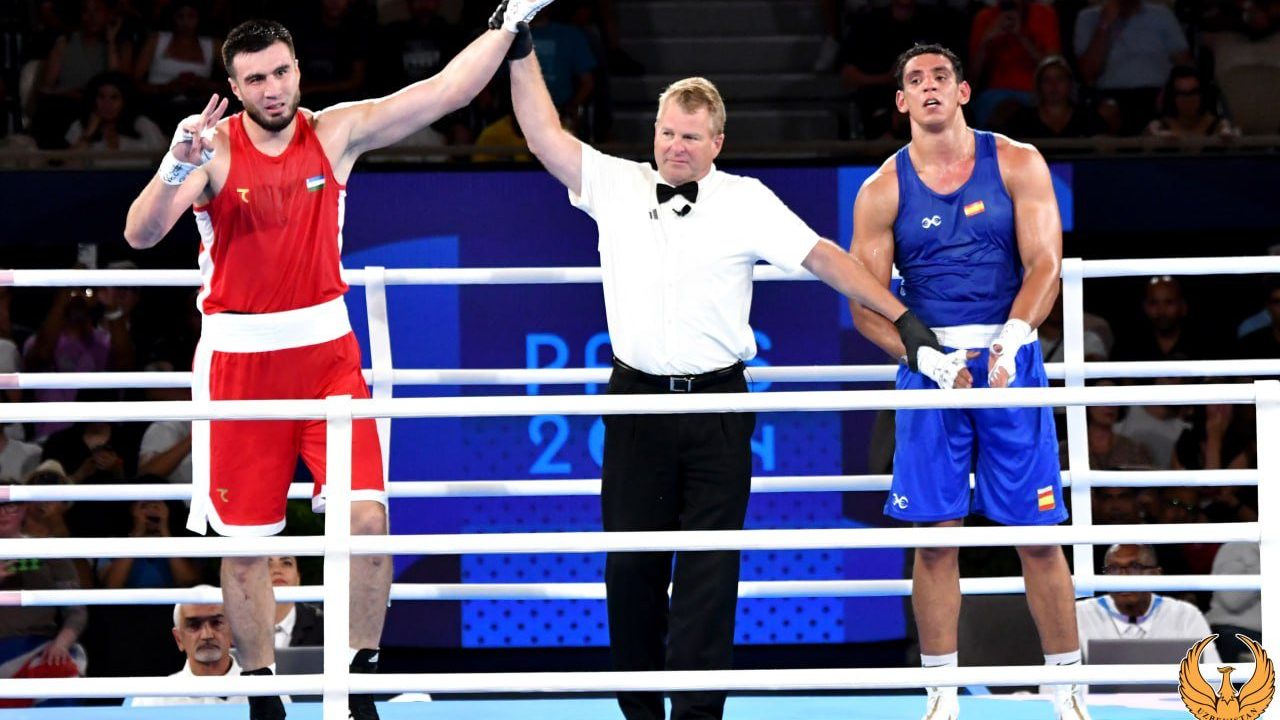
Every boxing fight that goes the distance ends the same way: an announcer reads three scorecards, and one fighter’s hand goes up. For new fans the numbers can look arbitrary. Why is one card 116-112 and another 115-113? Why does a single knockdown swing a whole fight? The answer is the 10-point must system, the scoring method used in professional boxing worldwide. Once you understand it round by round, you can score fights yourself.
The Basic Idea: Every Round Is Its Own Contest
Under the 10-point must system, each judge scores every round independently. The fighter who wins the round receives 10 points, and the fighter who loses it receives 9 or fewer. The word “must” is the key: in almost every round, a judge must pick a winner and give that fighter 10. Points are not carried over, and a dominant round does not earn bonus credit in the next one.
The Association of Boxing Commissions and Combative Sports (ABC), the umbrella group for North American athletic commissions, tells judges in its boxing judge manual to “score each round independently” and to treat each round as an individual bout. The manual specifically warns judges against keeping a running tally of the fight in their heads and adjusting later rounds to make a scorecard look closer. A six-round fight should be scored as six separate rounds, each on its own merit.
The system has a long history. According to Wikipedia’s overview of boxing scoring, the World Boxing Council introduced the 10-point must system in 1968, partly to reward knockdowns and to separate close rounds from clear ones. It has since become the standard method across the sport, replacing older approaches such as the rounds system and the five-point must system.
What Judges Look For: The Four Criteria
Judges do not count punches with a clicker. They make a judgment about who did the more effective boxing in each round, guided by four factors. The ABC judge manual lists them as:
- Clean and effective punching. Fights are won by clean punches that land. The manual stresses that not all punches are equal: the effect of a punch matters, hard punches count, and so does volume, with no fixed formula equating one with the other. Judges are reminded not to focus on head shots and ignore solid body punches.
- Effective aggressiveness. This rewards the boxer who takes the fight to the opponent and gets positive results from it. The manual is explicit that walking forward is not enough: if the aggressive boxer is being beaten to the punch by a counterpuncher, that is not effective aggressiveness.
- Ring generalship or ring control. The “thinking boxer” who controls the action with feints, footwork and positioning, making the opponent miss and setting up scoring chances. Running and simply avoiding action should not be rewarded.
- Defense. Slipping punches, countering, fighting off the ropes and making the opponent miss. The manual adds a pointed note: holding or clinching to avoid contact is not good defense.
In practice, clean punching carries the most weight in most judges’ minds, and the other criteria often act as tiebreakers when the punching is close. Sources differ on whether the criteria must be applied in strict order, so it is fair to say they are guidelines for an overall judgment rather than a mathematical checklist. The ABC manual also offers a practical tiebreak for a very close round: ask which boxer controlled the round and forced most of the action.
Where a punch must land to score
The ABC manual describes a scoring zone on the front of the body, split into the head, the body and the arms. Punches to the front and sides of the head and to the torso above the belt count. Punches landing on the arms are generally treated as blocked, unless they land high near the shoulders. This is why a fighter who shells up behind a high guard may absorb many punches without losing the round badly: a lot of what looks like contact from the cheap seats is landing on gloves and forearms.
Common Round Scores: 10-9, 10-8, 10-7 and 10-10
The ABC manual gives judges a rule of thumb for each score:
| Score | What it usually means |
|---|---|
| 10-9 | One boxer won the round, without a knockdown. This is by far the most common score. |
| 10-8 | One knockdown, or one boxer won in an extremely decisive way, including hurting the opponent. |
| 10-7 | Two knockdowns, or a clearly dominant round that included at least one knockdown. |
| 10-6 | More than two knockdowns; the score can go lower if more knockdowns occur. |
| 10-10 | No clear winner. The manual says this should rarely happen. |
How knockdowns are scored
A knockdown is the single most important event in a round short of a knockout. As a starting point, a round with one knockdown is scored 10-8 for the fighter who scored it. But the ABC manual insists that judges score the whole round, not just the knockdown. It walks through several situations:
- If Boxer A is already winning the round and then scores a knockdown, the round becomes 10-8 for A.
- If Boxer A is winning narrowly but gets knocked down mid-round, the score should usually be 10-8 for Boxer B, because the knockdown outweighs a slight edge.
- If Boxer A dominates the whole round and hurts Boxer B, but B scores a late flash knockdown, the manual suggests 10-9 for B. A knockdown is “second best only to a knockout.”
- If the knockdown fighter also wins the rest of the round decisively and hurts the opponent, a 10-7 with only one knockdown is possible.
One more rule surprises many fans: judges do not decide what is a knockdown. If the referee rules a knockdown, the judges score it as one, even if a replay suggests a slip or a push. If the referee waves it off as a slip, the judges cannot score it as a knockdown.
The 10-8 round without a knockdown
A 10-8 round is possible even when nobody hits the canvas, but the bar is high. The ABC manual describes a round in which one boxer aggressively pursues the other, lands clean punches throughout, including power shots that visibly stun the opponent, while the other boxer is in survival mode, backing up and throwing little of significance. Some judges almost never give these rounds; others are more willing. That difference is one reason scorecards for the same fight can vary.
Point Deductions
Only the referee can take points away. Judges score the round normally, then the deduction is applied to the offending boxer. That means a fighter can win a round on a judge’s card and still come out level after a deduction. For example, if Boxer A wins a round 10-9 but the referee deducts a point from A for a low blow, the round becomes 9-9. If A also scored a knockdown in that round, a 10-8 becomes 9-8.
Under the ABC’s Unified Rules of Boxing, an intentional foul that causes an injury carries a mandatory two-point deduction if the fight continues. Other fouls, such as repeated holding, low blows or deliberately spitting out the mouthpiece, can bring warnings and one-point deductions at the referee’s discretion. Commissions vary somewhat in how they handle penalties, which the ABC manual acknowledges.
A Worked Scorecard Example
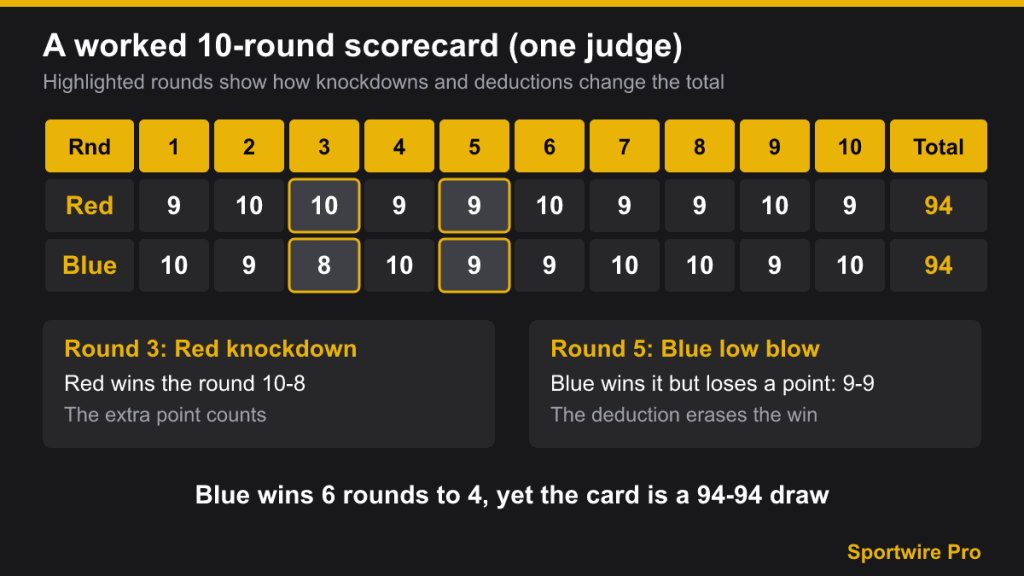
Imagine a 10-round fight between Boxer Red and Boxer Blue, scored by one judge:
| Round | What happened | Red | Blue |
|---|---|---|---|
| 1 | Blue lands the better jab | 9 | 10 |
| 2 | Red’s body work edges a close round | 10 | 9 |
| 3 | Red scores a knockdown and wins the round | 10 | 8 |
| 4 | Blue outworks Red | 9 | 10 |
| 5 | Blue wins, but is docked a point for a low blow | 9 | 9 |
| 6 | Red lands cleaner counters | 10 | 9 |
| 7 | Blue wins clearly | 9 | 10 |
| 8 | Blue wins narrowly | 9 | 10 |
| 9 | Red wins clearly | 10 | 9 |
| 10 | Blue wins a busy final round | 9 | 10 |
| Total | 94 | 94 | |
Count the rounds and Blue won six of them (1, 4, 5, 7, 8 and 10) to Red’s four. Yet the card is a draw, 94-94. The knockdown in round 3 was worth an extra point, and the point deduction in round 5 erased Blue’s win in that round. This is how the 10-point must system rewards knockdowns and punishes fouls, and it is why a fighter who wins more rounds does not always win the fight.
Scorecards are always added up as totals. A judge’s card favors whichever fighter has more total points, not more rounds won.
Types of Decisions
A professional fight that goes the distance is scored by three judges, seated apart and not allowed to confer. Each judge’s total decides which fighter that judge favors, and the combination of the three cards produces the official result:
- Unanimous decision: all three judges favor the same boxer.
- Split decision: two judges favor one boxer, and the third favors the other.
- Majority decision: two judges favor one boxer, and the third scores it even.
- Unanimous draw: all three judges score it even.
- Majority draw: two judges score it even.
- Split draw: one judge favors each boxer, and the third scores it even.
There are also technical outcomes when a fight is stopped early because of a foul. Under the ABC Unified Rules of Boxing, if an accidental foul stops a fight after four completed rounds, the result is a technical decision for whoever is ahead on the cards; before four rounds, it is a no decision. In those cases, the partial round is scored too, which is why the ABC manual urges judges to keep a mental score of each round as it unfolds.
Why Judges Disagree
Split decisions are not necessarily evidence of incompetence or corruption. Several features of the system make honest disagreement common:
- Close rounds are binary. A round that is 51-49 in a judge’s mind still goes 10-9. Swap three close rounds and a 116-112 card becomes 113-115.
- Different seats, different views. Judges sit on different sides of the ring. A body shot or a blocked punch may look very different from each angle.
- Weighing volume against power. One judge may favor the fighter who threw and landed more; another may favor the fighter whose fewer punches clearly hurt.
- Aggression versus control. Fans and commentators often reward the fighter coming forward, while the criteria reward only effective aggression.
The ABC manual also warns judges about common biases: do not favor the champion, do not assume the fighter who is cut or swollen is losing, and do not let a last-second flurry “steal” a round. A punch landed in the first ten seconds counts the same as one landed at the bell.
How to Score a Fight at Home
Scoring a fight yourself is the fastest way to understand the system. A few habits help:
- Write down a score at the end of each round, before you hear the commentators’ opinions.
- Watch both fighters, not just the one you like or the one throwing more.
- Ask what landed cleanly and what it did. Did punches snap heads back or move the opponent, or did they hit gloves?
- Decide who controlled where and how the fight was taking place.
- Use 10-8 for knockdowns, and only rarely for dominant rounds without one.
- Total the card at the end and compare it with the official cards.
Expect your card to differ from the judges’ by a round or two. That is normal.