Kickboxing vs Muay Thai: The Key Differences in Rules and Style
How kickboxing and Muay Thai differ in elbows, knees, clinch, sweeps and scoring, why the styles look so different, and the many rule sets inside kickboxing.
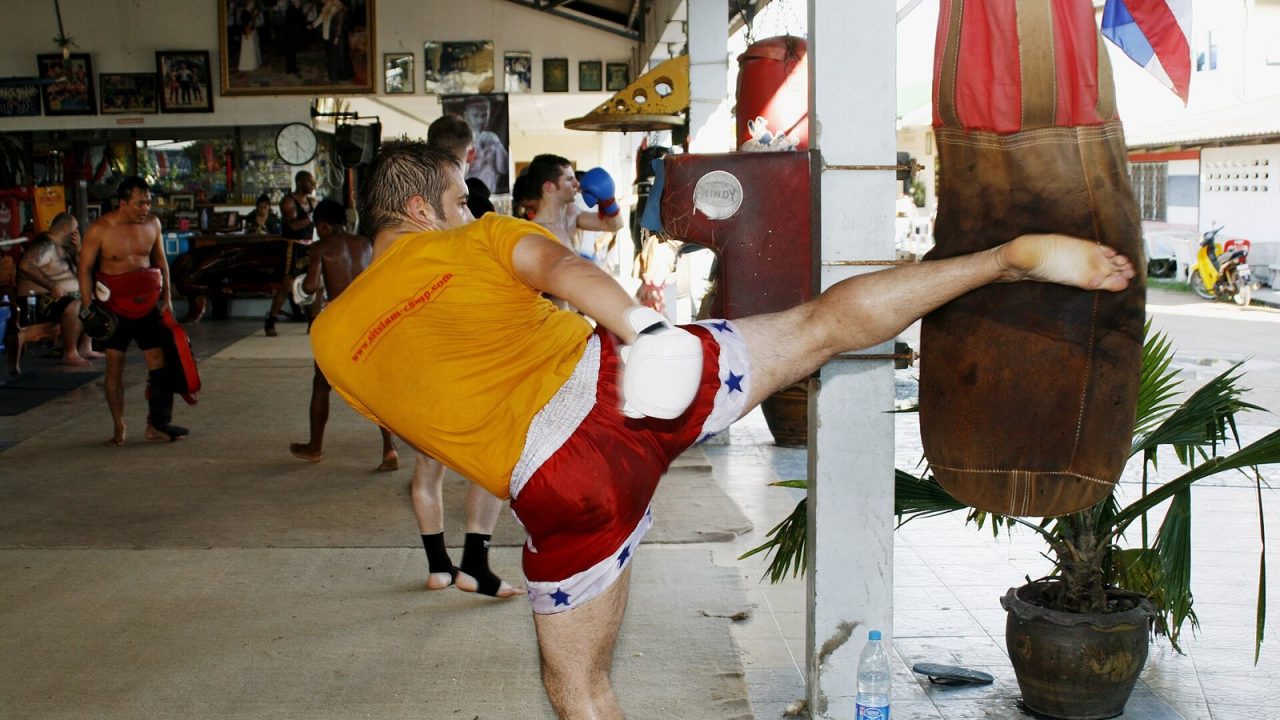
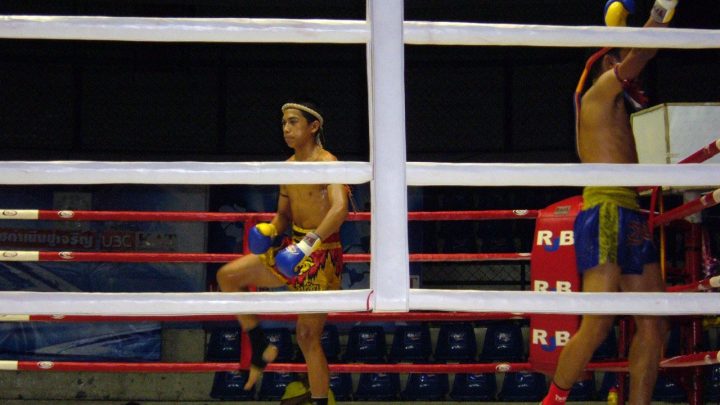
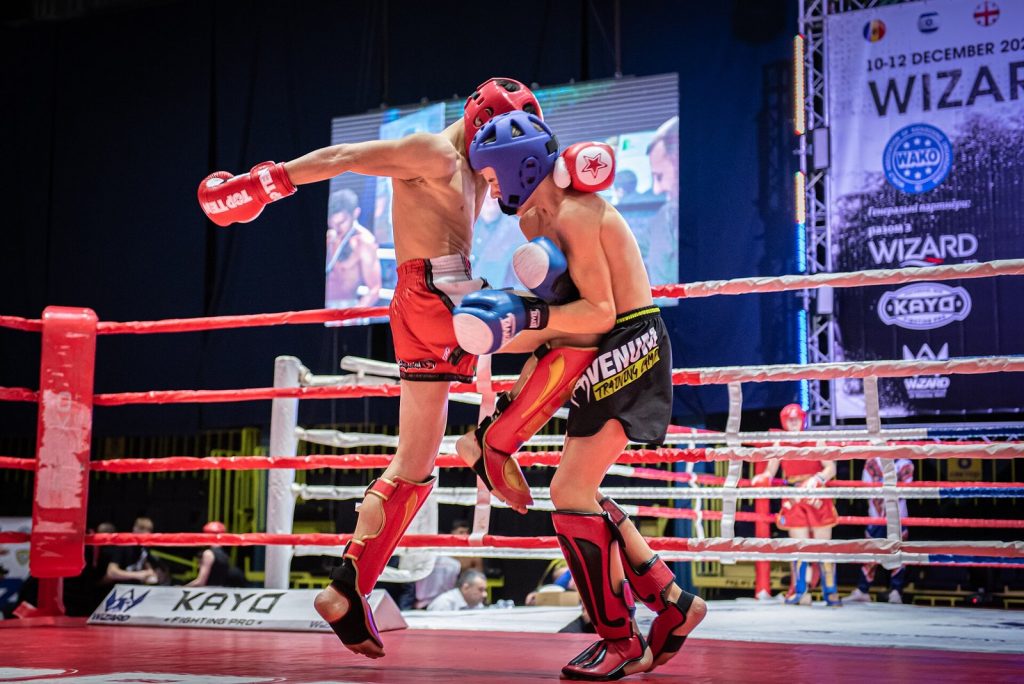
To a new viewer, kickboxing and Muay Thai look almost identical: two fighters in gloves and shorts, in a ring, throwing punches and kicks. Watch a few rounds of each, though, and the differences become obvious. Muay Thai fighters lean back, hold each other in long clinches, and throw elbows and knees at close range. Kickboxers stay more square, punch in longer combinations and are separated by the referee almost as soon as they grab each other.
Those differences are not just stylistic preferences. They come straight from the rules. This guide compares the two sports weapon by weapon and explains how scoring shapes the way each one is fought.
First, What Do We Mean by “Kickboxing”?
Muay Thai is a single, clearly defined sport with its roots in Thailand, often called “the art of eight limbs” because it uses fists, elbows, knees and shins. “Kickboxing,” on the other hand, is an umbrella term covering several rule sets that developed in different countries:
- American full contact, which developed in the United States in the 1970s, allows punches and kicks only above the waist. Elbows, knees, clinching and grappling are banned.
- Japanese kickboxing grew out of a hybrid of karate and Muay Thai. The name “kickboxing” was coined in Japan in 1966 by promoter Osamu Noguchi.
- K-1 rules (sometimes called Oriental rules) were codified by the K-1 promotion, founded in Japan in 1993 by Kazuyoshi Ishii. Punches, kicks including low kicks, and knees are legal; elbows and throws are not, and clinching is very limited.
- Low kick or “international” rules allow punches, knees and kicks including kicks to the legs, but ban elbows, throws and sweeps.
- Dutch-style kickboxing, which developed in the Netherlands in the 1970s, is famous for heavy punch-and-low-kick combinations and has strongly influenced modern rule sets.
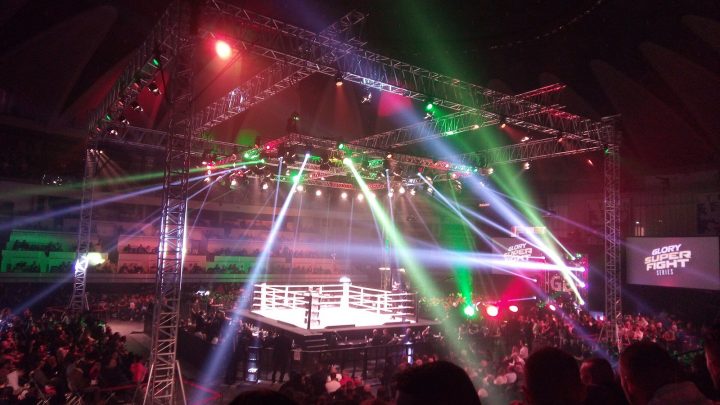
When fans compare “kickboxing vs Muay Thai” today, they usually mean K-1-style rules, which major promotions such as GLORY use as a base, versus traditional or professional Muay Thai. That is the comparison this article focuses on.
The Comparison Table
| Element | Muay Thai | K-1-style kickboxing (e.g. GLORY) |
|---|---|---|
| Punches | Legal | Legal |
| Kicks (including to the legs) | Legal | Legal (GLORY bans linear kicks to the legs) |
| Knees | Legal, including in the clinch | Legal, but only one knee per clinch in GLORY |
| Elbows | Legal | Banned |
| Clinch | Extended clinch fighting is central | Very limited (one strike in GLORY; around 5 seconds in classic K-1) |
| Catching kicks | Legal, can lead to sweeps or counters | Only to throw one immediate strike in GLORY |
| Sweeps and dumps | Legal in many forms | Banned in GLORY (except legal kicks that knock a fighter down) |
| Typical bout length | Traditional stadium format: five 3-minute rounds, two-minute rests | Three 3-minute rounds; five for titles |
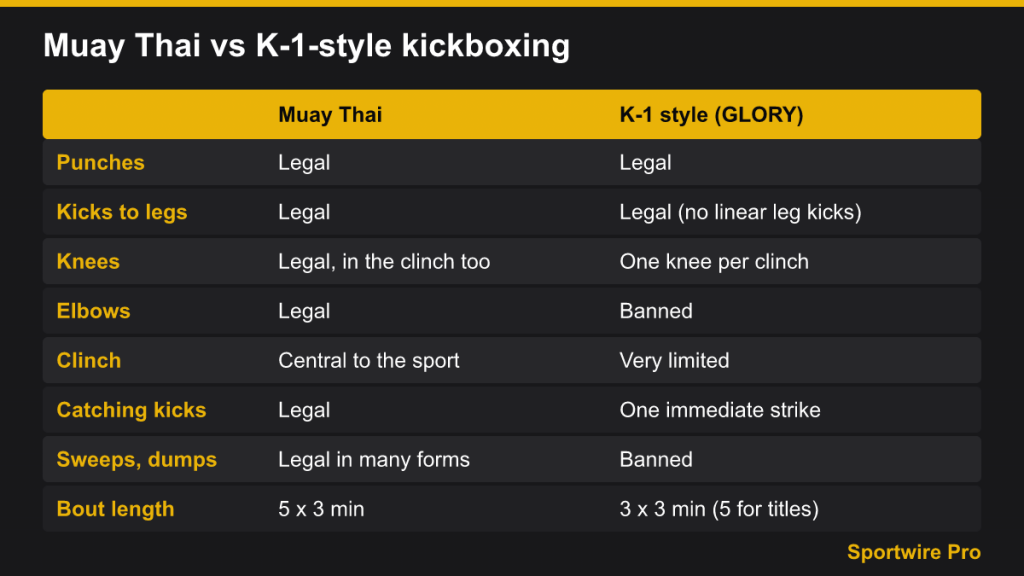
Details vary by promotion, commission and country, so always check the rules for the specific event you are watching.
Weapon by Weapon
Elbows
Elbows are the most obvious difference. In Muay Thai they are a major weapon, especially at close range and inside the clinch, and they are a common cause of cuts. In GLORY’s rules, elbow strikes, and striking with any part of the arm above the padded glove, are listed as fouls. Classic K-1 rules ban them too. Without elbows, kickboxers can stand closer in exchanges without the same risk of being cut, which encourages longer punching combinations.
Knees and the clinch
Both sports allow knees, but the clinch rules make them feel completely different. In Muay Thai, the clinch is a fight within a fight. Fighters battle for neck and arm control, throw knees to the body and head, and try to off-balance each other. Referees generally allow clinch exchanges to continue as long as there is meaningful work.
In GLORY, grabbing, clinching or holding is a foul except to immediately throw a single legal knee, after which the fighter must release. Classic K-1 rules permit clinching for around five seconds. Either way, the clinch becomes a brief opportunity rather than a sustained position. Be aware that some Muay Thai events held under Western commission rules also restrict clinch time, so not every “Muay Thai” bout features the long clinch battles of Thai stadium fights.
Catching kicks and sweeps
In Muay Thai, catching an opponent’s body kick is a key skill. Once the leg is caught, a fighter can counter with a strike, sweep the standing leg, or dump the opponent to the canvas. Successfully off-balancing an opponent is considered a sign of superiority.
GLORY allows a fighter to grab a leg only to throw a single immediate strike, accompanied by one step at most, and then release. Throws, leg sweeps, foot sweeps and pushing to off-balance an opponent are fouls. This removes much of the defensive value of catching kicks, so kickboxers rely more on checking, blocking and countering.
Kicks and punches
Both sports use the roundhouse kick heavily, to the legs, body and head. Kickboxing usually places more emphasis on punching, particularly fast combinations that flow into low kicks, a hallmark of Dutch style. GLORY also bans linear or thrusting kicks to the legs, such as side kicks to the knee; only kicks that arc, like roundhouse kicks, may target the legs.
How Scoring Shapes the Styles
Muay Thai scoring
Traditional Muay Thai scoring is famously different from Western combat sports. Judges look at the whole contest and value clean, effective technique, balance and composure, with kicks, knees and clinch dominance traditionally considered more important than punches. Visible effect on the opponent matters more than volume. Because judges view the fight as a whole, the opening rounds of a traditional five-round bout are often slower, as fighters read each other before the scoring rounds heat up.
Amateur Muay Thai, governed internationally by the International Federation of Muaythai Associations (IFMA), which the IOC fully recognized in July 2021, uses its own system. Under IFMA rules, a strike counts only if it lands cleanly without being blocked by the opponent’s glove, forearm, shin or foot.
Kickboxing scoring
GLORY uses a 10-point must system with clearly prioritized criteria: knockdowns first, then damage inflicted (with “high impact damage” such as wobbling an opponent weighed most heavily), then the number of clean strikes, and finally aggressiveness or ring control. Each round is scored on its own. A fighter who scores a knockdown wins the round unless they lose points for fouls. GLORY also uses open scoring, publishing judges’ scores after each round.
The result is that kickboxers tend to be busy from the opening bell. Every round counts the same, so there is no “feeling out” phase built into the sport’s culture.
Why the Fights Look So Different
Put the rules and scoring together and you can predict the styles:
- Stance: Muay Thai fighters often stand taller with more weight on the back leg, ready to lift the front leg to check kicks or to kick. Kickboxers often stand a little lower and more balanced, ready to punch in combinations.
- Range: In Muay Thai, close range brings elbows and the clinch. In kickboxing, close range is mostly punching range, because the referee will separate a clinch quickly.
- Pace: Muay Thai’s scoring rewards composure and building toward the later rounds. Kickboxing’s round-by-round scoring rewards consistent output.
- Defense: Catching kicks is a cornerstone of Muay Thai defense. In kickboxing, checking and blocking are relatively more important.
The scoring logic is similar in spirit to boxing’s 10-point must system, which we explain in our boxing scoring guide, but the criteria are tailored to each sport’s weapons.
Crossing Over Between the Sports
Many fighters compete in both sports during their careers, and some promotions run events under both rule sets. The transition is not always smooth.
Muay Thai to kickboxing: Thai-style fighters often have to increase their punching output and adjust to losing their clinch and elbow game. They also need to stay active in every round, rather than waiting for later rounds.
Kickboxing to Muay Thai: Kickboxers have to learn to defend elbows and fight in the clinch, where an experienced Thai fighter can neutralize their punching. They also have to get used to having their kicks caught.
Both sports also feed into MMA. Muay Thai’s clinch work and knees translate well to fighting against the cage, while kickboxing’s footwork and combinations are valuable at range.
Frequently Asked Questions
Is Muay Thai a type of kickboxing?
It depends on who you ask. Muay Thai is older and has its own traditions, rituals and scoring, so practitioners usually treat it as a separate sport. In everyday language, though, some people use “kickboxing” loosely enough to include it, and Japanese kickboxing itself was developed partly from Muay Thai. In competition, the distinction is clear: the rule set on the poster tells you which sport you are watching.
Which sport has more knockouts?
There is no reliable cross-promotion statistic to settle this, and it varies enormously by promotion, weight class and era. What can be said is that the rules push in different directions: kickboxing’s round-by-round scoring and limited clinch encourage constant exchanges, while Muay Thai’s elbows create more cut stoppages and its clinch creates more knee-related finishes.
Why don’t kickboxing referees let fighters clinch?
Because the rules say so. In GLORY, holding is a foul unless it is used to throw one immediate knee, and repeated fouls can lead to warnings and point deductions. The aim is to keep fighters striking rather than holding, which promoters see as more exciting for viewers.
Do both sports use the same gloves?
Both use boxing-style gloves. In GLORY, gloves are 8 ounces for weight classes under 65 kg and 10 ounces for all heavier classes, supplied by the promotion. Muay Thai glove rules depend on the event and regulator.
Which Should You Train?
If you are thinking about stepping into a gym, both offer excellent striking foundations. A few practical considerations:
- Your goals: if you are interested in MMA, Muay Thai’s clinch and elbows are directly useful. If you love punching combinations, kickboxing may suit you.
- The gym itself: the quality of coaching and the training culture matter far more than the name on the door. Many gyms teach a blend of both.
- Safety: beginners should start with technique work and controlled drills, wear appropriate protective gear and progress to sparring only under a qualified coach.