Floyd Mayweather’s Defensive Style: Why He Went Unbeaten
A tactical breakdown of Floyd Mayweather's style: the shoulder roll, lead right hand, pull counter and ring IQ that carried him to a 50-0 record.
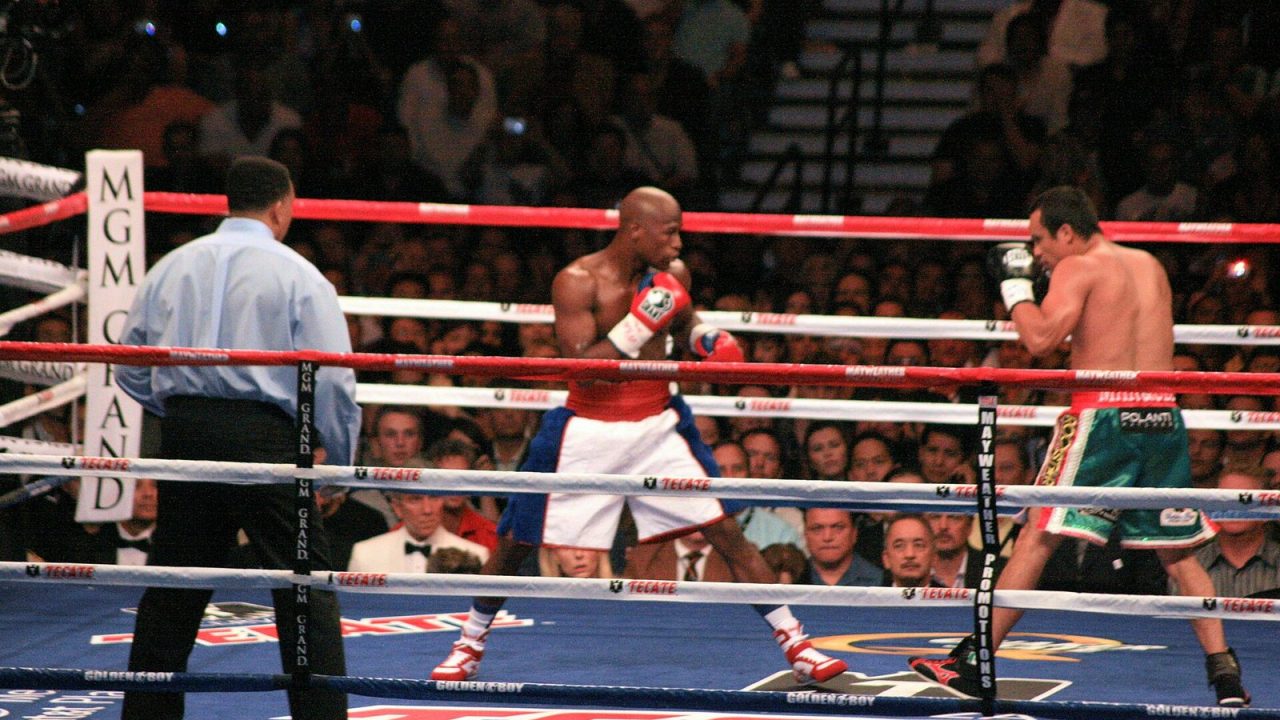
Floyd Mayweather Jr. retired from professional boxing with a record of 50 wins and no losses, 27 of them by knockout, after winning 15 major world titles across five weight classes. Fans argue endlessly about where he ranks among the greats, but almost nobody disputes one point: he was one of the hardest boxers to hit cleanly in the modern era.
This article is not a biography. It looks at how Mayweather fought: the shoulder-roll guard he became famous for, the punches he built around it, the way he controlled distance and read opponents, and how those habits produced such a long unbeaten run. If you are new to defensive terms, our guide to boxing defense basics explains slips, parries and the Philly shell in general.
The record in brief
A few facts frame the analysis:
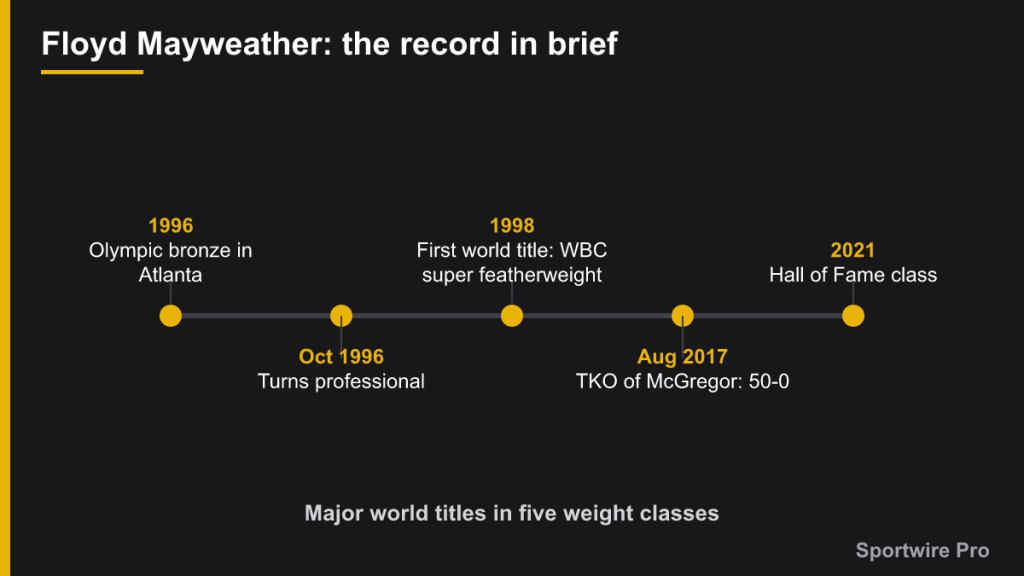
- Mayweather won a bronze medal at featherweight at the 1996 Olympics in Atlanta and turned professional on October 11, 1996.
- He won his first world title in 1998, stopping Genaro Hernández in the eighth round for the WBC super featherweight belt.
- He went on to win major world titles at super featherweight, lightweight, light welterweight, welterweight and light middleweight, as well as The Ring titles in three weight classes.
- His last professional fight was a tenth-round TKO of Conor McGregor on August 26, 2017, which took his record to 50-0. He later took part in exhibition bouts, which are not part of his professional record.
- He was inducted into the International Boxing Hall of Fame as part of the class of 2021.
Mayweather’s uncle Roger Mayweather trained him for much of his career, and his father, Floyd Mayweather Sr., also trained him at different stages. Both were part of a family boxing tradition that shaped his defensive style from an early age.
The shoulder roll at the center
The shoulder roll, part of a guard often called the Philly shell or crab-style defense, is the signature of Mayweather’s style. In an orthodox stance, the lead (left) hand is held low across the stomach, the lead shoulder is raised to cover the chin, and the rear (right) hand sits near the right side of the face.
Against a straight right hand, the defender turns his upper body away so the punch glances off the raised lead shoulder. The rear glove is ready to catch the jab or a left hook. Body shots on the lead side can be blocked by the low lead arm and elbow. As the opponent’s punch retracts, the defender rotates back toward him with his own right hand.
Why it suited Mayweather:
- Reflexes and timing: the shoulder roll relies on reading punches early, which Mayweather did exceptionally well.
- Efficient defense: small turns of the torso and shoulder replace big movements, so the defender stays in range to counter.
- Built-in counters: every shoulder roll turns the body and loads the right hand, so defense and offense happen in one motion.
The guard has weaknesses, and Mayweather’s opponents tried to exploit them. Hooks to the lead side of the head, punches thrown from unusual angles, sustained pressure against the ropes and southpaw lefts that come from a different line are all common ways to test a shoulder roll. His ability to change between the shell, a higher guard, footwork and clinching was what kept those openings from becoming lasting problems.
The punches that made it work
A defensive guard only wins fights if it produces scoring punches. Mayweather built a small set of reliable weapons around his defense.
The lead right hand
A lead right is a straight right hand thrown without a jab first. It is considered risky because it travels a long way, but Mayweather’s speed and timing made it a key weapon, especially against opponents who were waiting for a jab. Lead rights let him score quickly and get out before his opponent could answer.
The pull counter
The pull counter involves leaning back just out of range of the opponent’s jab, then coming forward with a right hand as the opponent’s arm retracts. It is often described as his trademark. It works because a fighter who has just thrown a jab has briefly moved his weight forward and has one hand away from his face.
The check hook
A check hook is a lead hook thrown while pivoting away from an opponent who is rushing forward. The defender turns on his lead foot, so the opponent runs onto the punch and finds himself facing empty space. It is a natural weapon against aggressive fighters who come forward in straight lines, and a standard part of the shoulder-roll counterpuncher’s toolkit, because the lead hand already sits low and loose, ready to swing up.
The jab to the body
Mayweather often jabbed to the chest or stomach, which kept opponents honest, slowed their forward movement and lowered their guard for later shots upstairs.
Ring IQ and adaptation
Many observers argue that Mayweather’s greatest skill was not any single technique but his ability to work out an opponent during a fight. Common patterns in his performances included:
- Measured starts: he often spent the early rounds studying an opponent’s timing and habits, accepting a few close rounds in exchange for information.
- Adjusting the plan: once he had seen what an opponent wanted to do, he took it away, whether that meant circling away from a power hand or tying up an inside fighter.
- Controlling pace: he rarely let fights become chaotic. Feints, jabs and clinches slowed the action to the speed he preferred.
- Using the ropes: unlike many boxers, Mayweather was comfortable near the ropes, using the shoulder roll there to make opponents miss and then pivoting out.
His accuracy reflected that control. CompuBox, the punch-statistics service used by broadcasters, rates him as the most accurate puncher in its records, with the highest plus-minus (the difference between his own connect rate and his opponents’) it has recorded.
How the style handled different opponents
Mayweather faced a wide range of styles during his unbeaten run, and many of his wins can be read as tactical problems solved.
| Opponent type | Examples | The approach |
|---|---|---|
| Rugged pressure fighters | José Luis Castillo (2002 rematch), Marcos Maidana (2014, twice) | Movement, clinching and counters to blunt forward pressure; both Maidana fights were among the closest of his career |
| Bigger, naturally heavier men | Oscar De La Hoya (2007), Saúl “Canelo” Álvarez (2013) | Speed and accuracy over size, with constant feints and lateral movement |
| Fellow elite technicians | Juan Manuel Márquez (2009), Manny Pacquiao (2015) | Jab, distance control and defense, winning by unanimous decision |
| Aggressive punchers | Diego Corrales (2001), Ricky Hatton (2007) | Counters as opponents came forward; Corrales was knocked down five times, Hatton stopped in the tenth round |
Not every win was dominant. The first Maidana fight ended in a majority decision, as did the Álvarez fight, in which one judge scored it even despite many observers seeing a clear Mayweather win. The variety of these results is part of the point: his style was adaptable, not a single formula.
Why he never lost
No single factor explains an unbeaten professional record, but several reinforced each other:
- Elite defense: he took relatively few clean punches, which reduced the chances of an upset knockout.
- Accuracy over volume: he did not need to outwork opponents to win rounds because he landed a high percentage of what he threw.
- Adaptability: his habit of adjusting during a fight meant opponents rarely found a lasting answer.
- Conditioning and discipline: his style required him to stay sharp for twelve rounds, and he was known for his work ethic in training.
- Career management: like all elite fighters, his record was also shaped by when and whom he fought, a point his critics often raise.
A style that changed over time
It is easy to describe Mayweather as a pure defensive fighter, but his style evolved. At super featherweight and lightweight he was faster, more willing to sit down on combinations and more often stopped opponents; the Corrales fight, with its five knockdowns, came from that period. As he moved up in weight against naturally bigger men, he relied more on accuracy, counters and ring control than on knockouts. His knockout rate fell, but his defense and decision-making became the main event. Watching an early title fight next to one of his later welterweight bouts is a useful way to see how a fighter adapts a style to age, weight and opposition.
Criticisms of the style
Mayweather’s approach was not universally loved. Critics argued that his safety-first style could produce cautious fights, especially compared with the action of his early career at super featherweight and lightweight, when he was more offensive. Others pointed out that some of his biggest fights came later than fans wanted, after opponents had passed their peaks. Those debates are part of how boxing evaluates any great fighter, and they do not change what his defensive skills achieved in the ring.
What boxers can learn from Mayweather
- Defense and offense are linked: the shoulder roll is a counterpunching setup, not just a way to avoid punches.
- Small movements are efficient: a turn of the shoulder or a short lean saves energy compared with big evasive movements.
- Information wins fights: early rounds are an investment in understanding the opponent.
- Style must match the athlete: the shoulder roll relies on reflexes and timing; many coaches teach it only to fighters who have mastered more basic defense first.
That last point matters for anyone trying to copy him. Many fighters have adopted a Mayweather-style shell without the reflexes, footwork and experience behind it, and have been hit cleanly as a result. Anyone learning these techniques should do so step by step under a qualified coach. For how lead-foot position and stance matchups affect which punches are safe, see our guide to orthodox vs southpaw stances.