Sugar Ray Robinson: Why Many Call Him the Greatest Boxer Ever
Sugar Ray Robinson's career explained: amateur dominance, welterweight and middleweight reigns, the LaMotta rivalry, his style and why he tops all-time lists.
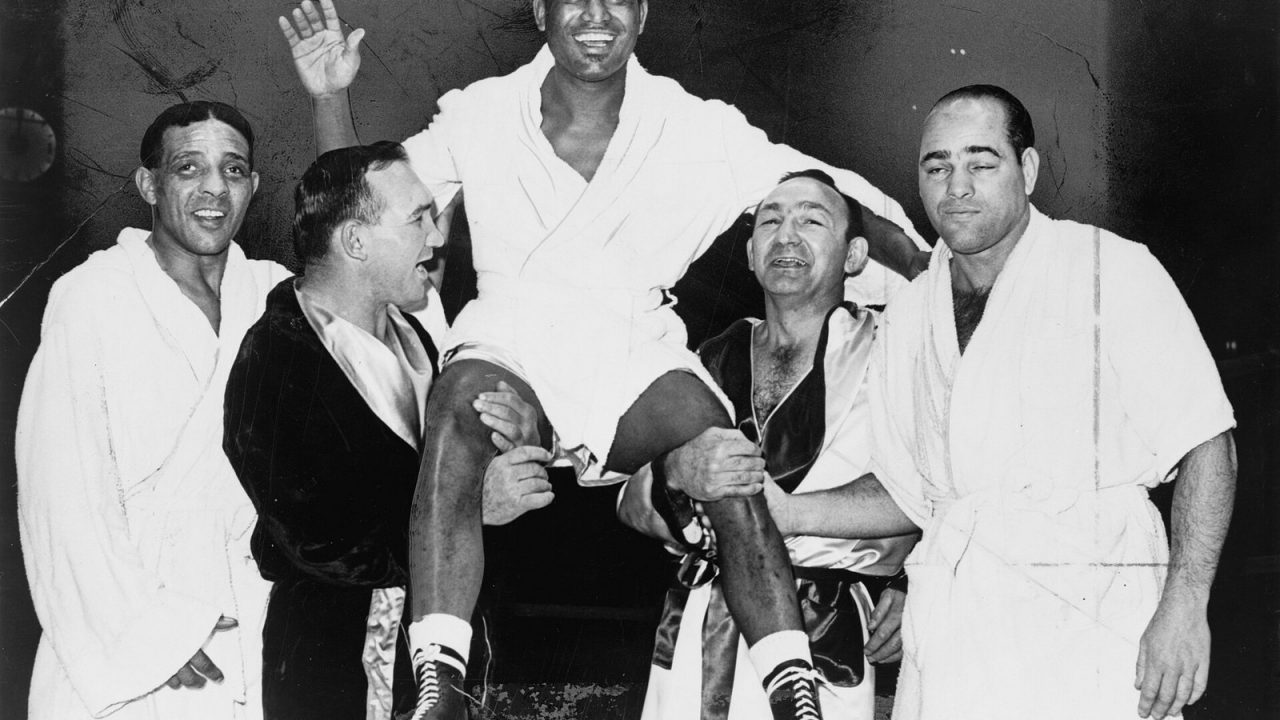
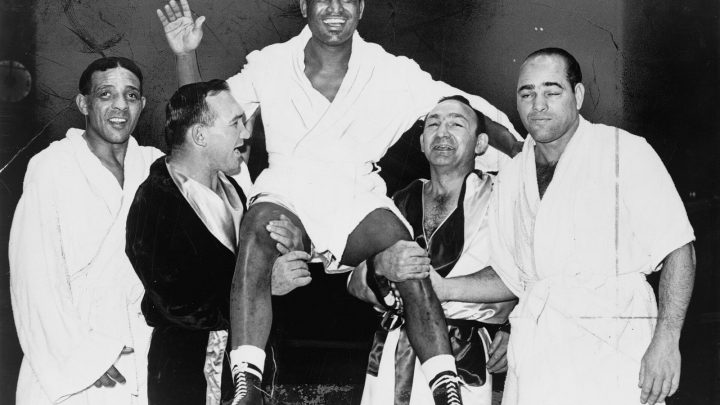
When fighters and historians argue about the greatest boxer of all time, one name comes up more than any other. Sugar Ray Robinson won the welterweight championship, became a five-time middleweight champion, fought more than 200 professional bouts and inspired the very phrase “pound for pound.” Muhammad Ali, Joe Louis, Roberto Durán and Sugar Ray Leonard are among the great champions who have named Robinson the best fighter, pound for pound, they ever saw.
This article explains why. It covers his amateur and professional career, his title reigns, his famous rivalry with Jake LaMotta, how he fought, and how his legacy is judged. A note on numbers first: records from Robinson’s era vary between sources, because early bouts were not always documented consistently. The figures here follow his commonly cited record, and where sources disagree, we say so.
From Walker Smith Jr. to “Sugar Ray”
Robinson was born Walker Smith Jr. on May 3, 1921, in Ailey, Georgia, and grew up largely in New York City. He took the name “Ray Robinson” as a young amateur, when he used an ID card belonging to another youth of that name to enter bouts, and the “Sugar” was added after a spectator at a fight in Watertown, New York, said he was “sweet as sugar.” The name stuck so firmly that later champions, including Sugar Ray Leonard, adopted it in tribute.
His amateur record is usually listed as 85 wins and no losses with 69 knockouts, although that record is disputed. He won New York Golden Gloves titles in 1939 at featherweight and 1940 at lightweight before turning professional.
The early professional years and the unbeaten streak
Robinson made his professional debut on October 4, 1940, stopping Joe Echevarria in the second round. He won his first 40 professional fights before losing a decision to Jake LaMotta in February 1943.
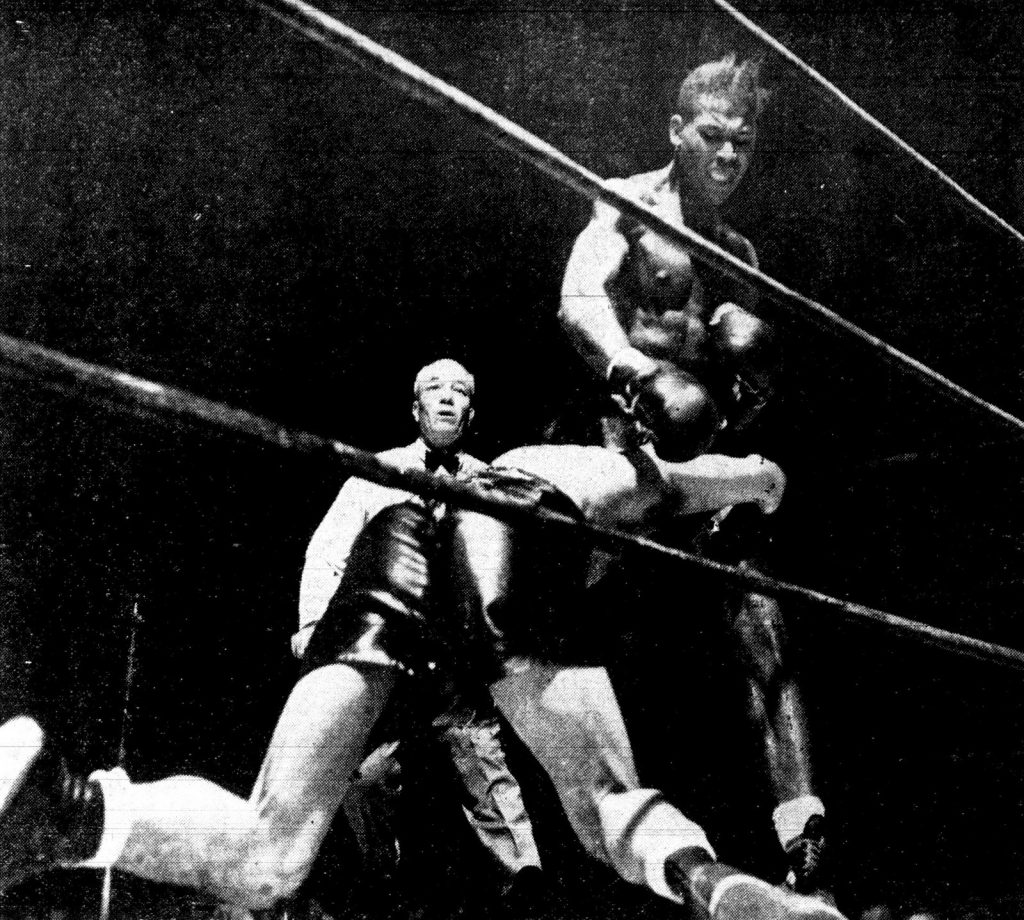
He then went on a 91-fight unbeaten run from 1943 to 1951, one of the longest in professional boxing history. During that stretch he fought frequently against a wide range of opponents, which is part of why his record is so admired. Boxing in the 1940s featured active fighters who might appear in the ring many times a year, and Robinson was busy even by those standards.
Welterweight champion
Despite his reputation, Robinson had to wait years for a world title shot. He finally won the vacant world welterweight title on December 20, 1946, with a 15-round decision over Tommy Bell. He held the welterweight championship until he moved up to middleweight, defending it several times and establishing himself as the best fighter in the world in the eyes of many observers.
His dominance at welterweight is one reason historians treat his peak, roughly the 1940s into 1951, as among the finest stretches any boxer has had.
The Jake LaMotta rivalry
Robinson and Jake LaMotta fought six times between 1942 and 1951. Robinson won five of them. LaMotta’s win in February 1943 was the first defeat of Robinson’s professional career, and the rivalry became one of the most famous in boxing.
The styles explained the drama. LaMotta was a relentless pressure fighter famous for his durability, willing to absorb punishment to get inside. Robinson was faster, more versatile and more technically refined. Their fights tested whether skill could repeatedly overcome toughness and pressure, and most of the time it did.
- October 1942, Madison Square Garden: Robinson won a unanimous decision over ten rounds.
- February 5, 1943, Detroit: LaMotta knocked Robinson through the ropes in the eighth round and won a unanimous decision.
- February 26, 1943, Detroit: just three weeks later, Robinson won a close decision despite a seventh-round knockdown.
- 1945: Robinson won twice more, the second by a disputed split decision in Chicago.
The final fight, on February 14, 1951, is remembered as the “St. Valentine’s Day Massacre.” At Chicago Stadium, Robinson stopped LaMotta in the 13th round to win the world middleweight championship. LaMotta, famous for his chin, never went down; the fight was stopped with him still on his feet. The rivalry reached a new audience decades later through Martin Scorsese’s 1980 film Raging Bull, based on LaMotta’s autobiography, which dramatizes their fights and earned Robert De Niro the Academy Award for Best Actor for his portrayal of LaMotta. The fight became one of the most famous in the history of the division, and The Ring named Robinson its Fighter of the Year for 1951, an honor he had also received in 1942.
Five times middleweight champion
Robinson’s middleweight career was a series of losses and regains, which is why he is often described as a five-time middleweight champion.
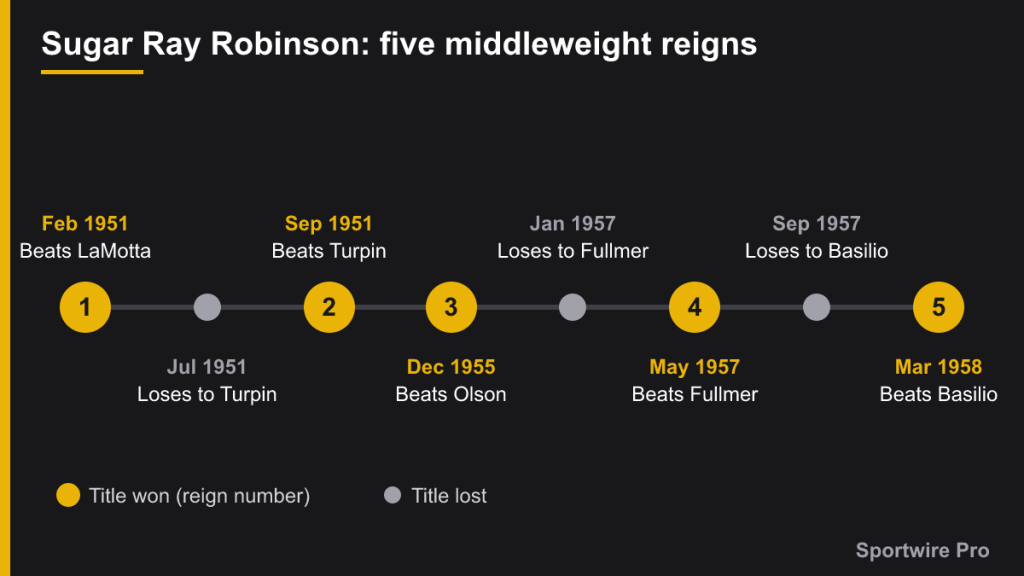
- February 1951: won the title by stopping LaMotta.
- July 1951: lost it to Randolph Turpin in London, a major upset.
- September 1951: regained it with a tenth-round TKO of Turpin at the Polo Grounds in New York.
- June 25, 1952: challenged Joey Maxim for the light heavyweight title at Yankee Stadium. Robinson was ahead on all three judges’ scorecards, but the extreme heat caused him to collapse at the end of the 13th round, and he lost by retirement. He retired later that year.
- 1955: returned to the ring and regained the middleweight title, beating Bobo Olson by second-round knockout in December 1955.
- January 1957: lost the title to Gene Fullmer.
- May 1957: regained it in the rematch with a fifth-round knockout from a lightning-fast left hook that critics have called “the perfect punch.”
- September 1957: lost the title to Carmen Basilio.
- March 1958: won it back from Basilio, becoming middleweight champion for the fifth time.
Robinson continued to fight well past his prime. His final professional bout was a unanimous decision loss to Joey Archer on November 10, 1965, in Pittsburgh.
His record, and why it varies
Robinson’s professional record is commonly given as 174 wins, 19 losses and 6 draws, with 2 no contests and 109 knockouts, across 201 bouts. You will find slightly different numbers in different references, partly because bouts from the 1940s and 1950s were not always recorded consistently and partly because sources treat exhibitions and disputed results differently.
The record also needs context. Most of his losses came late in his career, after his comeback and as he fought on into his forties. Through his 1951 middleweight title win, he had lost only once, to LaMotta, in well over 100 professional fights.
How Robinson fought
Robinson’s style is the main reason he is so admired by other boxers. He is generally described as a boxer-puncher: a fighter who could box from the outside, counterpunch, or stand and trade, depending on what the fight needed.
- Versatility: he could adapt his approach to the opponent instead of relying on one game plan.
- Footwork: his movement allowed him to control distance and create angles.
- Defense: his head movement and defensive skills are considered among the best of all time, making him hard to hit cleanly.
- Combination punching and power: he could finish opponents with either hand, from different angles, and threw fluid combinations rather than single shots.
- Timing: the knockout of Fullmer showed how a single well-timed punch could change a fight.
For fans learning to watch boxing, Robinson’s fights are a useful study because he combines so many skills at once. Our guide to boxing defense basics explains the head movement and footwork concepts that underpinned his style.
“Pound for pound” and the greatest-ever debate
The phrase “pound for pound” was coined by sportswriters during Robinson’s career to describe a fighter who, if all boxers were the same size, would be the best. Robinson was the man they had in mind, and the idea has since grown into the modern pound-for-pound rankings published by magazines and websites. Our explainer on pound-for-pound rankings covers how those lists work today.
Arguments for Robinson as the greatest usually rest on several points:
- Peak dominance: one loss in his first 130-plus fights and a 91-fight unbeaten run.
- Championships in two weight classes during a demanding era, and five middleweight title wins.
- Quality and volume of opposition: he fought often, against strong contenders and future Hall of Famers.
- Complete skill set: fellow fighters admired him for doing everything well.
- Endorsements from other greats: champions such as Ali and Leonard named him the best they saw.
Counterarguments exist. Some critics note that he fought on too long and that the second half of his career included many losses. Others point out that comparing eras is always difficult: training, nutrition, scheduling and the number of championships available have all changed dramatically. Those debates are part of the appeal of all-time rankings, and Robinson’s name usually remains at or near the top regardless.
Beyond the ring
Robinson was a flamboyant public figure. He is credited with popularizing the large entourage that later became a common sight around star fighters, and his style outside the ring made him a celebrity. He died on April 12, 1989, in Los Angeles, and was inducted into the International Boxing Hall of Fame as part of its inaugural class in 1990. In 1999, the Associated Press named him the best boxer of the 20th century.
Why he still matters
Robinson’s influence is still visible in modern boxing. The idea of the complete boxer-puncher who can adapt mid-fight, the concept of pound-for-pound greatness and the “Sugar” nickname itself all trace back to him. For many historians and fighters, he remains the standard by which all other boxers are measured.