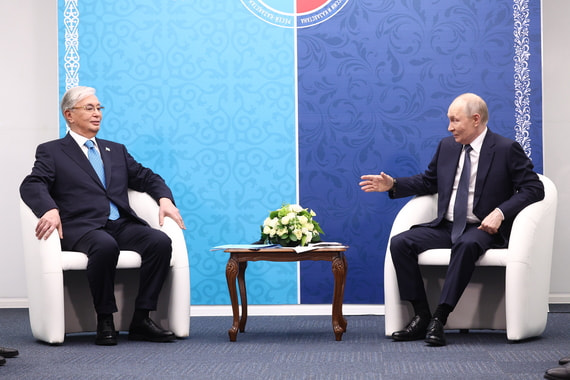
Kazakhstan’s President Kassym-Jomart Tokayev has made a significant diplomatic proposal to Russian President Vladimir Putin, suggesting a freeze on the ongoing military conflict in Ukraine. The Kazakh leader argued that the continuation of hostilities serves only the interests of adversaries of both Russia and Ukraine, representing a position that reflects the delicate balancing act Central Asian nations must perform between major powers. This proposal comes at a critical juncture when international efforts to find a peaceful resolution to the conflict have largely stalled, and the war continues to exact a heavy toll on both sides.
Tokayev’s statement carries considerable weight given Kazakhstan’s unique position as Russia’s largest Central Asian neighbor and a member of the Moscow-led Eurasian Economic Union. The two countries share the world’s longest continuous land border, stretching over 7,500 kilometers. Despite these close ties, Kazakhstan has consistently maintained a careful diplomatic distance from fully endorsing Russia’s military actions in Ukraine, reflecting both domestic political considerations and the country’s aspirations to maintain constructive relationships with Western nations and international institutions.
Kazakhstan’s Balancing Act Between East and West
Since the conflict began in February 2022, Kazakhstan has walked a diplomatic tightrope, neither openly condemning Russia’s actions nor providing explicit support for the military operation. Tokayev notably declined to recognize the independence of the Donetsk and Luhansk People’s Republics, a decision that signaled Astana’s commitment to the principles of territorial integrity and international law. This stance has occasionally created tension with Moscow but has allowed Kazakhstan to preserve its relationships with European and American partners who remain important investors in the country’s vast energy sector.
The proposal to freeze the conflict represents a continuation of this measured approach. By framing the ongoing war as beneficial only to external adversaries, Tokayev is attempting to find common ground that both Moscow and Kyiv might consider without directly criticizing either party. This diplomatic language reflects the reality that Kazakhstan, with its significant Russian-speaking minority and deep economic integration with Russia, cannot afford to alienate its powerful neighbor while simultaneously maintaining its sovereignty and independent foreign policy.
Historical Context and Regional Implications
Kazakhstan’s diplomatic initiative must be understood within the broader context of Central Asian politics and the region’s historical relationship with Russia. Following the collapse of the Soviet Union in 1991, Kazakhstan emerged as an independent nation but maintained close economic and security ties with Moscow. The country hosts the Baikonur Cosmodrome, from which Russia launches its space missions, and participates in the Collective Security Treaty Organization alongside other former Soviet states. However, Kazakhstan has also pursued a multi-vector foreign policy, developing relationships with China, the European Union, and the United States.
The war in Ukraine has created significant challenges for Kazakhstan’s economy, particularly regarding trade routes and financial transactions that pass through or involve Russia. Western sanctions on Moscow have complicated business operations for Kazakh companies, while the country has had to carefully navigate pressure from both sides regarding sanctions compliance. At the same time, Kazakhstan has benefited from some Russian companies and capital relocating to escape sanctions, as well as increased interest from firms seeking alternative trade routes that bypass Russia entirely.
International Reactions and Future Prospects
The proposal for a conflict freeze comes amid various international peace initiatives, including efforts by China, African nations, and other parties to mediate an end to the hostilities. However, significant obstacles remain, as both Russia and Ukraine have articulated positions that appear fundamentally incompatible. Moscow has indicated it would require recognition of territorial gains and guarantees regarding Ukraine’s future NATO membership, while Kyiv has insisted on the complete restoration of its territorial integrity, including Crimea, which Russia annexed in 2014.
Tokayev’s suggestion of a freeze rather than a comprehensive peace agreement may represent a more pragmatic approach, acknowledging the difficulty of achieving a final settlement while prioritizing an end to active combat operations. Such frozen conflicts exist elsewhere in the former Soviet space, including in Georgia’s breakaway regions and Moldova’s Transnistria. While these situations are far from ideal, they have at least prevented large-scale military confrontations for extended periods. Whether this model could apply to Ukraine, given the scale and intensity of the current conflict, remains an open question that will likely be debated in diplomatic circles in the coming months.
Expert Opinion: Tokayev’s proposal reflects growing fatigue among post-Soviet states with a conflict that disrupts regional stability and economic ties. While a true freeze would require concessions neither side currently appears willing to make, Kazakhstan’s diplomatic intervention signals that even Russia’s closest allies are seeking an exit strategy. This may gradually build pressure for negotiations, though any breakthrough remains unlikely without significant shifts in the military situation on the ground.