The August Coup of 1991 remains one of the most pivotal moments in modern Russian history, marking the beginning of the end for the Soviet Union. For three dramatic days in August, a group of hardline Communist officials attempted to seize power from Soviet President Mikhail Gorbachev, ultimately failing in a sequence of events that would reshape the geopolitical landscape of the entire world. How this dramatic episode has been presented to successive generations of Russian schoolchildren reveals much about the evolving political narratives and ideological shifts that have characterized post-Soviet Russia over the past three decades.
The Events That Shook an Empire
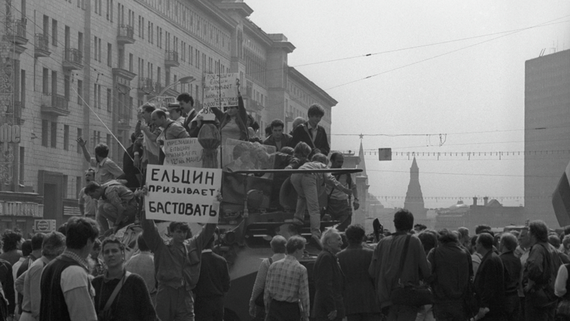
On August 19, 1991, a self-proclaimed State Committee on the State of Emergency (GKChP) announced that President Gorbachev was unable to perform his duties due to health reasons. The committee, composed of high-ranking officials including Vice President Gennady Yanayev, KGB Chairman Vladimir Kryuchkov, and Defense Minister Dmitry Yazov, declared a state of emergency and dispatched tanks into the streets of Moscow. Their stated goal was to prevent the signing of a new Union Treaty that would have decentralized power away from Moscow to the Soviet republics. The coup plotters believed they were saving the Soviet Union from disintegration, but their actions would ultimately accelerate its collapse.
Russian President Boris Yeltsin emerged as the face of resistance, famously climbing atop a tank outside the Russian White House to denounce the coup as unconstitutional. Thousands of Muscovites formed human chains around government buildings, and key military units refused to fire on civilians. By August 21, the coup had collapsed, its leaders arrested, and Gorbachev returned to Moscow—though to a fundamentally changed political reality. Within months, the Soviet Union would cease to exist entirely, replaced by fifteen independent nations.
Early Textbook Narratives: Democracy Triumphant
In the immediate aftermath of the Soviet collapse, Russian history textbooks presented the August Coup in starkly heroic terms. The 1990s-era educational materials portrayed the events as a triumph of democratic forces over authoritarian reaction. Textbooks from this period emphasized the courage of ordinary citizens who stood against tanks, the constitutional illegitimacy of the coup plotters, and the decisive leadership of Boris Yeltsin. The phrase “a country on the brink of anarchy” was often used to describe what might have happened had the coup succeeded, framing the resistance as having saved Russia from a return to totalitarian rule.
These early textbooks drew clear moral lines: the GKChP members were portrayed as villains attempting to reverse the progress of perestroika and glasnost, while the defenders of the White House were presented as heroes of a new democratic Russia. Students learned about the three young men who died during the coup—Dmitry Komar, Ilya Krichevsky, and Vladimir Usov—who were posthumously awarded the title Hero of the Soviet Union, the last individuals to receive this distinction.
Shifting Perspectives in the Putin Era
As Russia’s political landscape evolved under Vladimir Putin’s leadership, so too did the textbook treatment of the August Coup. Educational materials published in the 2000s and 2010s began presenting a more ambiguous narrative. While still acknowledging that the coup was unconstitutional, newer textbooks introduced greater complexity into the story. Some texts began questioning whether the coup’s failure truly represented an unambiguous victory, given the economic chaos and social upheaval that followed the Soviet collapse. The hardship of the 1990s—hyperinflation, unemployment, and the rise of oligarchs—became part of the context in which students were asked to understand these events.
Contemporary Russian textbooks often present the August Coup within a framework of national tragedy rather than democratic triumph. The dissolution of the Soviet Union, which Putin famously called “the greatest geopolitical catastrophe of the twentieth century,” colors how the coup is now discussed. Students today may learn about the events with less emphasis on democratic heroism and more focus on the instability and suffering that followed. This evolution in educational narratives reflects broader debates within Russian society about the meaning of the Soviet experience and the nature of the post-Soviet transition.
Expert Opinion: The evolving textbook treatment of the August Coup serves as a barometer for Russia’s changing relationship with its Soviet past and democratic aspirations. As geopolitical tensions continue and Russia’s domestic political trajectory diverges further from Western liberal democracy, we can expect future educational materials to increasingly frame the coup’s failure as the beginning of a period of national weakness rather than liberation—a narrative shift with significant implications for how younger generations understand concepts of sovereignty, democracy, and national identity.