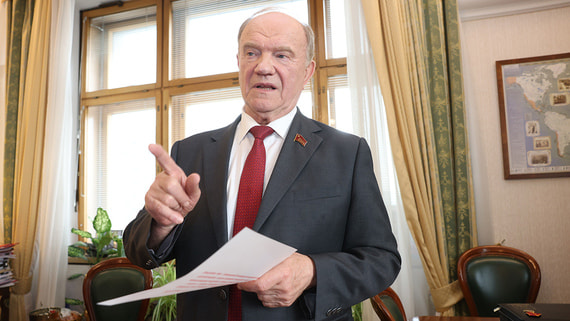
Gennady Zyuganov, the long-standing leader of the Communist Party of the Russian Federation (CPRF), has issued a statement calling for a ‘united approach’ in assessing the current political situation within the party. His remarks come in direct response to ongoing attempts to remove two prominent Communist deputies, Mikhail Matveyev and Oleg Mikhailov, from upcoming electoral races. The internal party conflict has drawn significant attention to the dynamics within Russia’s largest opposition party and raises questions about the future direction of Communist politics in the country.
The situation surrounding deputies Matveyev and Mikhailov has become increasingly contentious in recent weeks. Both politicians have been vocal members of the Communist faction in the State Duma, often taking positions that diverge from the mainstream party line on certain issues. Their potential disqualification from electoral participation has sparked debate within the party ranks about the boundaries of internal dissent and the mechanisms of candidate selection. Zyuganov’s call for unity appears aimed at preventing further escalation of these internal tensions while maintaining party discipline.
Historical Context of Communist Party Politics
The Communist Party of the Russian Federation has a complex history of managing internal disagreements since its reformation following the dissolution of the Soviet Union in 1991. Under Zyuganov’s leadership, which has spanned over three decades, the party has generally maintained a united front despite occasional internal disputes. The party remains the second-largest political force in the State Duma, holding approximately 15 percent of seats, and serves as the primary opposition voice in Russian politics. However, the party’s relationship with the Kremlin has often been characterized as that of a ‘systemic opposition’ – critical on certain economic and social issues while remaining loyal on fundamental questions of state policy.
Mikhail Matveyev, representing the Samara region, has been particularly notable for his outspoken positions on various domestic issues. His willingness to challenge certain government policies has earned him both supporters and critics within the party structure. Similarly, Oleg Mikhailov, representing the Komi Republic, has carved out a reputation as a deputy who prioritizes regional interests and is not afraid to voice dissenting opinions. The attempts to exclude both deputies from electoral competition suggest underlying tensions between different factions within the Communist Party regarding the appropriate level of criticism toward federal authorities.
Implications for Opposition Politics
Political analysts have noted that Zyuganov’s intervention in this matter reflects the delicate balancing act required to maintain party cohesion while preserving some degree of political credibility as an opposition force. The 80-year-old leader, who has led the party through numerous electoral cycles since 1993, faces the challenge of appeasing both traditionalist members who favor strict party discipline and younger, more reform-minded politicians who advocate for a more assertive opposition stance. The outcome of this internal dispute could set important precedents for how the party handles dissent and candidate selection in future electoral cycles.
The broader context of Russian electoral politics also plays a significant role in understanding this situation. With parliamentary and regional elections serving as important barometers of political sentiment, the composition of candidate lists becomes a matter of strategic importance. The Communist Party must navigate between maintaining its role as a legitimate opposition voice and avoiding direct confrontation with the ruling United Russia party and the presidential administration. Zyuganov’s emphasis on a ‘united approach’ suggests a preference for internal resolution of disputes rather than public conflicts that could weaken the party’s electoral position or its relationships with other political actors.
Looking Ahead
As the situation continues to develop, the fate of Matveyev and Mikhailov will likely serve as an indicator of the Communist Party’s internal dynamics and its tolerance for diverse viewpoints among its elected representatives. The party’s decision will be closely watched by political observers seeking to understand the evolving nature of opposition politics in Russia. Whether Zyuganov’s call for unity will successfully resolve the current tensions or merely postpone more fundamental questions about the party’s direction remains to be seen. What is clear is that the Communist Party, like any long-standing political organization, must continually negotiate between the demands of party discipline and the need for genuine political engagement with the concerns of its constituents and representatives.
Expert Opinion: This internal dispute within the CPRF reveals the structural tensions inherent in Russia’s managed democracy, where opposition parties must balance authentic criticism with systemic constraints. The resolution of this conflict will likely signal whether the Communist Party intends to pursue a more independent political course or continue its traditional role as controlled opposition, potentially affecting voter enthusiasm in upcoming electoral cycles.