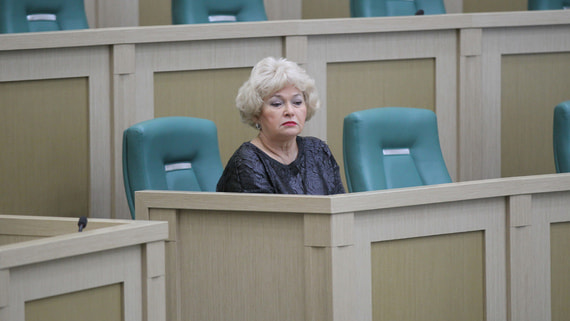
Lyudmila Narusova, a veteran Russian senator and the mother of the late opposition figure Ksenia Sobchak’s father, Anatoly Sobchak, has secured another opportunity to continue her political career in Russia’s upper chamber of parliament. The head of the Republic of Tuva has included her in his list of three candidates for the position of senator, keeping her prospects alive for remaining in the Federation Council despite the complex political landscape that has defined Russian politics in recent years.
The decision by Tuva’s regional leadership represents a significant development in Russian federal politics, as Narusova has been one of the more outspoken members of the Federation Council throughout her lengthy tenure. Her inclusion in the candidate shortlist means that should the regional leader be re-elected, Narusova stands a strong chance of retaining her seat in the upper house of Russia’s parliament, where she has served as a representative of the remote Siberian republic for many years.
A Political Legacy Spanning Decades
Lyudmila Narusova’s political journey is deeply intertwined with some of the most transformative periods in modern Russian history. She is the widow of Anatoly Sobchak, the first democratically elected mayor of St. Petersburg who served from 1991 to 1996 and played a crucial role in shaping post-Soviet Russian politics. Sobchak was also notably Vladimir Putin’s political mentor, having hired the future president as an advisor during his time as mayor. This historical connection has given Narusova a unique position in Russian political circles, bridging the reformist era of the 1990s with contemporary governance.
Her career in the Federation Council began in the 2000s, and she has represented the Republic of Tuva since 2012. The sparsely populated region in southern Siberia, bordering Mongolia, has provided her with a political base far from the power centers of Moscow and St. Petersburg. Throughout her tenure, Narusova has occasionally voiced positions that diverged from the Kremlin mainstream, though she has navigated these waters carefully enough to maintain her position within the establishment.
The Federation Council Selection Process
The mechanism by which senators are appointed to the Federation Council reflects Russia’s federal structure. Regional governors or republic heads typically select their representatives to the upper chamber from a pre-approved list of three candidates. This system gives considerable power to regional executives while maintaining a degree of formal choice. For Narusova, being included in this shortlist was the critical first step in securing her political future, as exclusion would have effectively ended her senatorial career.
The Republic of Tuva, despite its small population of approximately 330,000 people, holds the same representation rights in the Federation Council as Russia’s most populous regions. This constitutional arrangement ensures that voices from Russia’s diverse ethnic republics and remote territories are represented at the federal level. Narusova’s continued association with Tuva suggests ongoing support from the regional political establishment, though the dynamics of such relationships in Russian politics often remain opaque to outside observers.
Implications for Russian Parliamentary Politics
Political analysts note that Narusova’s retention on the candidate list carries symbolic weight beyond her individual career. As someone connected to the democratic reform movement of the 1990s through her late husband’s legacy, her presence in the Federation Council represents a thread of continuity with an earlier political era. However, observers are careful to note that the Federation Council’s role in contemporary Russian governance is primarily consultative, with real decision-making power concentrated in other institutions.
The coming regional elections will determine whether the current head of Tuva retains his position and, subsequently, whether Narusova continues as senator. Russian regional elections, while formally competitive, typically see incumbent candidates backed by the ruling United Russia party succeed in their re-election bids. This suggests that Narusova’s chances of remaining in the Federation Council are relatively strong, barring unexpected political developments.
Expert Opinion: Narusova’s inclusion in Tuva’s senatorial candidate list demonstrates her remarkable political survival skills in an increasingly centralized Russian political system. Her continued presence in the Federation Council serves multiple purposes: it maintains a symbolic link to the reformist 1990s while posing no real challenge to current power structures. As regional elections approach, her reappointment appears likely, though her future influence will depend on her ability to navigate the ever-narrowing boundaries of acceptable political discourse in Russia.