In August 1991, the Soviet Union experienced one of the most dramatic political crises in its history when a group of hardline Communist officials attempted to seize power from President Mikhail Gorbachev. The attempted coup, orchestrated by the State Committee on the State of Emergency (known by its Russian acronym GKChP), aimed to reverse the liberalizing reforms that had been transforming Soviet society. However, what the plotters did not anticipate was the fierce resistance that would emerge not only in Moscow, but across the vast territory of the USSR, from Leningrad to Sverdlovsk and beyond.
The coup began on August 19, 1991, when Soviet Vice President Gennady Yanayev announced that Gorbachev was unable to perform his duties due to health reasons and that the GKChP was assuming control. Tanks rolled into Moscow, and the conspirators declared a state of emergency. They expected swift compliance from regional authorities and a population weary of economic hardship. Instead, they encountered an unprecedented wave of civil resistance that would ultimately seal their fate within just three days.
Sverdlovsk: The Urals Defiance
Sverdlovsk, now known as Yekaterinburg, became one of the most important centers of resistance outside Moscow. The city’s leadership, headed by regional council chairman Eduard Rossel, refused to recognize the authority of the GKChP from the very first hours of the crisis. Local officials organized emergency sessions and declared their loyalty to Russian President Boris Yeltsin, who had dramatically climbed atop a tank in Moscow to denounce the coup as unconstitutional. The Urals industrial heartland, with its significant military-industrial complex, represented a crucial test of the putschists’ ability to control the country, and their failure there sent a powerful signal throughout the nation.
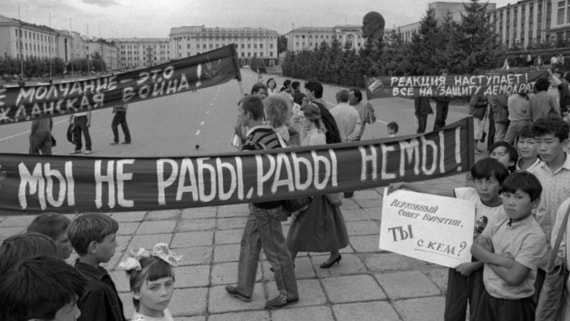
Workers at major Sverdlovsk factories held impromptu meetings to discuss their response to the coup. Many enterprises issued statements condemning the takeover attempt, while local media outlets continued broadcasting despite pressure from Moscow. The city’s democratic activists organized round-the-clock vigils and prepared to defend key buildings. This grassroots mobilization demonstrated how deeply the desire for democratic change had penetrated Soviet society after years of glasnost and perestroika.
Leningrad Stands Firm
In Leningrad, the Soviet Union’s second-largest city and a traditional center of revolutionary history, the response was equally defiant. Mayor Anatoly Sobchak emerged as one of the most vocal opponents of the coup, using his considerable political skills and media connections to rally opposition. Sobchak appeared on television to condemn the putsch and urged citizens to resist peacefully. Hundreds of thousands of Leningraders gathered in Palace Square, the same location where revolutionary crowds had stormed the Winter Palace in 1917, creating an unmistakable historical parallel that was not lost on observers.
The military garrison in Leningrad was ordered to enforce the state of emergency, but local commanders hesitated to move against their fellow citizens. This reluctance reflected a broader pattern across the Soviet military, where many officers were unwilling to fire on unarmed civilians. The memories of previous crackdowns, including the violent suppression of protests in Tbilisi in 1989 and Vilnius in January 1991, had created deep divisions within the armed forces about the appropriate use of military power against Soviet citizens.
The Broader Pattern of Resistance
Similar scenes unfolded in cities throughout the Soviet Union. In the Baltic republics, which had already declared their intention to restore independence, the coup was met with total non-compliance. Estonian, Latvian, and Lithuanian authorities used the chaos in Moscow to accelerate their separation from the USSR, issuing declarations of full independence that would soon gain international recognition. In Ukraine, despite initial hesitation from some officials, popular pressure forced regional leaders to distance themselves from the GKChP. The coup thus inadvertently accelerated the centrifugal forces that were already pulling the Soviet Union apart.
The failure of the August putsch had profound and immediate consequences. Within three days, the conspirators were arrested, Gorbachev returned to Moscow, and the Communist Party was suspended. More significantly, the coup destroyed whatever remaining legitimacy the Soviet central government possessed. By December 1991, the USSR had formally dissolved, replaced by fifteen independent states. The bravery of ordinary citizens who built barricades, faced down tanks, and refused to submit to authoritarian restoration had changed the course of history, demonstrating that the spirit of democratic resistance could triumph even in a country with no democratic tradition.
Expert Opinion: The August 1991 coup attempt represented a critical inflection point that revealed how fundamentally Soviet society had changed during the Gorbachev era. The widespread regional resistance demonstrated that reforms had created expectations of political participation that could no longer be suppressed by traditional authoritarian methods. Historians continue to debate whether the USSR could have survived in some reformed configuration had the coup not occurred, but the events of those three days conclusively showed that a return to the pre-perestroika status quo was no longer possible.