Thirty-five years ago, one of the most dramatic political crises in Soviet history came to an abrupt end with the arrest of the leaders behind the failed August coup of 1991. The State Committee on the State of Emergency, known by its Russian acronym GKChP, attempted to seize power from Soviet President Mikhail Gorbachev in a desperate bid to preserve the crumbling Soviet Union. Their failure accelerated the very collapse they sought to prevent, and within months, the USSR ceased to exist. The fate of these coup plotters offers a fascinating window into the turbulent transition from Soviet communism to post-Soviet Russia.
The August coup began on August 19, 1991, when a group of hardline Communist Party officials, military leaders, and KGB officers declared a state of emergency and announced that Gorbachev was unable to perform his duties due to health reasons. In reality, Gorbachev had been placed under house arrest at his vacation residence in Crimea. The conspirators aimed to halt the reforms that were dismantling Soviet power and prevent the signing of a new union treaty that would have decentralized authority away from Moscow.
The Key Figures Behind the Putsch
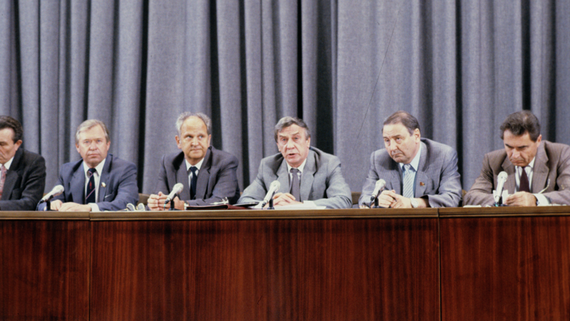
The GKChP consisted of eight principal members, representing the highest echelons of Soviet power. Gennady Yanayev, the Soviet Vice President, was nominally the leader and became acting president during the coup. His trembling hands during a press conference became a symbol of the plotters’ uncertainty and weakness. Vladimir Kryuchkov, the chairman of the KGB, was considered the mastermind behind the operation, having long warned about the dangers of Gorbachev’s reforms. Defense Minister Dmitry Yazov commanded the military forces, while Interior Minister Boris Pugo controlled the police apparatus. Other members included Prime Minister Valentin Pavlov, who conveniently fell ill during the crucial hours, Oleg Baklanov from the defense industrial complex, Vasily Starodubtsev representing collective farmers, and Alexander Tizyakov from state enterprises.
The coup collapsed after just three days, facing massive public resistance led by Russian President Boris Yeltsin, who famously stood atop a tank outside the Russian parliament building, the White House, rallying citizens to resist. Military units refused to fire on civilians, and key commanders defected to Yeltsin’s side. By August 21, it was clear the putsch had failed, and arrests began immediately.
Trials, Amnesty, and Unexpected Outcomes
Following their arrests, the coup leaders faced charges of treason, which carried the potential death penalty under Soviet law. However, the legal proceedings took an unexpected turn. Boris Pugo, the Interior Minister, committed suicide along with his wife shortly after the coup’s failure, becoming the only plotter to die as a direct consequence of the events. The remaining conspirators were held in prison awaiting trial, but the process dragged on for years as the Soviet Union collapsed and Russia emerged as an independent state.
In February 1994, the newly elected Russian State Duma, dominated by nationalists and communists opposed to Yeltsin’s reforms, passed an amnesty that freed all the coup participants. This controversial decision reflected the complex political landscape of post-Soviet Russia, where many viewed the conspirators not as criminals but as misguided patriots trying to save their country. The amnesty allowed figures like Yanayev, Kryuchkov, and Yazov to live out their remaining years as free men, some even becoming minor celebrities in nationalist circles.
Legacy and Historical Perspective
The subsequent lives of the coup plotters varied considerably. Some retreated into quiet obscurity, while others remained active in politics and public commentary. Gennady Yanayev spent his final years defending the coup as a necessary attempt to preserve the Soviet state, passing away in 2010. Vladimir Kryuchkov died in 2007, having published memoirs justifying his actions. Dmitry Yazov, the last surviving member of the GKChP, lived until 2020, dying at the age of 95. Throughout his later years, he continued to argue that the coup was an attempt to prevent the catastrophe of Soviet dissolution.
Historians continue to debate the significance of the August coup. Some argue that it was a desperate, poorly planned action by men out of touch with political reality. Others suggest that had the plotters acted more decisively, they might have succeeded in prolonging Soviet rule, potentially for years. What remains undisputed is that the coup’s failure fundamentally delegitimized the Soviet system, empowered Yeltsin’s Russian government, and set in motion the final collapse of the USSR in December 1991. The faces of the putsch thus became symbols of a dying empire’s final convulsion.
Expert Opinion: The August 1991 coup represents a pivotal moment where institutional decay met individual indecision. The conspirators possessed the formal levers of power but lacked the conviction to use them ruthlessly, reflecting broader systemic paralysis within the Soviet state. Their amnesty and subsequent rehabilitation in certain Russian political circles foreshadowed the incomplete reckoning with Soviet history that continues to shape Russian politics today, particularly regarding questions of state power versus democratic reform.