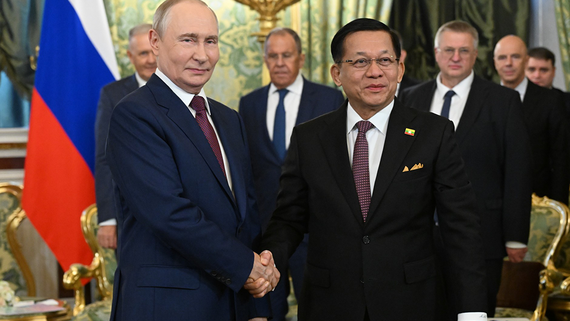
In a significant diplomatic engagement that underscores Russia’s growing influence in Southeast Asia, Myanmar’s military leader recently concluded a high-profile visit to Moscow, where he held extensive talks with Russian President Vladimir Putin and Prime Minister Mikhail Mishustin. The visit, which attracted considerable international attention, highlighted the deepening strategic partnership between the two nations at a time when both face varying degrees of international isolation and sanctions pressure from Western governments.
The meetings covered a broad spectrum of bilateral issues, including military cooperation, economic partnerships, energy sector development, and regional security concerns. For Myanmar’s junta, which seized power in a February 2021 coup that overthrew the democratically elected government of Aung San Suu Kyi, Russia represents one of the few major powers willing to maintain robust diplomatic and military ties despite widespread international condemnation of the military takeover.
Strategic Military Cooperation Takes Center Stage
Defense cooperation emerged as a central theme during the Moscow discussions. Russia has historically been one of Myanmar’s primary arms suppliers, providing fighter jets, helicopters, armored vehicles, and various weapons systems to the Southeast Asian nation’s military. The relationship dates back to the Soviet era but has intensified considerably following the 2021 coup, as Myanmar found itself cut off from Western military supplies and facing comprehensive sanctions.
Military analysts suggest that Myanmar’s defense forces are increasingly dependent on Russian equipment as alternatives become scarce. The country has reportedly sought additional Su-30 fighter aircraft, air defense systems, and various military technologies from Russian manufacturers. For Moscow, the relationship offers both strategic positioning in a geopolitically important region and a reliable customer for its defense industry at a time when the Kremlin faces its own economic pressures due to sanctions related to the Ukraine conflict.
Economic Partnerships and Energy Development
Beyond military matters, the leaders explored expanding economic cooperation across multiple sectors. Energy development featured prominently in these discussions, with both sides expressing interest in Russian participation in Myanmar’s oil and gas sector. Russia’s state energy companies have been seeking new markets and partners as European nations have reduced their dependence on Russian hydrocarbons, making Southeast Asian markets increasingly attractive.
Trade between the two countries, while modest compared to Myanmar’s commerce with neighboring China and Thailand, has shown growth potential. Agricultural products, industrial equipment, and technological transfers were among the areas identified for enhanced cooperation. The discussions also touched on potential Russian investments in Myanmar’s infrastructure development, including transportation networks and power generation facilities that the country desperately needs to support economic growth.
Geopolitical Implications and International Response
The visit carries significant geopolitical implications that extend well beyond bilateral relations. For Russia, maintaining strong ties with Myanmar serves multiple strategic purposes, including demonstrating that Moscow cannot be isolated internationally despite Western sanctions, establishing a foothold in a region traditionally influenced by China and the United States, and securing a partner in various international forums where votes matter.
Western governments and human rights organizations have expressed concern about the deepening Russia-Myanmar relationship, arguing that Russian support enables the military junta to continue its violent suppression of pro-democracy movements and ethnic minorities. Since the 2021 coup, Myanmar’s military has been accused of widespread human rights violations, including extrajudicial killings, arbitrary detentions, and the displacement of hundreds of thousands of civilians. The United Nations and various humanitarian organizations continue to document these abuses and call for accountability.
The Association of Southeast Asian Nations (ASEAN), of which Myanmar is a member, has struggled to address the crisis effectively, with its consensus-based approach proving inadequate to the challenge. Russia’s willingness to engage with the junta without preconditions contrasts sharply with Western approaches and some ASEAN members’ positions, potentially complicating regional diplomatic efforts to find a peaceful resolution to Myanmar’s ongoing civil conflict.
Expert Opinion: The deepening Moscow-Naypyidaw partnership represents a significant shift in regional power dynamics, with Russia strategically positioning itself as an alternative patron for internationally isolated regimes. As Western sanctions continue to push both countries toward greater bilateral cooperation, we can expect accelerated military transfers and energy deals that will further entrench Russian influence in Southeast Asia while providing the Myanmar junta with crucial external support to maintain its grip on power despite domestic resistance.