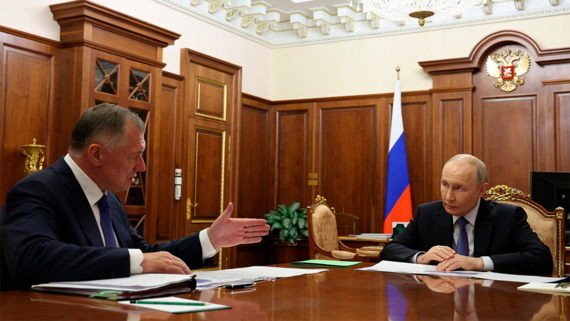
Russian President Vladimir Putin held a working meeting with Deputy Prime Minister Marat Khusnullin to discuss the current state of the country’s mortgage lending and construction industries. The high-level discussion comes at a critical time for Russia’s real estate sector, which has been navigating significant challenges including elevated interest rates, shifting government policies on subsidized lending programs, and broader economic pressures stemming from international sanctions and domestic monetary policy adjustments.
The meeting between Putin and Khusnullin, who oversees construction, housing, and utilities in the Russian government, reflects the Kremlin’s ongoing attention to sectors that directly affect millions of Russian citizens. Housing affordability and construction activity have long been priorities for the Russian leadership, with various government programs aimed at stimulating both homeownership and development activity across the country’s vast territory.
Current State of Russia’s Housing Market
Russia’s housing and mortgage markets have undergone significant transformations in recent years. The country has relied heavily on subsidized mortgage programs to make homeownership accessible to ordinary citizens, particularly young families and residents of developing regions. These programs, which offered interest rates well below market levels, helped drive a construction boom in many Russian cities during the early 2020s. However, the sustainability of such subsidies has come under increasing scrutiny as budget pressures mount and the Central Bank of Russia maintains historically high key interest rates to combat inflation.
The Central Bank’s key rate currently stands at elevated levels, making standard market-rate mortgages prohibitively expensive for many potential homebuyers. This has created a complex situation where demand for subsidized programs has surged while the government faces difficult decisions about the fiscal sustainability of continuing such generous support. Industry analysts have noted that the construction sector’s health is intimately tied to the availability of affordable financing, creating a delicate balancing act for policymakers.
Government Housing Programs Under Review
Deputy Prime Minister Khusnullin has been instrumental in shaping Russia’s housing policy over the past several years. Under his supervision, the government has implemented various initiatives including preferential mortgage rates for families with children, special programs for IT professionals, and regional development schemes aimed at boosting construction in less economically developed areas. The meeting with Putin likely addressed the effectiveness of these programs and potential adjustments needed to respond to current economic conditions.
Historical context is important for understanding Russia’s housing challenges. Following the Soviet era, Russia inherited a housing stock that was often aging and inadequate for modern standards. Successive governments have made housing construction a priority, with ambitious targets for new residential completions set regularly. The country has made substantial progress in increasing the volume of housing construction, though quality concerns and regional disparities in development remain ongoing issues that officials must address.
Economic Factors Influencing the Sector
The broader economic environment presents both challenges and opportunities for Russia’s construction and mortgage sectors. International sanctions have affected access to certain construction materials and technologies, forcing the industry to adapt through import substitution and seeking alternative suppliers from countries maintaining trade relations with Russia. At the same time, government investment in infrastructure projects, including those related to the development of newly incorporated territories, has provided some support for construction companies and employment in the sector.
Looking ahead, the trajectory of Russia’s housing market will depend significantly on decisions made at the highest levels of government regarding subsidy programs, interest rate policies, and overall economic priorities. The meeting between Putin and Khusnullin represents part of an ongoing dialogue about how to balance fiscal responsibility with the political and social importance of maintaining accessible housing for Russian citizens. Industry observers will be watching closely for any policy announcements that may emerge following this discussion, as such decisions could have far-reaching implications for developers, banks, and millions of potential homebuyers across the country.
Expert Opinion: The Russian government faces an increasingly difficult challenge in maintaining housing affordability while managing fiscal constraints and elevated interest rates. We anticipate a gradual restructuring of subsidy programs toward more targeted support for specific demographics rather than broad-based preferential lending. The construction sector’s resilience will largely depend on the government’s ability to find sustainable financing mechanisms that don’t overburden the federal budget while still keeping the housing market accessible to middle-income families.