In the tumultuous final days of the Soviet Union, words became weapons as powerful as any military force. The August 1991 crisis in Moscow demonstrated how the framing of political events through specific terminology could determine their legitimacy in the eyes of both the public and the international community. What the organizers carefully labeled a “state of emergency” was quickly rebranded by their opponents as a “coup” or “putsch” — a linguistic shift that ultimately helped seal their fate and reshape the course of world history.
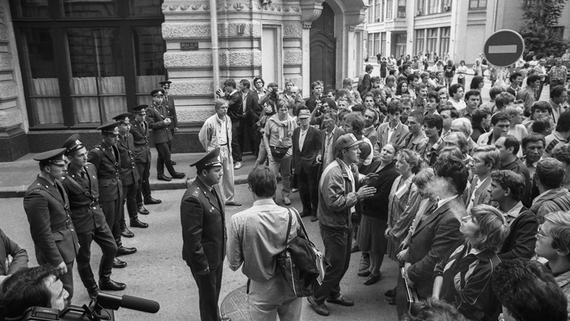
The three-day standoff that began on August 19, 1991, saw hardline Communist Party officials attempt to reverse the reforms that were rapidly dissolving the Soviet empire. Their choice of terminology was deliberate and calculated: by declaring a “state of emergency” under the authority of the State Committee on the State of Emergency (GKChP), they sought to cloak their actions in constitutional legitimacy. This careful selection of words was designed to present their seizure of power as a lawful response to national crisis rather than an illegal grab for control.
The Battle of Words and Political Legitimacy
The linguistic contest that unfolded during those critical August days revealed the profound connection between language and political power. Boris Yeltsin, then President of the Russian Soviet Federative Socialist Republic, immediately recognized the importance of terminology in shaping public perception. Standing atop a tank outside the Russian White House, he deliberately and repeatedly referred to the GKChP’s actions as a “coup d’état” and a “right-wing, reactionary, unconstitutional putsch.” This reframing transformed the narrative from one of constitutional crisis management to one of illegal power seizure, effectively delegitimizing the plotters in the eyes of the Soviet public and the world.
International media played a crucial role in amplifying this linguistic battle. Western news organizations quickly adopted the terminology of “coup” rather than accepting the GKChP’s preferred framing. This global consensus on vocabulary further isolated the plotters and strengthened the hand of reformers like Yeltsin and Soviet President Mikhail Gorbachev, who had been placed under house arrest in Crimea. The choice of words by CNN, BBC, and other major international broadcasters effectively sided with the democratic opposition without explicitly taking a political stance.
Historical Context and the Power of Framing
The August 1991 events did not occur in a vacuum but emerged from years of growing tension within the Soviet system. Gorbachev’s policies of glasnost (openness) and perestroika (restructuring) had unleashed forces that many hardliners believed threatened the very existence of the Soviet state. The Baltic republics had already declared independence, and other Soviet republics were moving in the same direction. The New Union Treaty, scheduled for signing on August 20, would have fundamentally restructured the USSR into a loose federation — a prospect the coup plotters found unacceptable.
Understanding the historical significance of terminology in political crises helps explain why both sides fought so fiercely over vocabulary. Throughout Russian and Soviet history, the naming of events carried enormous consequences. The Bolsheviks had masterfully used language to legitimize their own 1917 seizure of power, transforming what opponents called a coup into the “Great October Socialist Revolution.” The GKChP organizers hoped to achieve similar linguistic success by presenting themselves as defenders of constitutional order rather than its violators. Their failure to control the narrative contributed significantly to their rapid collapse after just three days.
The Collapse and Its Lasting Implications
By August 21, the coup had failed spectacularly. Mass resistance in Moscow, military units refusing to follow orders, and the international community’s unified condemnation all contributed to the plotters’ downfall. The linguistic battle had been won by the reformers, and the word “putsch” became permanently associated with the events in historical memory. Gorbachev returned to Moscow, but his authority had been fatally weakened. Within months, the Soviet Union itself would cease to exist, replaced by fifteen independent republics.
The August 1991 crisis offers enduring lessons about the relationship between language, power, and legitimacy. It demonstrated that in moments of political crisis, the ability to define events may be as important as the ability to control streets and institutions. The plotters possessed tanks and television stations, but they lost the battle for vocabulary — and with it, the battle for power. This episode remains a powerful reminder that political legitimacy is not merely a matter of force or constitutional authority but is fundamentally shaped by the words we use to describe and interpret political actions.
Expert Opinion: The August 1991 events represent a watershed moment in understanding how information warfare operates during political crises. Modern scholars of political communication increasingly recognize that the coup’s failure established a template for how democratic movements can leverage terminology to delegitimize authoritarian actions. Looking forward, this precedent suggests that any future attempts to seize power through extra-constitutional means will face similar battles over framing — battles that social media has made even more complex and unpredictable than they were in 1991.